Publications
Research papers and ongoing work, with summaries and available code.
5 publications shown
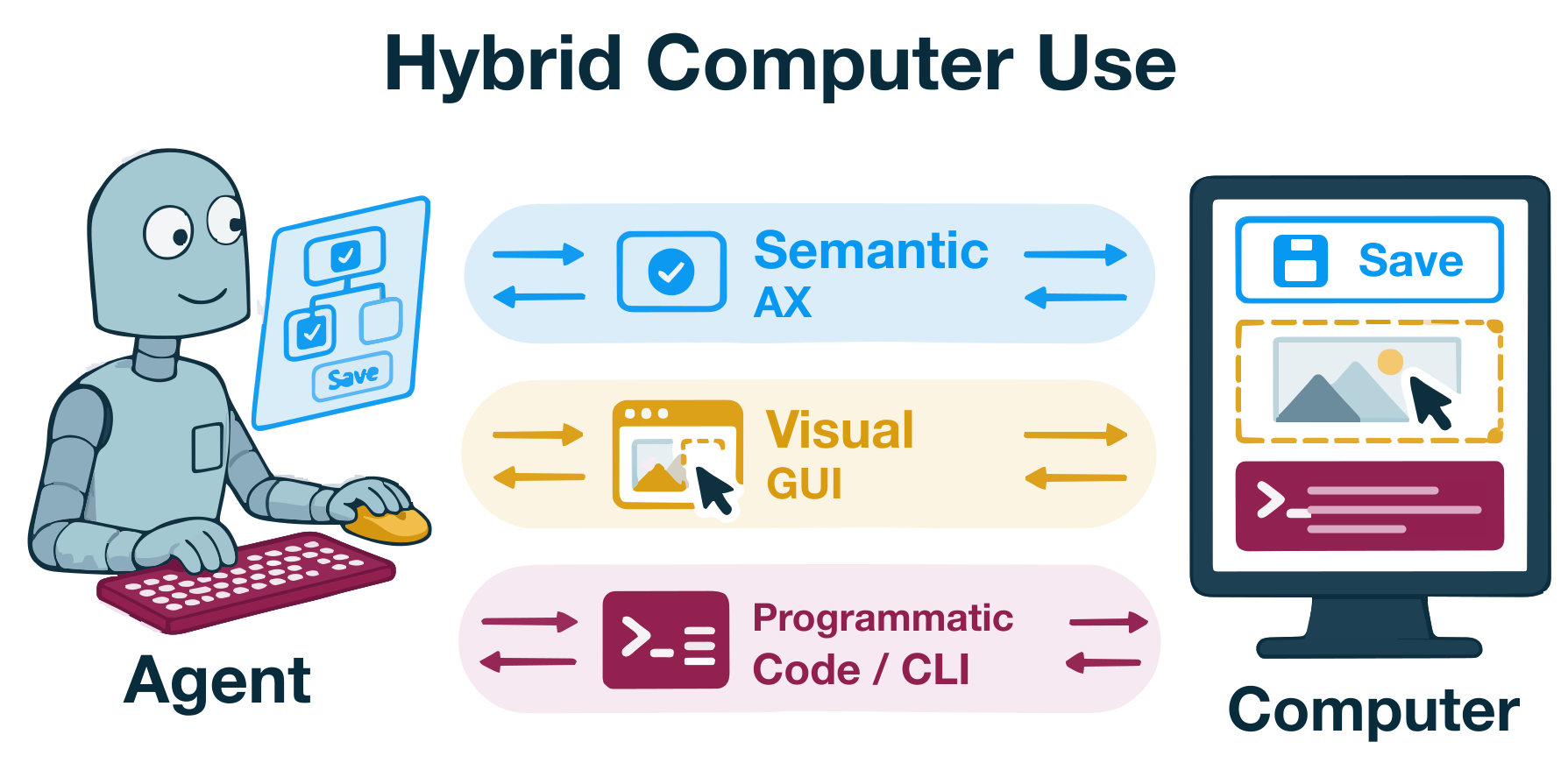
Hybrid Computer Use: A Unified Programmatic, Semantic, and Visual Interface for General Agents
Haoqing Wang, Xiaoyi Zhang†, Sicheng Fan, Zhexin Zhang, Xinjie Zhang, Jiahao Li, Bin Li, Yan Lu
arXiv preprint arXiv:2610.41432 · 2026
An exploration of hybrid computer use: a unified interface that lets general agents choose and combine programmatic (code and CLI), semantic (AX), and visual (GUI) channels.
Computer-use agents tackle both everyday desktop tasks and long-horizon professional workflows. Interfaces centered on screenshots and mouse-and-keyboard actions require repeated visual interpretation while leaving semantic and programmatic capabilities underused. Hybrid Computer Use (HCU) brings three complementary interaction channels into a general agent: programmatic tools such as code and CLI, semantic interaction through accessibility (AX), and visual interaction through graphical user interfaces (GUI). HCU adds AX and GUI tools to the agent's existing tools through MCP, leaving channel selection and combination to the model. Its AX tools return compact observations, support batched actions with postconditions, and report changes as AX diffs. Cross-channel action guards check targets and layouts against live state before input. A supplementary skill explains how to use and coordinate the channels. On OSWorld 2.0, HCU achieves the highest Partial and Binary scores among the compared systems. Trajectory analysis shows that all evaluated models improve with HCU while dividing work across the channels differently.
@article{hcu2026,
  title = {Hybrid Computer Use: A Unified Programmatic, Semantic, and Visual Interface for General Agents},
  author = {Haoqing Wang and Xiaoyi Zhang and Sicheng Fan and Zhexin Zhang and Xinjie Zhang and Jiahao Li and Bin Li and Yan Lu},
  year = {2026},
  month = {oct},
  journal = {arXiv preprint arXiv:2610.41432},
  doi = {10.48550/arXiv.2610.41432},
  url = {https://arxiv.org/abs/2610.41432}
}
Mage-VL-Cowork: A Full Training Recipe to Learn Hybrid Computer Use from Evolved Harnesses
Xiaoyi Zhang*†, Haoqing Wang*, Xinjie Zhang, Xiang Ming, Xing Wang, Senqiao Yang, Kaichen Zhang, Zhaoyang Jia, Andong Tan, Xinjiang Wang, Jinghao Guo, Yifei Shen, Xiao Li, Peng Zhang, Xun Guo, Jiahao Li, Shicheng Zheng, Jinglu Wang, Zongyu Guo, Wenxuan Xie, Bin Li, Yan Lu, and
Technical report · 2026
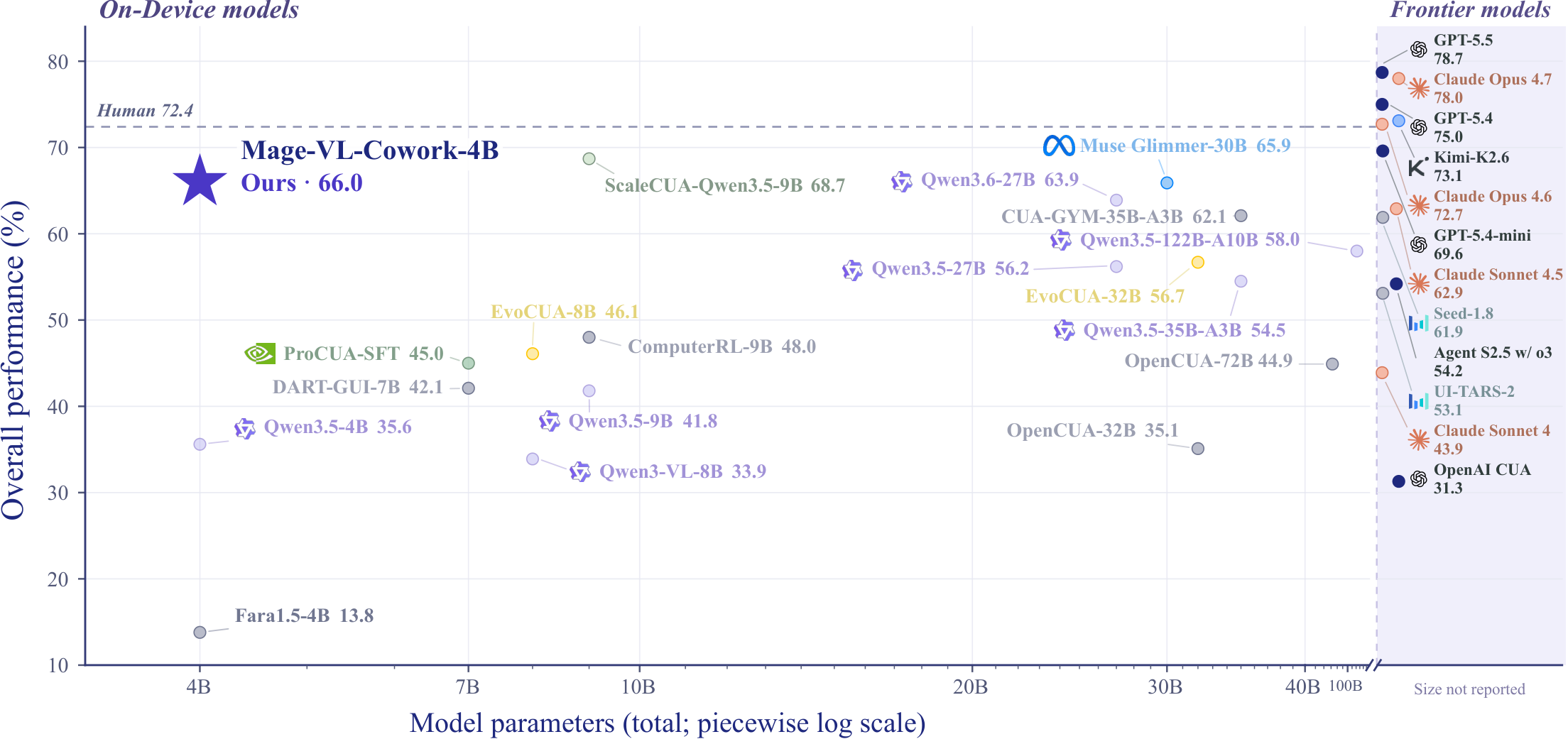
A 4B hybrid computer-use agent that combines GUI interaction with code and terminal execution in one policy, reaching 66.0% on OSWorld-Verified under a 50-step budget.
Effective computer-use agents should combine visual GUI interaction with code and terminal execution within a single policy. Mage-VL-Cowork is a 4B hybrid computer-use agent trained from a general multimodally aligned checkpoint through a five-stage curriculum across midtraining, SFT, and RL. Mage-CUA-Forge replaces per-task agent construction with reusable, skill-conditioned generation workflows and application-specific preparers. It synthesizes 293,806 desktop and web tasks across 6,915 skills and reduces recurring per-task expenditure by 82.6%. Instead of directly distilling a default teacher, the work evolves the teacher harness and uses specialized harnesses to produce high-quality trajectories and stage-specific supervision. Mage-VL-Cowork-4B reaches 66.0% on OSWorld-Verified with lower reasoning cost, the best reported result at its parameter size.

Mage-VL: An Efficient Codec-Native Streaming Multimodal Foundation Model
Senqiao Yang*, Kaichen Zhang*, Zhaoyang Jia*, Jinghao Guo*, Yifei Shen*†, Xinjie Zhang*†, Xiaoyi Zhang, Haoqing Wang, Xiao Li, Peng Zhang, Xiang An, Yin Xie, Zhening Liu, Xun Guo, Jiahao Li, Shicheng Zheng, Jinglu Wang, Zongyu Guo, Wenxuan Xie, Zihan Zheng, Yuxuan Luo, Bin Li, Yan Lu, and
arXiv preprint arXiv:2607.24904 · 2026
An efficient codec-native streaming multimodal foundation model that reduces visual token consumption by over 75% and achieves up to 3.5x wall-clock inference speedup.
Standard vision-language models (VLMs) suffer from Moravec's paradox: they excel at complex offline visual reasoning but struggle with simple streaming perception tasks and process them inefficiently. We present Mage-VL, an efficient codec-native streaming foundation model for real-time multimodal understanding and interaction. At its core, our custom tokenizer, Mage-ViT, replaces uniform frame sampling by selectively encoding dynamic, entropy-rich regions using motion vectors and residual energy across sparse anchor (I) and predicted (P) frames. Operating at a 16 x 16 patch level, this reduces visual token consumption by over 75% while preserving spatiotemporal context. Trained from scratch on approximately 560M unlabeled images and 100M unlabeled video frames, Mage-ViT matches or outperforms flagship encoders trained on billions of image-text pairs. We establish AI4AI data pipelines encompassing prompt-code joint optimization for multimodal captioning and AI-driven performance diagnosis to guide training recipes. Furthermore, through a bio-inspired dual-system architecture - a lightweight System 1 event gate and a causal System 2 decoder - Mage-VL enables proactive streaming perception. Extensive evaluations show that Mage-VL-4B matches Qwen3-VL-4B on static tasks while achieving strong gains in video understanding and 2D/3D spatial reasoning, with up to a 3.5x wall-clock inference speedup, and comprehensively surpasses the 15B Phi-4-reasoning-vision baseline. Beyond model artifacts, we deliver seven key empirical findings covering pre-training data efficiency, variable-resolution scaling, codec system acceleration, VideoQA SFT redundancy, motion-spatial synergy, AI4AI data pipelines, and Zero-Vision SFT for multimodal RL.
@article{yang2026magevl,
  title = {Mage-VL: An Efficient Codec-Native Streaming Multimodal Foundation Model},
  author = {Senqiao Yang and Kaichen Zhang and Zhaoyang Jia and Jinghao Guo and Yifei Shen and Xinjie Zhang and Xiaoyi Zhang and Haoqing Wang and Xiao Li and Peng Zhang and Xiang An and Yin Xie and Zhening Liu and Xun Guo and Jiahao Li and Shicheng Zheng and Jinglu Wang and Zongyu Guo and Wenxuan Xie and Zihan Zheng and Yuxuan Luo and Bin Li and Yan Lu},
  year = {2026},
  month = {jul},
  journal = {arXiv preprint arXiv:2607.24904},
  doi = {10.48550/arXiv.2607.24904},
  url = {https://arxiv.org/abs/2607.24904}
}
WebHarbor: Docking Real Websites for Evolving GUI Agent Environments
Research work · 2026
Local, resettable website environments for GUI Agent training and evaluation, built from real websites with authentication, databases, and multimodal content.
Live websites introduce network failures, access restrictions, and content drift into GUI Agent training and evaluation. WebHarbor uses coding agents to recreate real websites as local Docker environments with authentication, databases, and multimodal content. These environments support interactive tasks and state resets between runs. The environment collection can expand with new websites and tasks as agent capabilities develop.
Learning to Respond: A Large-Scale Benchmark and Progressive Learning Framework for Trigger-Centric Online Video Understanding
Jiawen Qian*, Hang Du*, Guoshun Nan, Shan Huang, Jiaqi Yu, Haoqing Wang, Jingfeng Chen, Mengxue Cai, Mengdi Yang, Jiarong Li, Zhilong Li, Hua Wang, Jun Liu, Xudong Jiang, Sicong Leng†, and
Under review · 2025
A large-scale benchmark (TV-Online) and progressive learning framework for trigger-centric online video understanding.
The rapid growth of online video platforms has created an urgent demand for real-time video understanding. Unlike offline tasks, online video understanding emphasizes proactive responsiveness, where models must detect when sufficient evidence has appeared in a stream to answer a given question (trigger) and respond immediately. We introduce TV-Online (Trigger Video-Online), a large-scale dataset with 50K videos, 200K questions, and 500K time-stamped answers, covering progressively complex trigger-based tasks. We further propose a streaming-oriented modeling paradigm with protocol-level tagging and structured state management, trained via a progressive strategy using difficulty annotations and reinforcement objectives. Finally, we introduce a unified evaluation metric integrating semantic, temporal, and coverage dimensions.
@unpublished{qian2025learningToRespond,
  title = {Learning to Respond: A Large-Scale Benchmark and Progressive Learning Framework for Trigger-Centric Online Video Understanding},
  author = {Jiawen Qian and Hang Du and Guoshun Nan and Shan Huang and Jiaqi Yu and Haoqing Wang and Jingfeng Chen and Mengxue Cai and Mengdi Yang and Jiarong Li and Zhilong Li and Hua Wang and Jun Liu and Xudong Jiang and Sicong Leng},
  year = {2025},
  month = {sep},
  booktitle = {Under review}
}