Lecture 25:Retrieval Augmented Language Models
导论:RAG 是系统问题,不是“搜一下再拼 Prompt”
Douwe Kiela 的讲座从语言模型历史出发,逐层增加 retrieval、reranking、fusion、joint training、active retrieval 与 tool use。整场课的核心不是某个产品化 pipeline,而是一个研究问题:外部知识怎样进入生成过程,哪些组件应被冻结或训练,证据何时检索、如何排序、在哪里融合,以及系统怎样证明输出真正受证据约束。
来源:Stanford 课堂视频 00:01:39
读图:标题中的 Augmented 改变模型边界
普通 language model 把主要知识压进参数;retrieval-augmented language model 在推理或训练时访问外部文档、向量索引、搜索引擎或其他工具。增强的不只是输入长度,而是可更新的 non-parametric memory 与模型之间的接口。
本讲的统一问题
设输入为 \(x\)、外部语料为 \(\mathcal{D}\)、检索器为 \(R\)、生成器为 \(G\),最简流程是
真正困难发生在两个等号内部:\(R\) 怎样学习“对 \(G\) 有用”的证据,\(G\) 是否会使用 \(z_{1:k}\),以及整个系统怎样在质量、成本、更新和可信度之间取舍。
证据边界与阅读方法
本讲发生在 2023 年 12 月。讲者对 DRAGON、vector database、retrieval hardware 与未来产业结构的判断保留为课堂时间点意见;RAG、REALM、FiD、RETRO、Atlas、RePlug 等机制则回到原论文解释。旧稿中的 dashboard、incident runbook、gate dropout、drift monitor 和地域治理并无课堂证据,全部移除。
本章小结
RAG 的教学主线是从“外部文档进入 prompt”走向“检索、表示、融合与生成共同优化”。后续章节先说明为什么需要外部记忆,再用 train/test taxonomy 比较架构,最后讨论 RAG 2.0 的系统化方向。
为什么需要 Retrieval Augmentation
课程先把 retrieval 放回 language modeling 的历史,而不是从某个 2023 年产品名开始。这样做能区分三个层次:autoregressive objective 很旧,规模带来新能力,instruction tuning 修复人机接口,而 retrieval 处理的是知识更新、证据来源与可控记忆。
语言模型不是近几年才出现
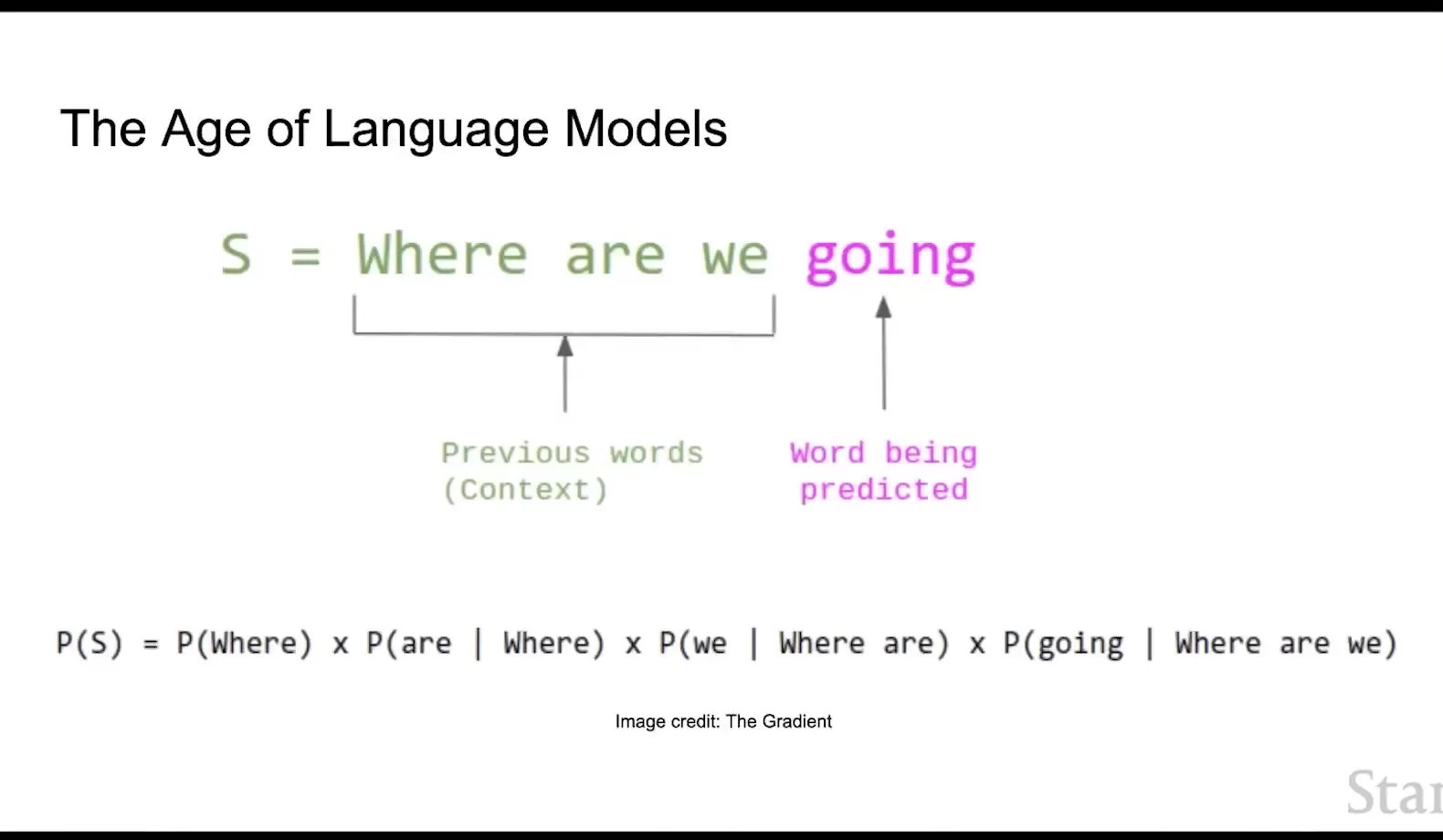
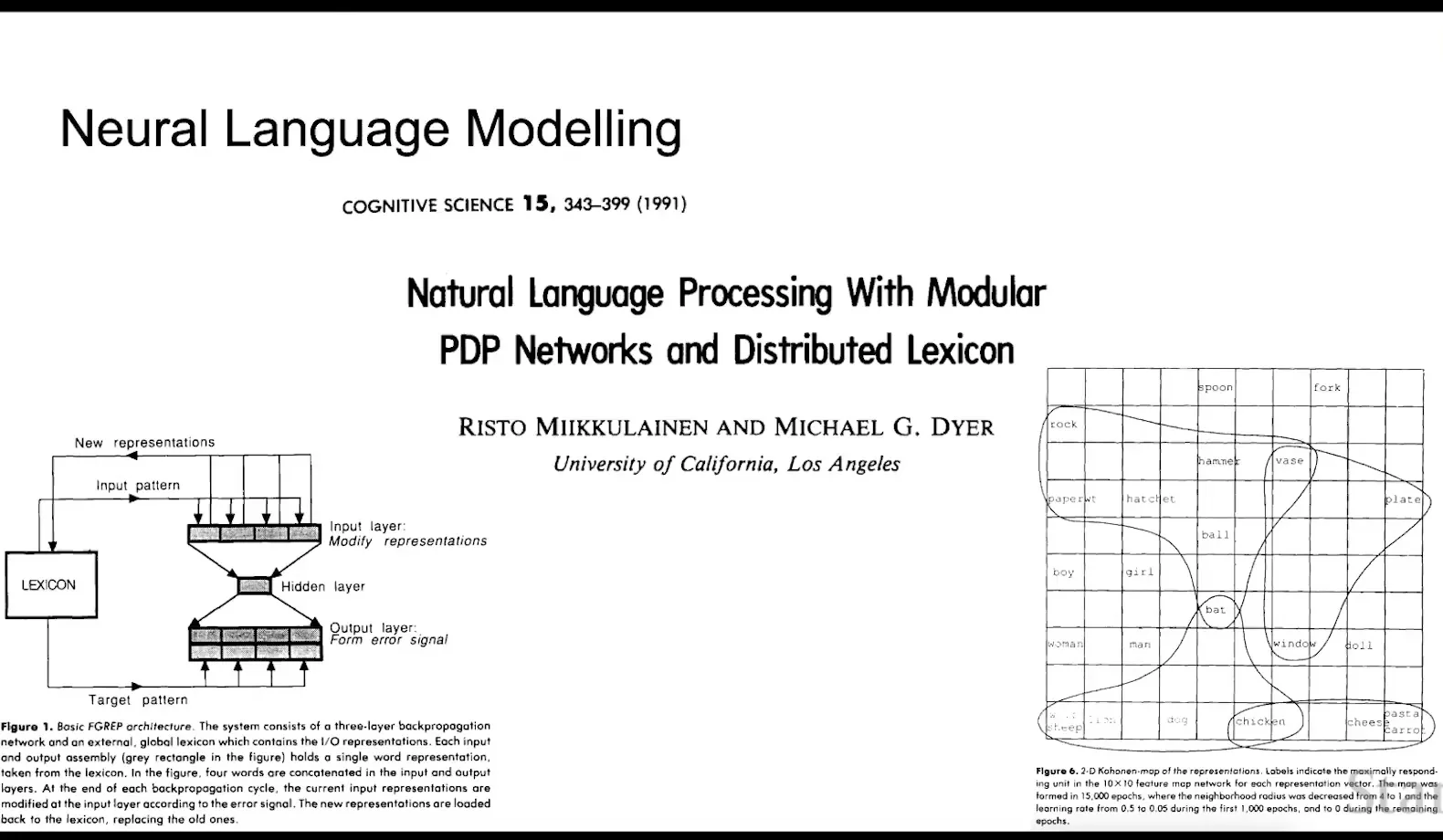
Age of Language Models slide 用一个简单句子说明 next-token factorization:预测 “going” 时,前面的 “Where are we” 是 context。下一页展示 1991 年 neural language modelling 工作,提醒读者语言模型与神经网络结合已有数十年历史。
来源:Stanford 课堂视频 00:02:21
Autoregressive factorization
对 token 序列 \(w_{1:T}\),自回归语言模型写成
\(w_{< t}\) 是位置 \(t\) 之前的上下文,模型只需反复估计下一个 token 的条件分布。LLM 的参数规模和训练数据巨大,但这个概率分解本身并不新。
来源:Stanford 课堂视频 00:02:57
读图:历史页服务于概念校准
这张扫描页不是要求记住旧网络结构,而是提醒:distributed lexicon、neural sequence processing 与概率语言建模早已存在。今天的突破来自规模、优化、硬件、数据和 interface 的共同演化,不能把整段历史缩成某家公司“发明语言模型”。
课堂提示
Kiela 开玩笑说,如果认为 OpenAI 发明了语言模型,他会生气。这个幽默在教学上承担了校准作用:autoregressive idea 很旧,LLM 的新颖性主要来自 scale 与现代训练栈。
Next-token prediction 与“坏掉的用户界面”
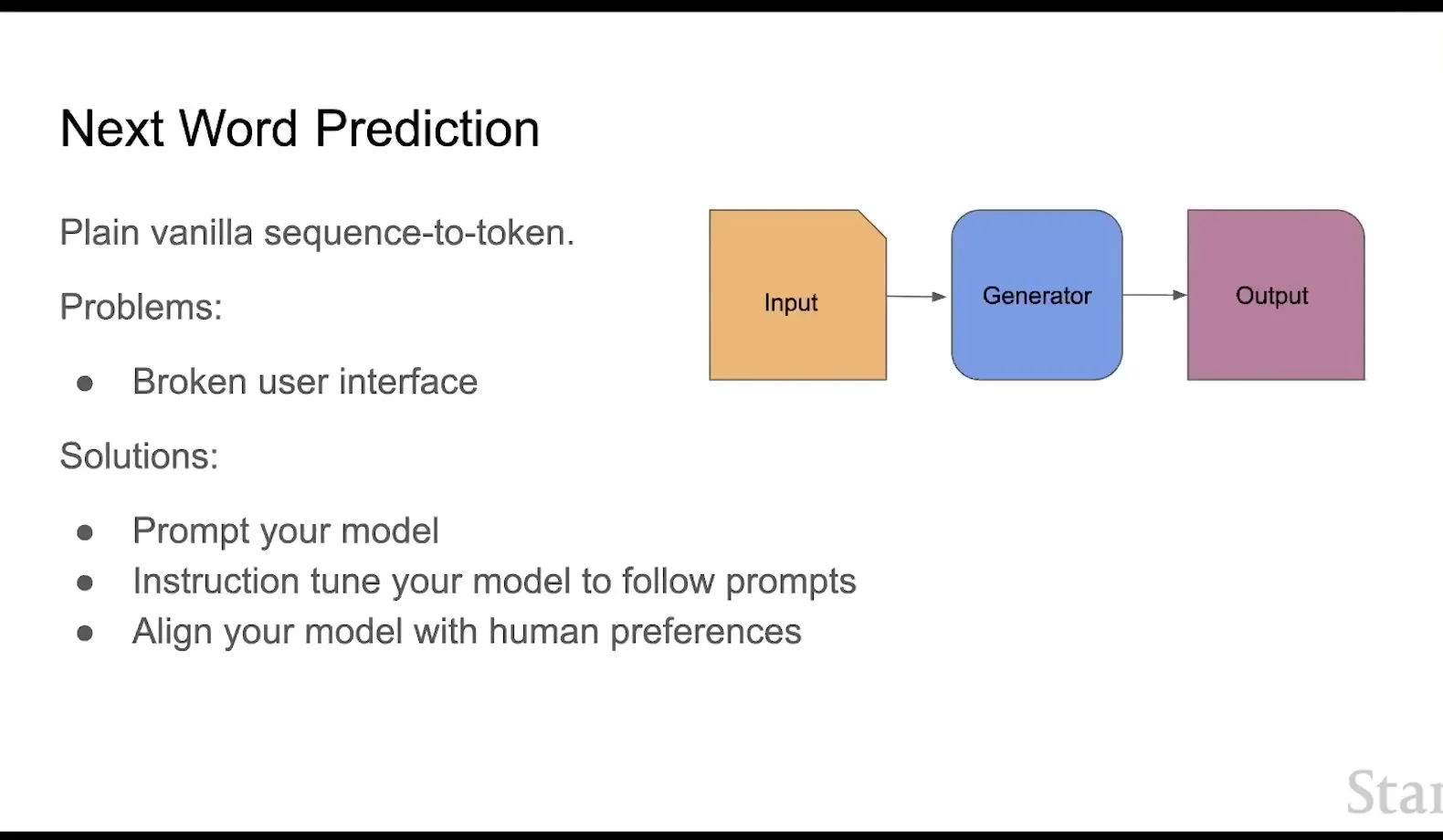
Next Word Prediction slide 把系统画成 input–generator–output,并指出 plain sequence-to-token 的问题之一是 broken user interface。用户过去需要构造奇怪 prompt 才能让模型执行任务;ChatGPT 式 instruction tuning 与 alignment 让人能够直接表达意图。
来源:Stanford 课堂视频 00:04:30
读图:模型 objective 与用户 objective 不同
预训练只要求预测语料中的下一 token,用户却希望模型遵循命令、拒绝危险请求、保持格式并完成任务。Prompting、instruction fine-tuning 与 RLHF 是 interface alignment:它们让模型更容易被调用,但没有自动解决知识陈旧、证据缺失或事实错误。
课堂提示
讲者把 ChatGPT 的关键贡献概括为“fix the user interface”。人更擅长直接说想要什么,而不是猜测哪个奇怪 prompt 能触发行为;instruction data 在普通网页语料中又非常稀少。
把输出 elicitation 修好之后,仍然有五类缺口
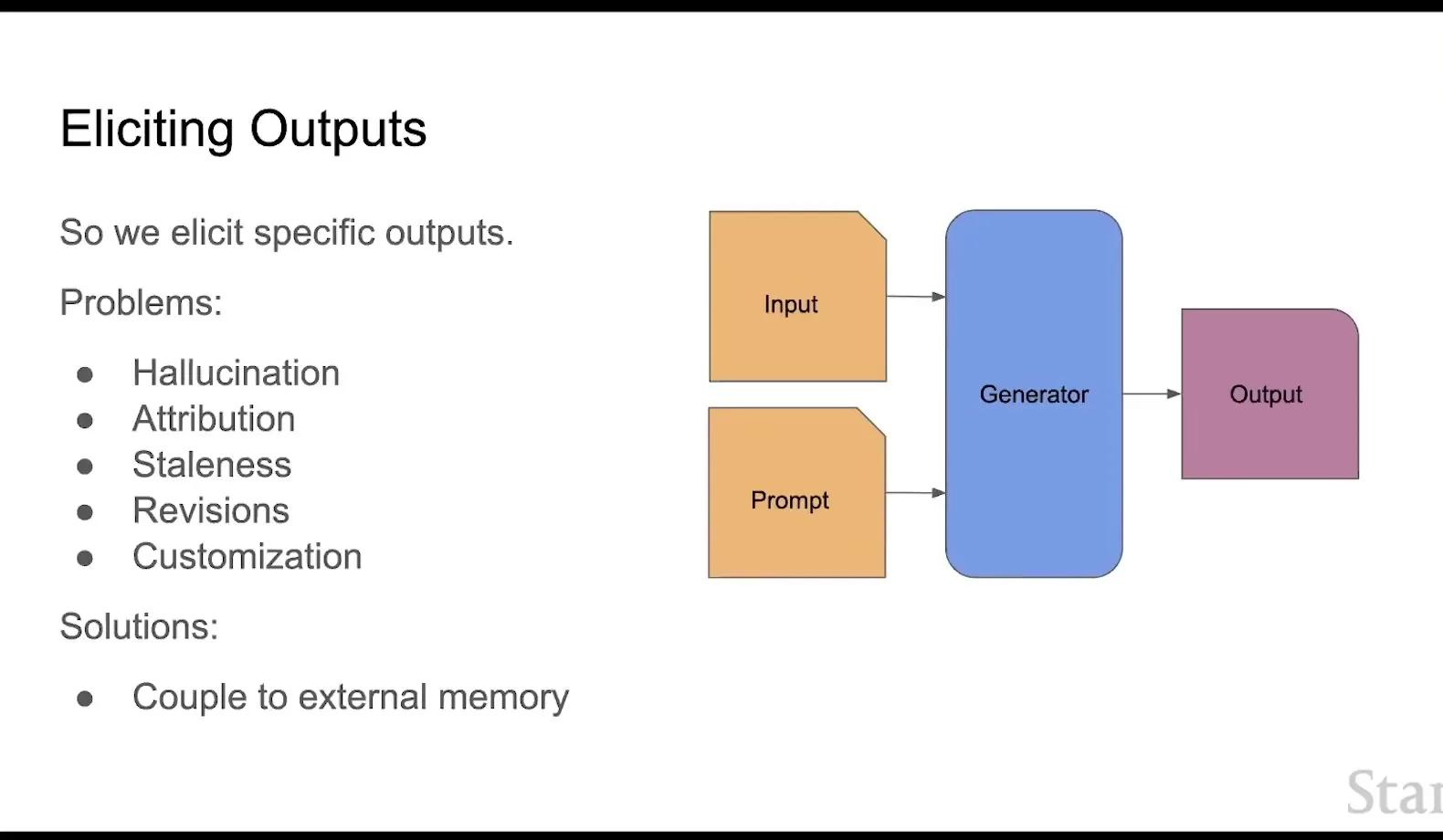
Eliciting Outputs slide 把 prompt、instruction tuning 与 alignment 放在 generator 之前,右侧列出 hallucination、attribution、staleness、revisions 与 customization。这五项不是同一个错误率,而是分别对应事实、来源、时间、可更新性与用户/组织边界。
来源:Stanford 课堂视频 00:06:09
术语消化:五类问题不能混成“准确率”
| 问题 | 表现 | Retrieval 可能提供什么 |
|---|---|---|
| Hallucination | 输出与可接受事实源冲突 | 提供显式证据,但生成器仍可能忽略 |
| Attribution | 无法指出来源 | 返回文档 ID、段落和时间戳 |
| Staleness | 参数知识过时 | 替换或刷新 index,而不重训全部模型 |
| Revision | 错误事实难以精确更正 | 修改文档或访问策略 |
| Customization | 不同组织需要不同知识边界 | 切换私有/领域 index 与权限 |
检索到证据不等于 grounded generation
Retriever 可能找到正确文档,generator 仍可能引用错段落、混入参数记忆或完全忽略证据。因此至少要分别评估 retrieval quality、evidence utilization 与 final answer correctness。
课堂提示
讲者强调,尤其在 strict accuracy requirements 的 enterprise 场景,模型高置信地“make up stuff”、不给 attribution、不能快速修订和定制,都会阻止真实部署。
Contextualization:外部记忆进入生成器
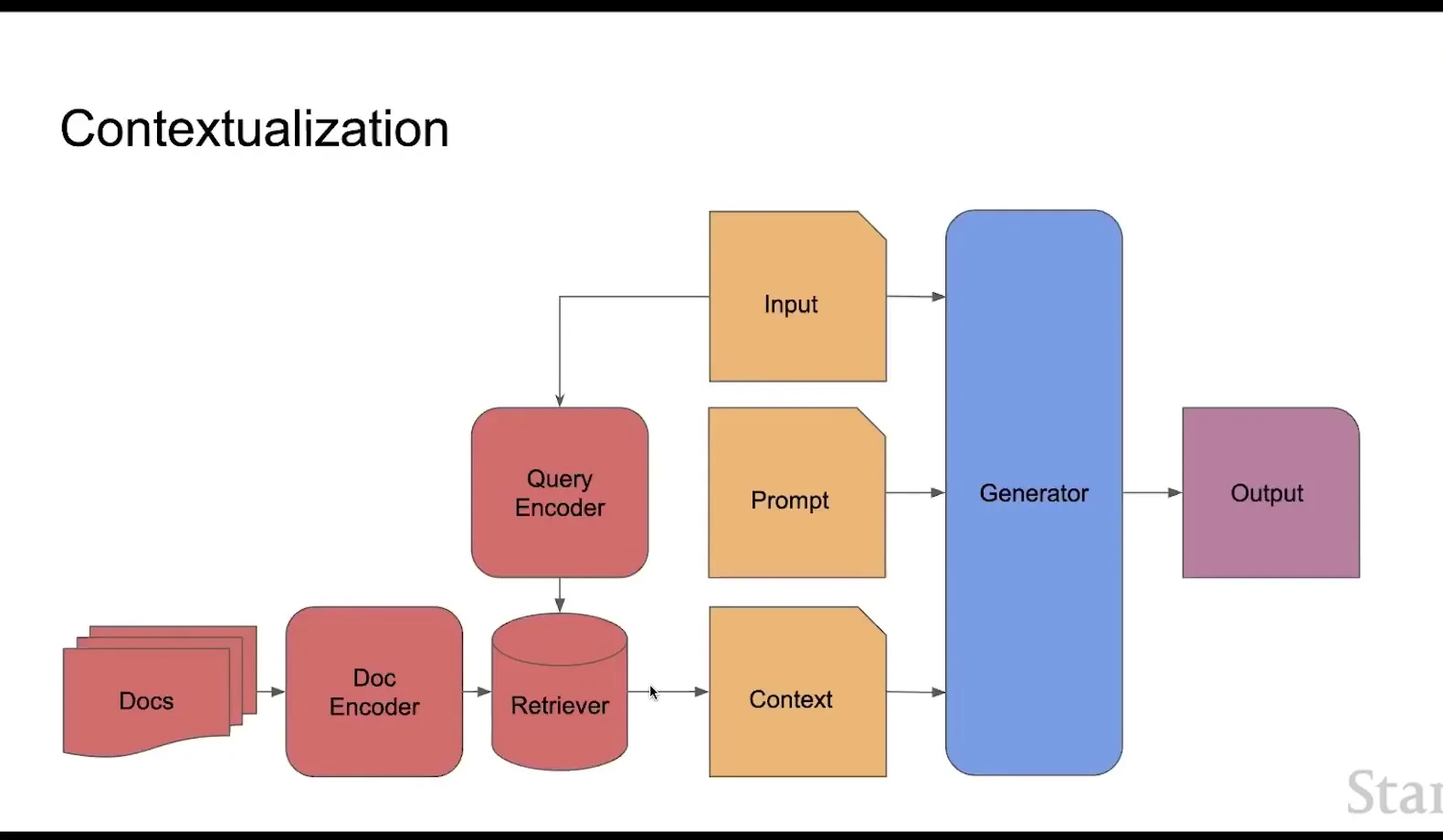
Contextualization architecture 增加 documents、document encoder、retriever、query encoder 与 context。用户输入不再只进入 generator,也形成 query;retriever 从外部文档集合中找证据,再把结果与 prompt 一起交给模型。
来源:Stanford 课堂视频 00:06:48
第一使用语表:Retriever、Index、Embedding、Context
| 术语 | 含义 |
|---|---|
| Document chunk | 从文档切出的可检索单位,粒度决定召回与上下文成本 |
| Embedding | 把 query 或 chunk 映射为向量,以便计算相似度 |
| Index | 支持查找的数据结构,可为倒排索引、向量索引或混合索引 |
| Retriever | 根据 query 从 index 返回候选 chunk 与分数 |
| Context | 最终提供给 generator 的证据文本,不等同于整个 index |
来源:Stanford 课堂视频 00:07:48
Parametric 与 non-parametric memory
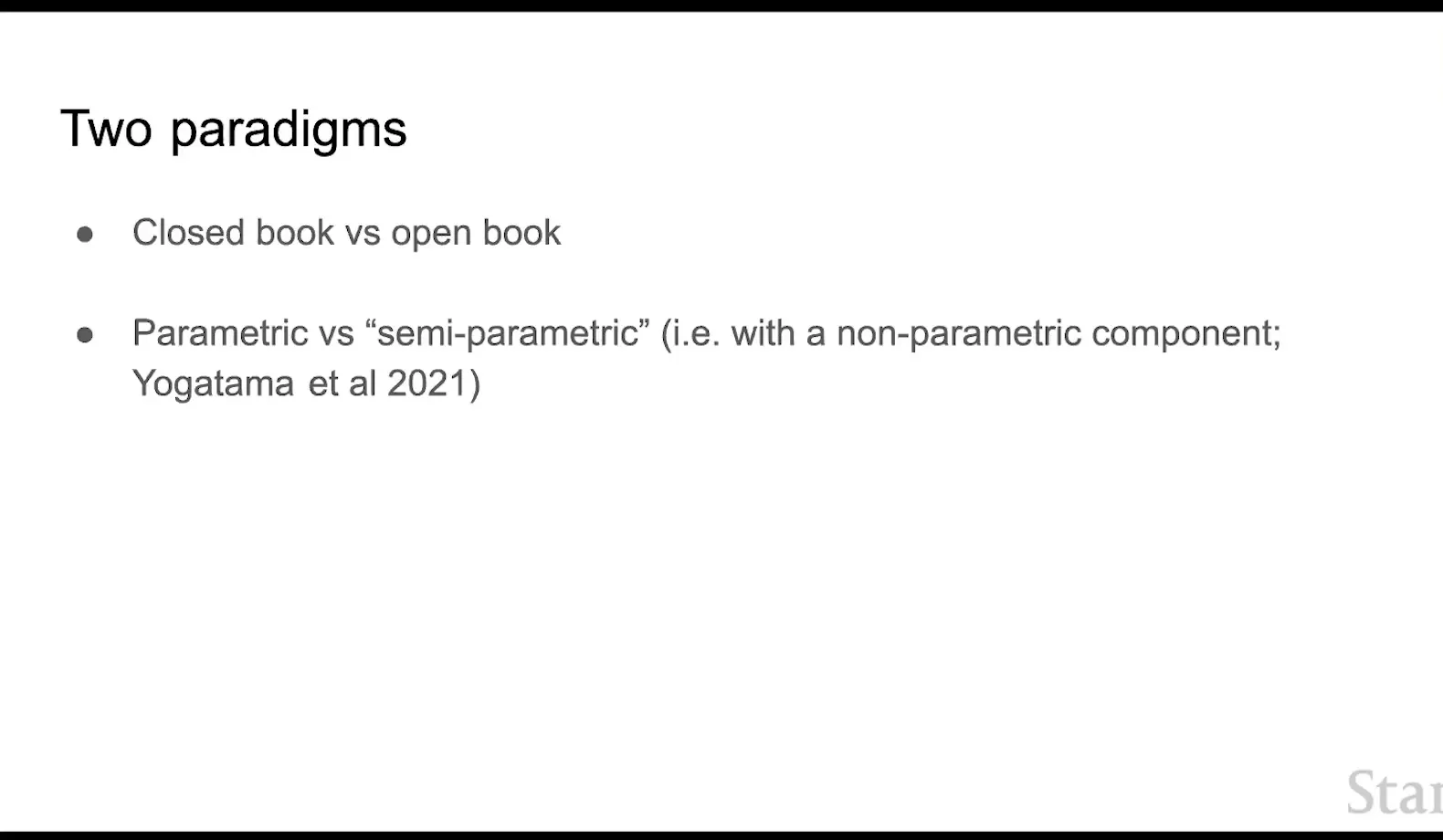
Parametric memory 是模型权重中通过训练形成的统计知识,更新通常需要继续训练;non-parametric memory 是可直接读写或替换的文档、数据库、索引与缓存。RAG 常被称为 semi-parametric,因为生成器有参数,而外部 memory 可在测试时变化。
为什么 external index 能缓解部分问题
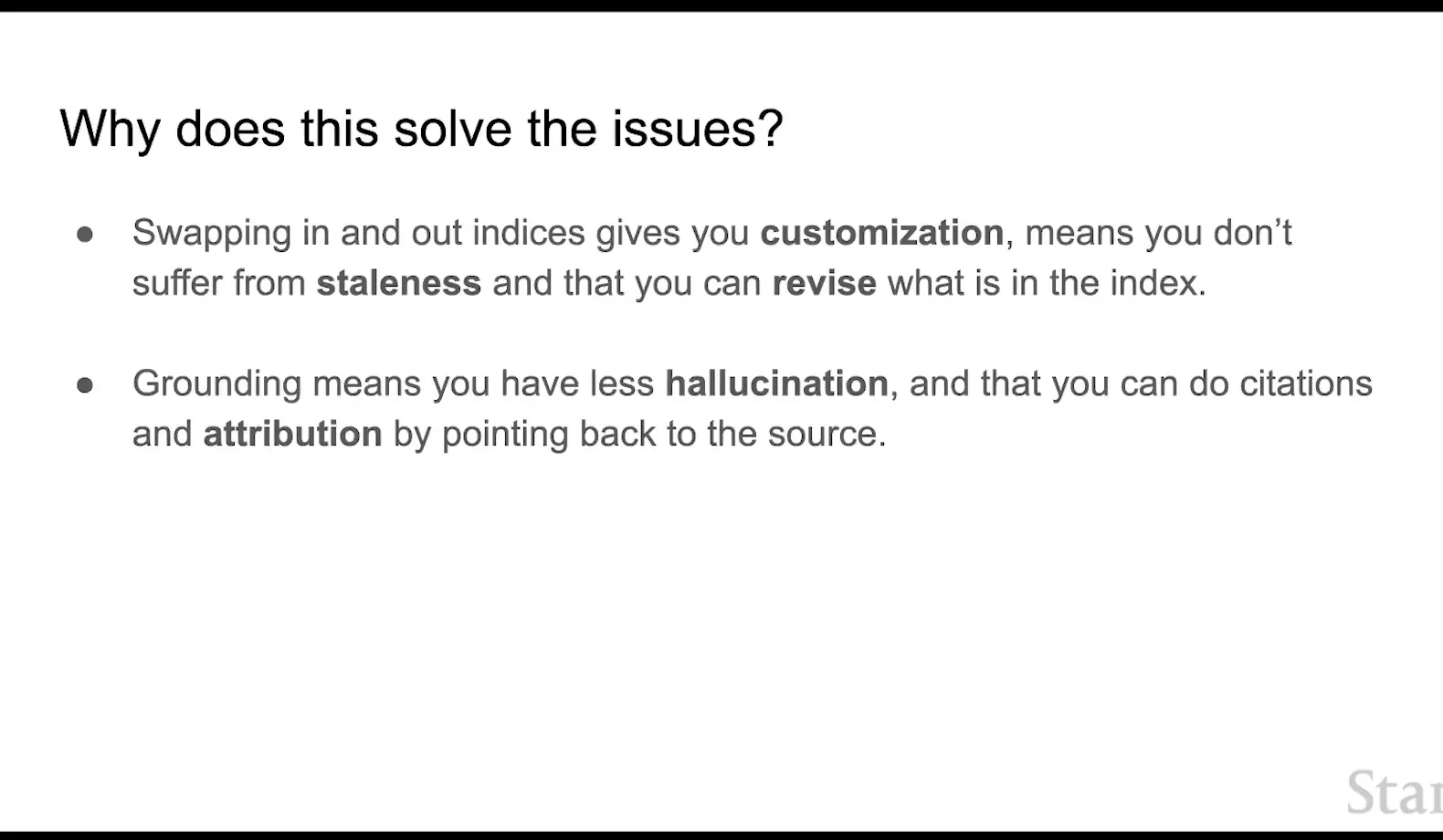
Why does this solve the issues slide 给出两条直接收益:替换 index 可以 customization、避免 staleness、修订错误;grounding 可以减少 hallucination,并提供 citation 与 attribution。注意用词是“less”而非“zero”。
来源:Stanford 课堂视频 00:08:57
读图:可更新性来自状态位置变化
若事实只存在于权重中,修正需要训练与重新部署;若事实位于 index,更新路径变成 document update \(\rightarrow\) re-index \(\rightarrow\) 下一次 retrieval。代价是系统必须管理文档版本、权限、chunking 和检索一致性。
外部知识库不是自动真相库
Index 可能包含错误、冲突、过期或恶意内容。RAG 把“模型是否记错”部分转化成“系统信任什么数据源、如何排序与引用”;它提高可控性,却把数据治理和 source selection 变成显式责任。
课堂提示
课堂提醒,index 可换、事实可修订、来源可引用,但 generator 仍可能不理会 context。检索增强真正要求 retriever 与 generator 之间建立有效接口。
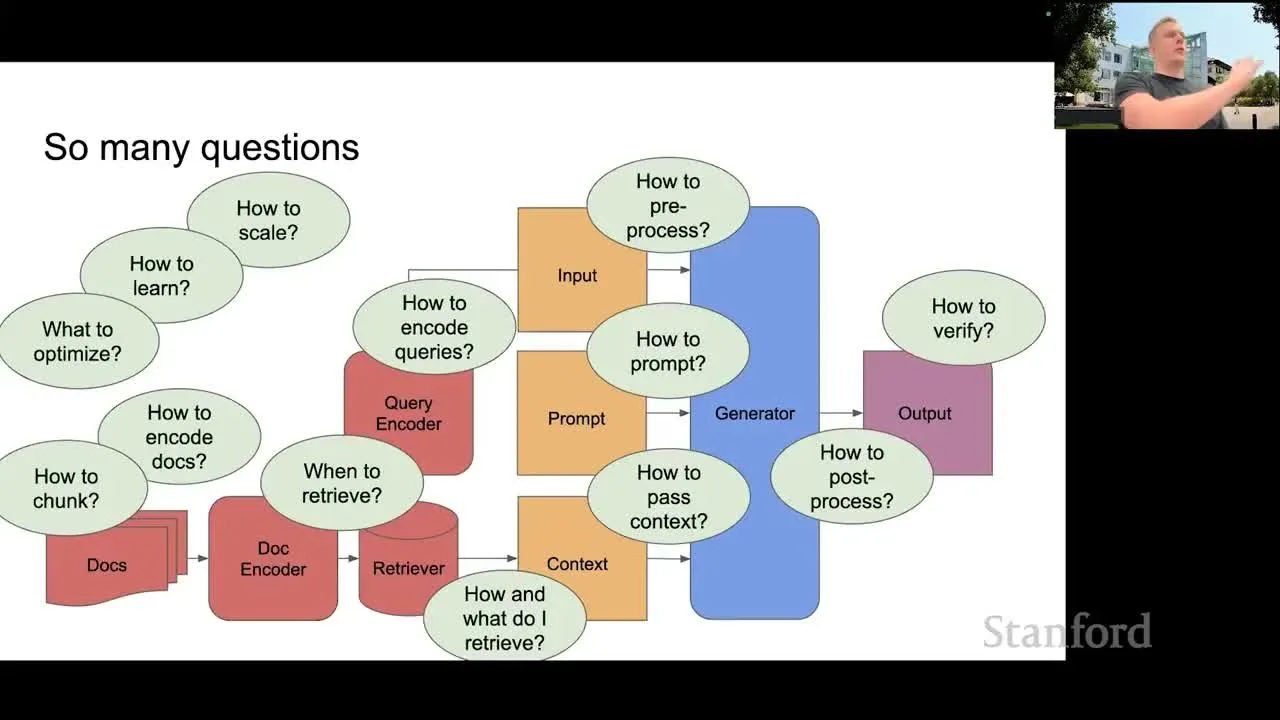
一张架构图会产生许多研究问题
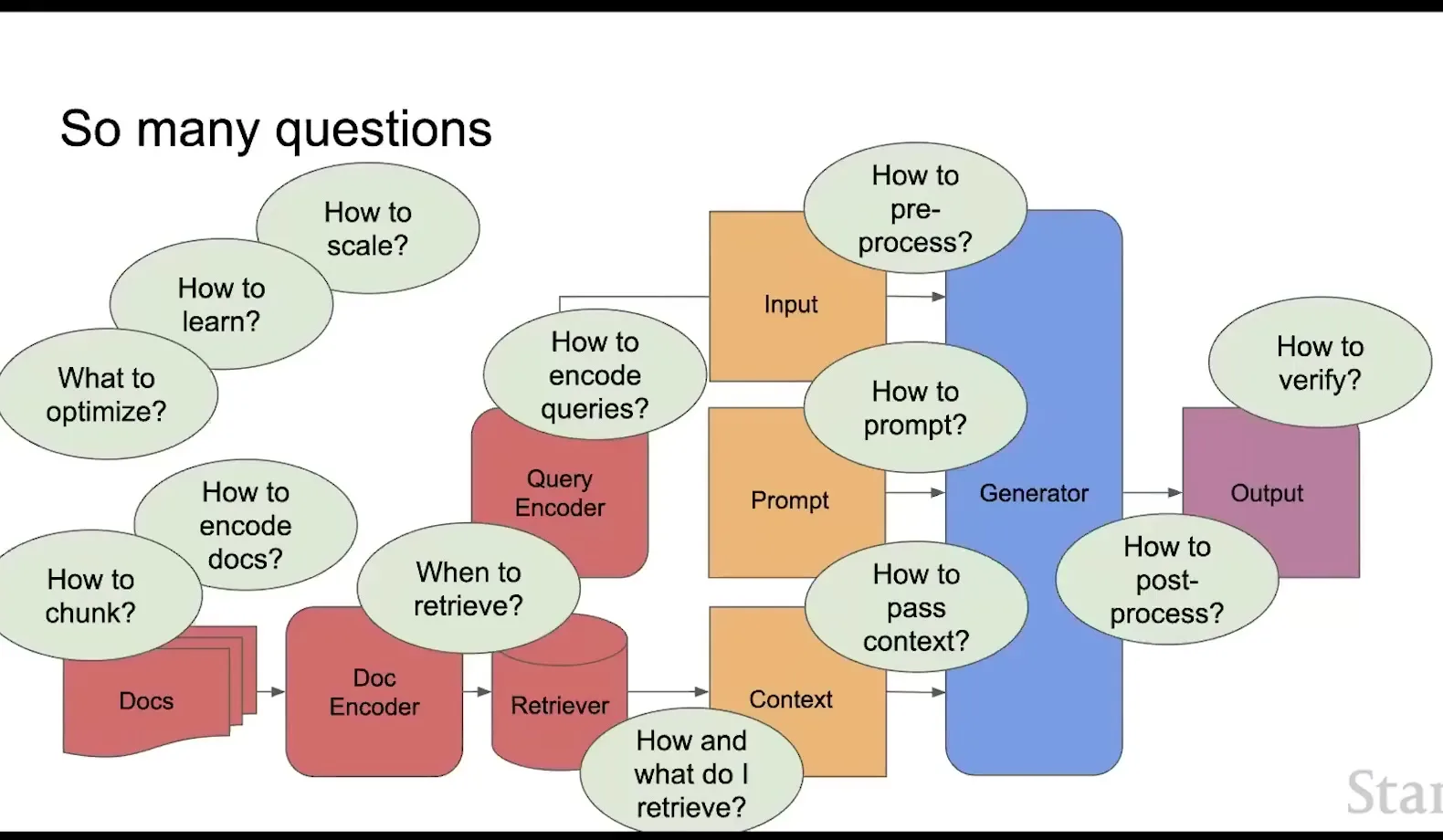
Many Questions slide 围绕基础图追问:系统如何学习、扩展与预处理,怎样编码和检索文档,又该如何设计 prompt 并验证答案。它把 RAG 从单一 trick 展开为完整的系统设计空间,也为后面按 train/test、representation 和 fusion 分类做准备。
来源:Stanford 课堂视频 00:09:57
RAG 的六个设计轴
- Corpus:哪些文档可被访问,谁维护版本与权限;
- Chunking:如何切分、重叠、保留层级;
- Representation:sparse、dense、late interaction 或 hybrid;
- Retrieval policy:何时检索、取多少、是否多跳;
- Fusion:拼 prompt、cross-attention、decoder fusion 或 token-level memory;
- Learning/evaluation:哪些组件有梯度,怎样区分检索与生成错误。
本章小结
Retrieval augmentation 主要补充可更新、可归因和可定制的外部记忆。它没有改变 next-token objective,也不会自动保证生成忠实;因此需要把 corpus、index、retriever、fusion、generator 和 evaluation 当作一套系统来设计。
Train Time 与 Test Time:哪些组件真正被训练
理解 RAG 论文最有效的方法,不是按年份背模型名,而是问两个问题:训练时更新什么,测试时运行什么。Frozen RAG、RePlug、RAG、REALM 和 Atlas 的核心差异,都能映射到 language model、query encoder、document encoder、reranker、index 与 prompt 的更新边界。
训练与推理要分开列账
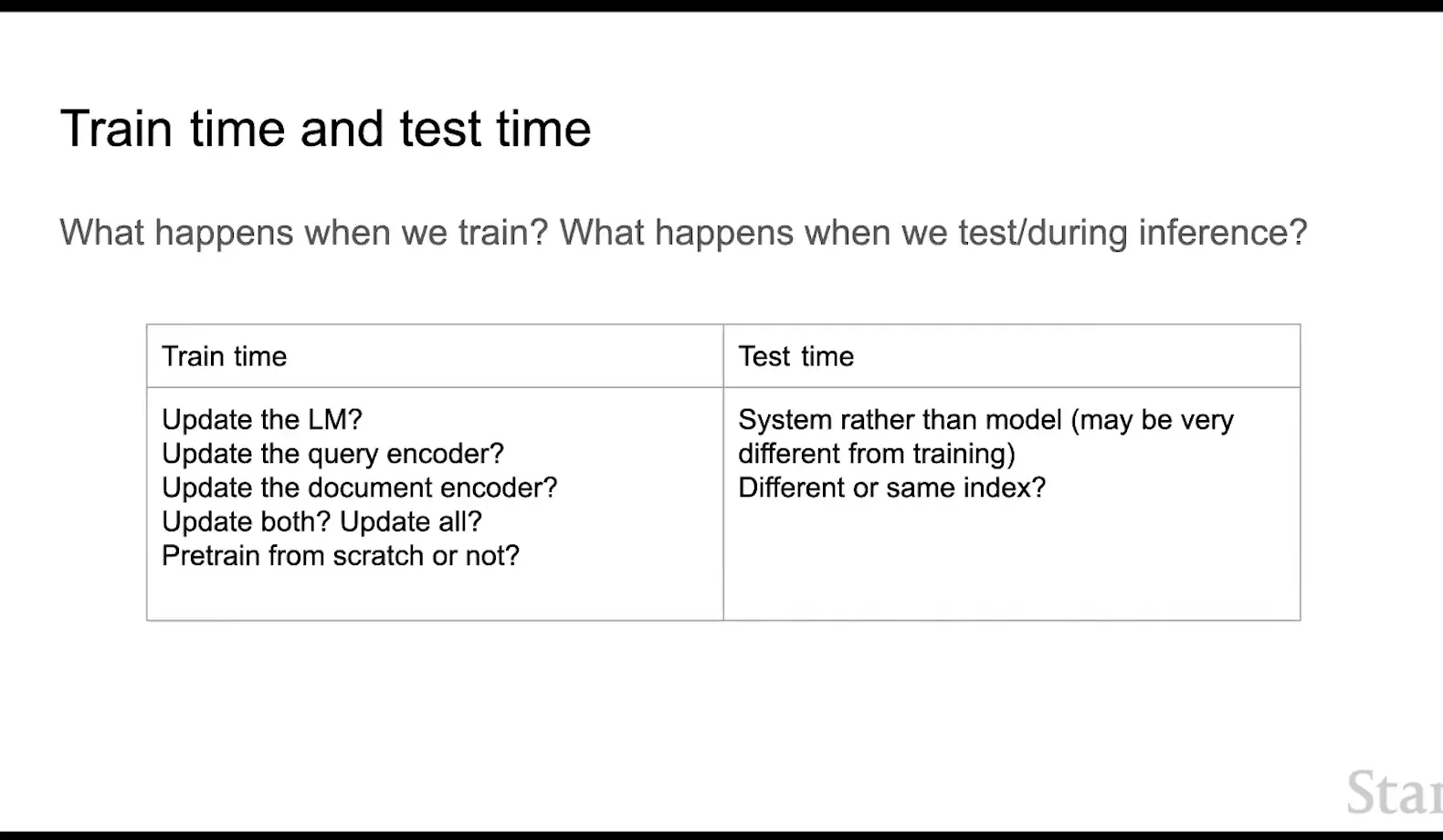
Train Time and Test Time slide 左侧询问是否更新 LM、query encoder、document encoder、是否一次更新全部,以及是否从零预训练;右侧询问系统是否是 frozen model、retrieval 如何变化、不同例子是否使用不同或同一 index。
来源:Stanford 课堂视频 00:10:54
读图:同一个组件可能在训练时冻结、推理时仍参与
“Frozen” 指参数不更新,不等于组件不运行。Frozen retriever 仍会搜索,frozen generator 仍会生成;index 也可能在不训练 encoder 的情况下更新文档。论文比较时必须同时标注 parameter update、index refresh 与 inference calls。
参数与状态的分层
令参数集合为
分别代表 generator、query encoder、document encoder 与 reranker;令 \(I_t\) 表示时刻 \(t\) 的 index 状态。训练可以更新 \(\Theta\) 的子集,部署可以只替换 \(I_t\)。参数学习与知识库更新是两条不同生命周期。
Frozen RAG:不训练也能得到强基线
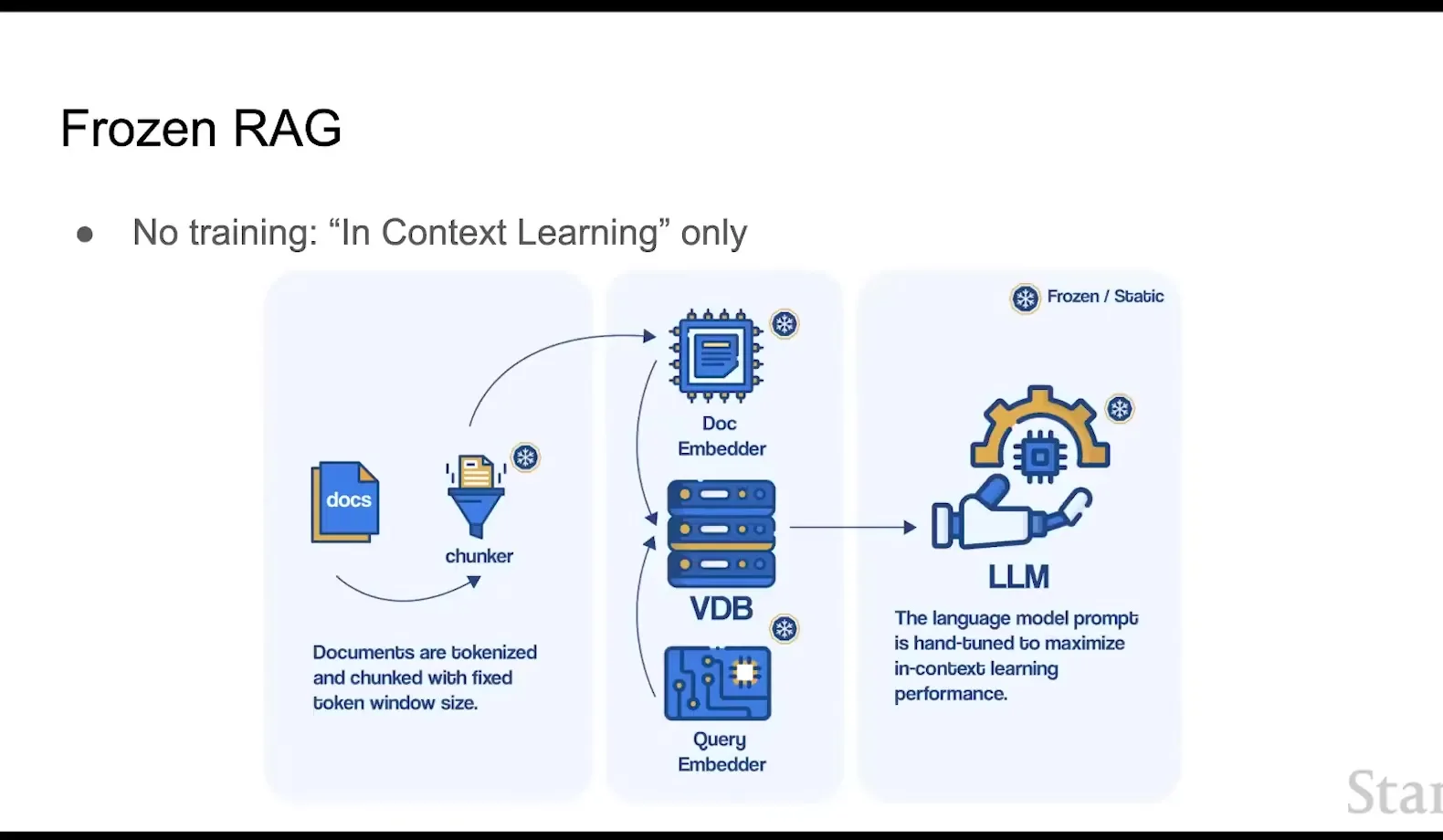
Frozen RAG slide 把 no training 与 in-context learning 放在一起:用现成 retriever 或 vector database 找文档,把文档拼进 prompt,再调用冻结 LLM。它实现快、适合 black-box API,但 retriever 和 generator 并未为彼此优化。
来源:Stanford 课堂视频 00:11:57
读图:Frozen RAG 的工程价值与研究局限
价值在于模块可替换、无需模型权重、可快速接入私有文档;局限在于 retrieval score 不一定等于 generator utility,chunk 排名与 prompt 位置可能错配,generator 也可能依赖参数记忆覆盖证据。
Frozen 不等于便宜
每个请求仍需 embedding、search、reranking、prompt tokens 与 generation。若 top-\(k\) 过大,输入 token 成本和 latency 可能超过检索收益;若 top-\(k\) 太小,关键证据可能丢失。
课堂提示
Kiela 把 frozen RAG 称为 “In-Context Learning only”,并反复指出它是很强的实用起点,却也是各组件独立训练的 Frankenstein system。
Contextualization via Retrieval:先训练哪一边
下一张 architecture slide 用红框突出 documents、document encoder、retriever 与 query encoder,表示先让 retrieval side 适应任务。Generator 仍可冻结,训练信号则来自检索监督、最终答案 likelihood 或 reranking objective。
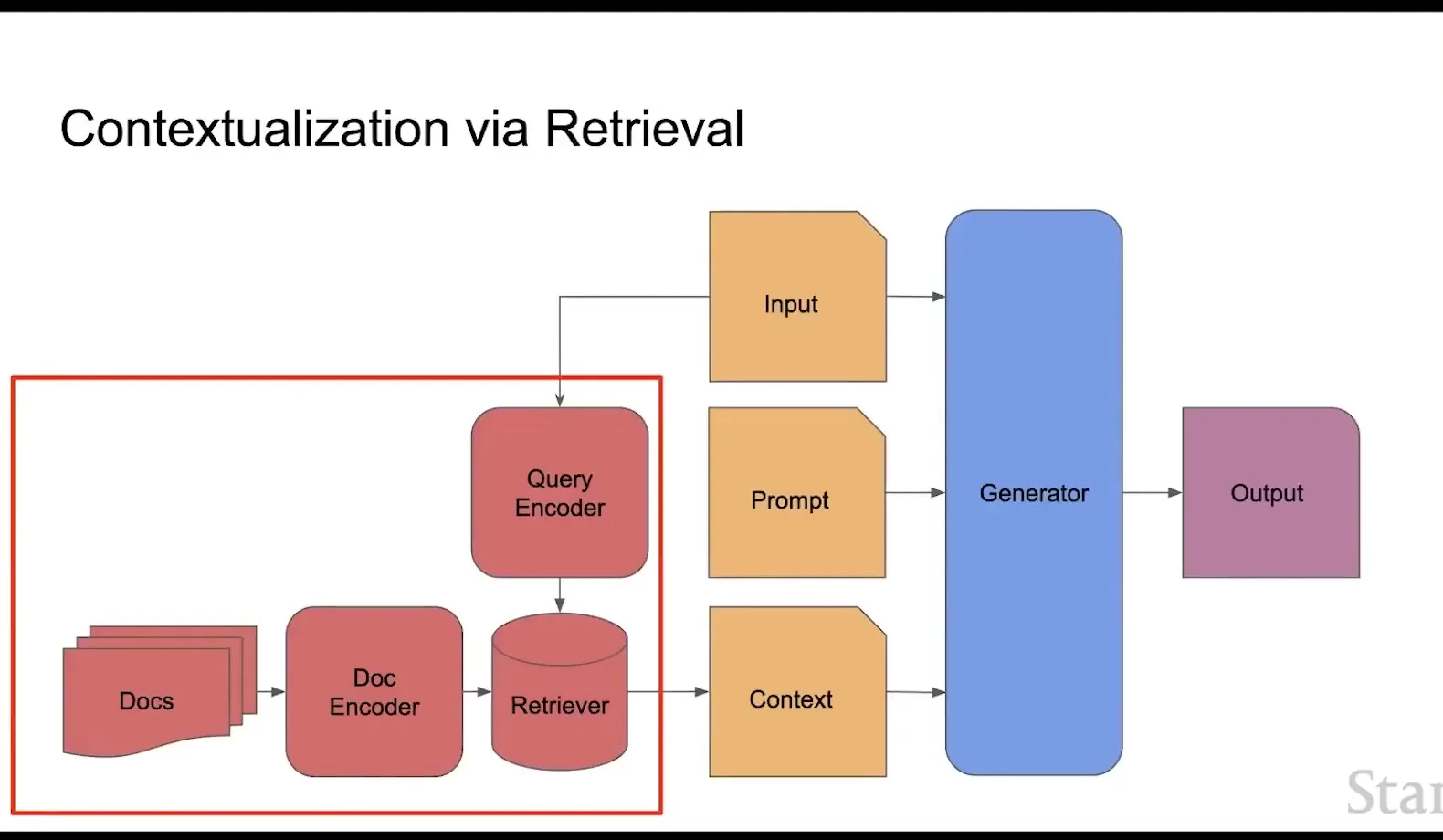
来源:Stanford 课堂视频 00:12:09
三种常见 retriever supervision
- Direct relevance labels:query–positive passage pairs 与 hard negatives;
- Answer-containing heuristic:文档是否包含答案字符串,便宜但噪声大;
- Generator-derived signal:哪份文档让正确答案 likelihood 更高,更贴近最终任务但计算更贵。
课堂提示
课堂的 taxonomy 不是“训练或不训练”二选一,而是逐项询问 LM、query encoder、document encoder、reranker 与 index。后续所有模型都可以放回这张表定位。
本章小结
RAG 架构需要同时报告 parameter updates、index refresh 与 inference behavior。Frozen RAG 用最少训练快速获得能力;更紧耦合的方法则让 retriever 或 generator 接收最终任务信号,代价是训练复杂度、索引刷新和计算成本上升。
Retrieval Stack:Sparse、Dense、Late Interaction 与 Hybrid
检索器决定 generator 能看到哪些证据。课堂从传统 sparse retrieval 讲到 dense bi-encoder、vector database、ColBERT late interaction,再以 SPLADE、DRAGON 与 hybrid search 收束。不同表示不是简单的“新方法淘汰旧方法”,而是 exact match、semantic match、效率与可更新性的取舍。
Sparse Retrieval:词项空间中的精确匹配
Sparse retrieval slide 展示 TF-IDF、BM25 与 DrQA。文档向量的维度对应词项,大多数维度为零,因此称为 sparse;query 与 document 共享词项时获得高分,品牌名、编号、专有名词和代码 token 往往受益。
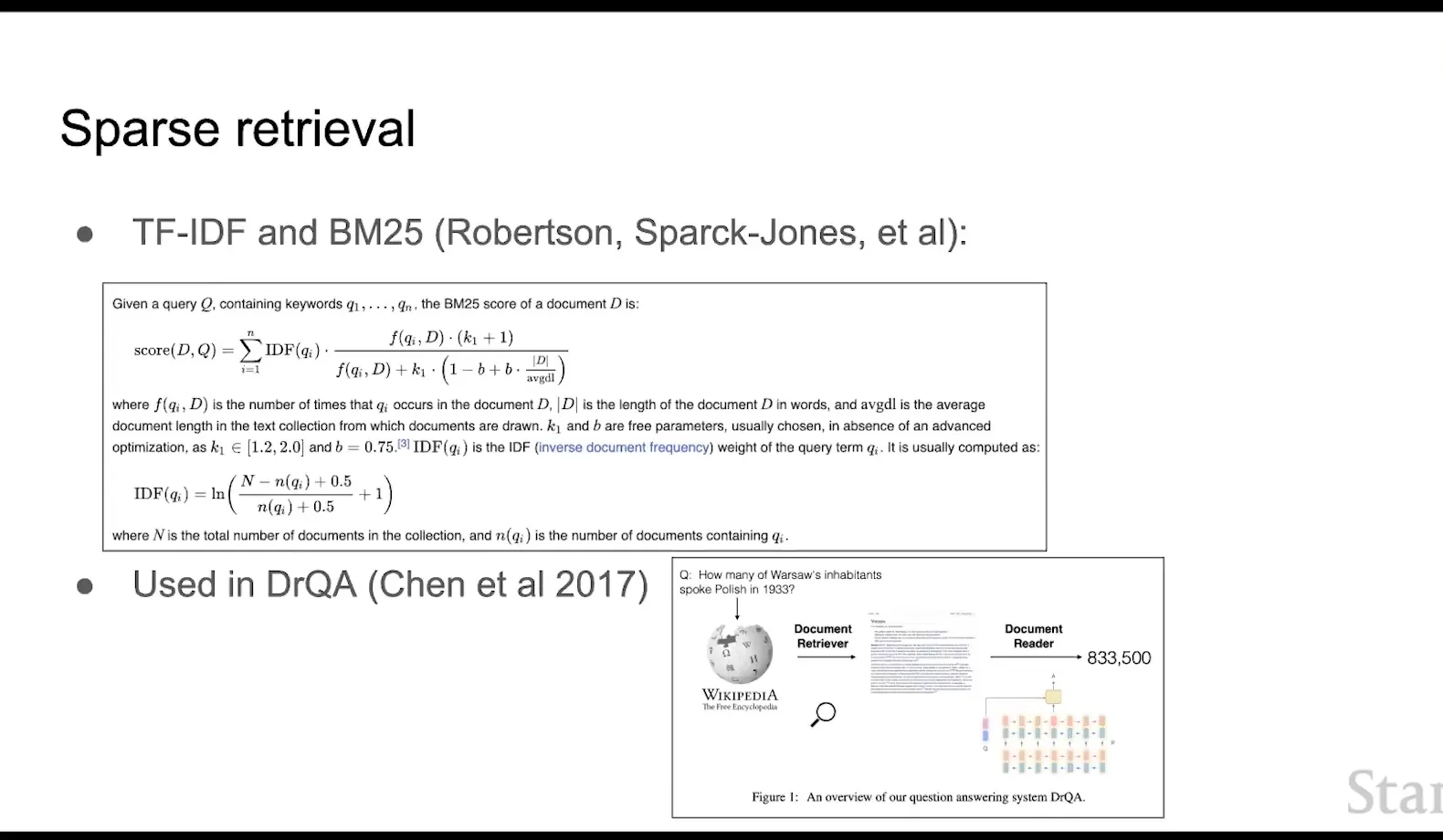
来源:Stanford 课堂视频 00:15:03
BM25 的核心直觉
对 query \(Q\) 与文档 \(D\),BM25 可写为
\(f(q,D)\) 是词频,\(\operatorname{IDF}\) 提高稀有词权重,长度归一化避免长文档仅因词多而占优。它不理解深层语义,却对 exact lexical evidence 强而高效。
课堂提示
Q&A 中讲者用 Apple 与 pear 解释 dense retrieval 的风险:品牌名需要精确匹配时,不希望“语义相近”把公司 Apple 扩成水果 pears。
Dense Retrieval:把 query 与 passage 投入共享向量空间
Dense retrieval slide 展示 ORQA 与 DPR。Query encoder 和 passage encoder 生成低维 dense embeddings,再用 dot product 或 cosine similarity 排序。它可以召回词面不同但语义相关的 passage,但 representation 是否适合当前 generator 和 domain 取决于训练。
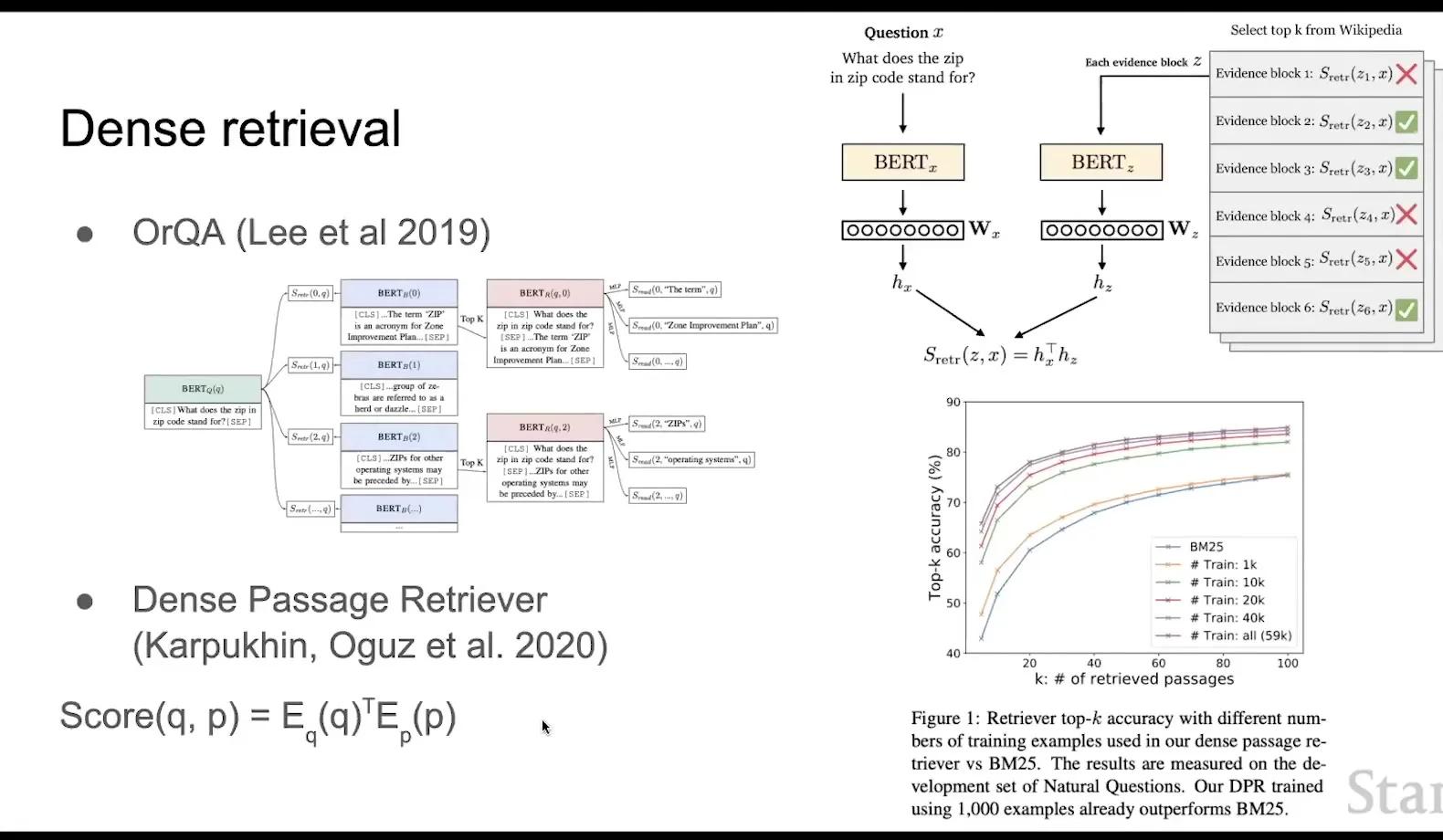
来源:Stanford 课堂视频 00:16:48
Dense similarity 与 MIPS
设 query embedding 为 \(e_q\in\mathbb{R}^d\),文档 embedding 为 \(e_i\),常用分数为
Maximum Inner Product Search(MIPS)是在大规模 index 中近似寻找最高内积向量;FAISS 等库用量化、分桶或图结构降低穷举成本。
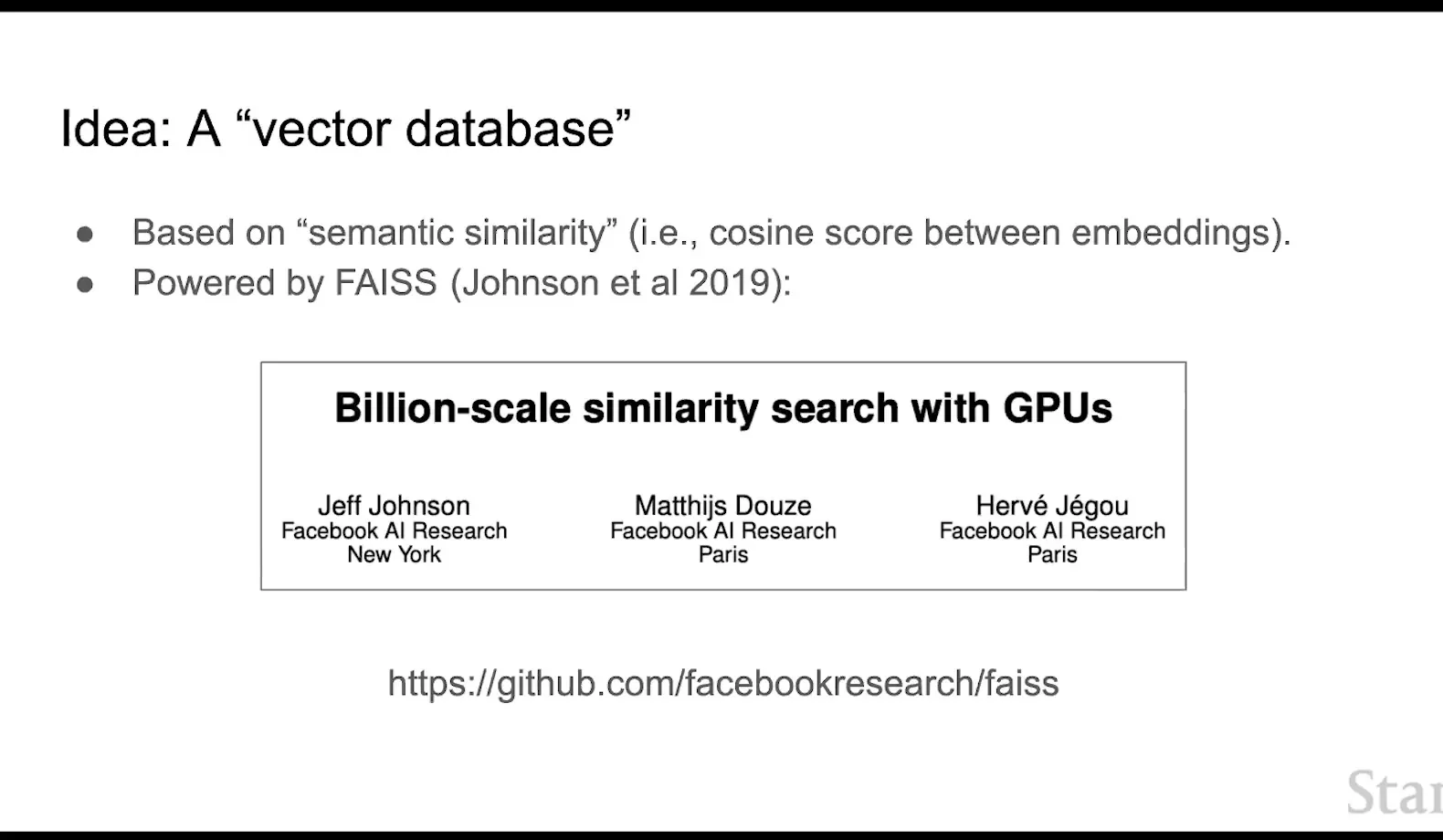
来源:Stanford 课堂视频 00:17:45
读图:Vector database 存的是可搜索表示
它通常负责写入 embedding、建立 ANN index、过滤 metadata、执行 top-\(k\) search 与更新。数据库不会替模型决定 chunk 是否可信,也不会保证 semantic similarity 等于 task relevance;这些仍取决于 encoder、corpus 与 downstream objective。
ColBERT:从单向量压缩到 token-level late interaction
Bi-encoder 把整个 query 和 passage 各压成一个向量,效率高但可能丢失细粒度匹配。ColBERT 保留每个 token 的 contextual embedding,预先编码文档,查询时对每个 query token 找最匹配的 document token,再聚合分数。
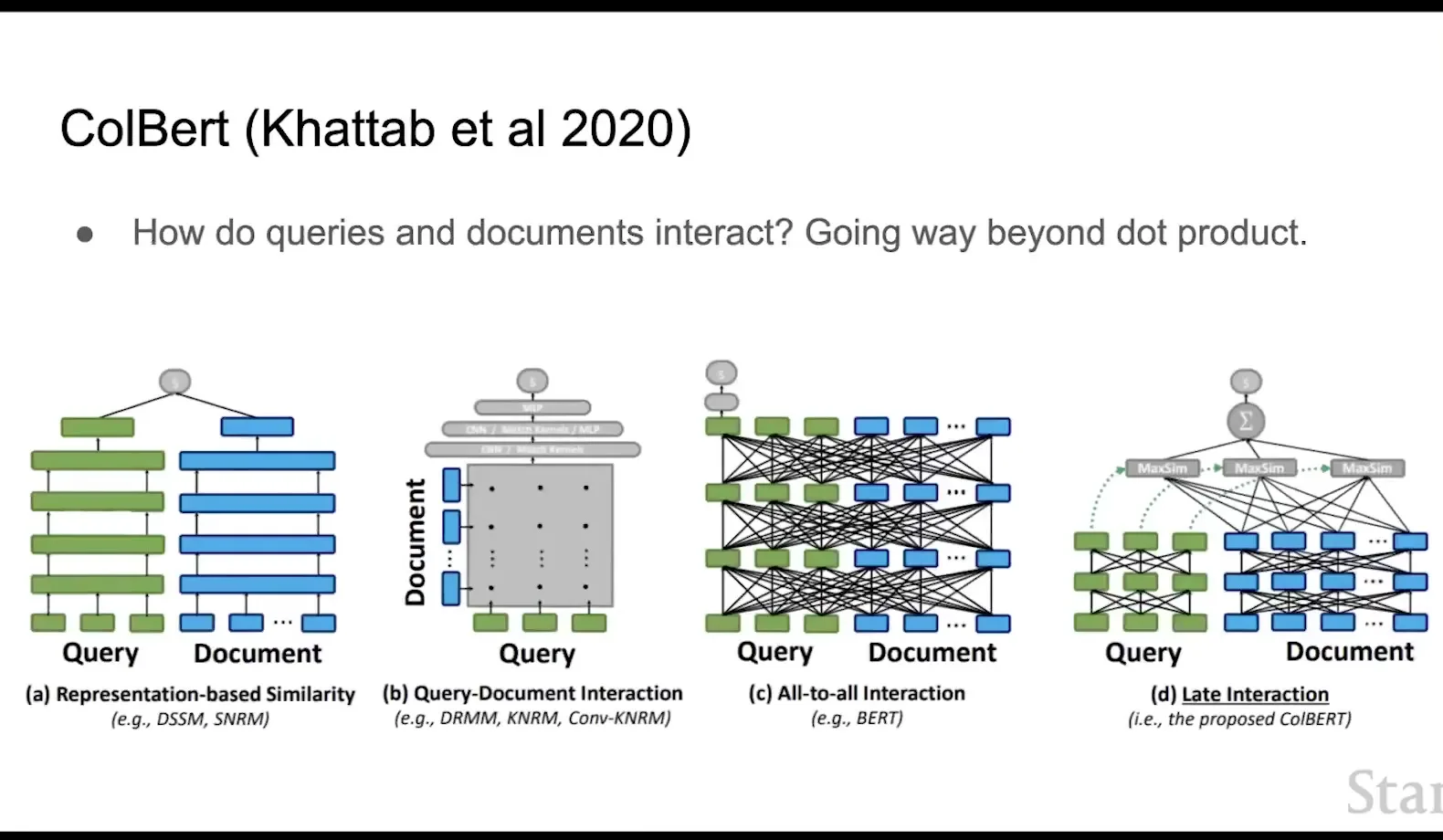
来源:Stanford 课堂视频 00:17:51
MaxSim late interaction
设 query token embeddings 为 \(Q_1,\ldots,Q_m\),document token embeddings 为 \(D_1,\ldots,D_n\),ColBERT 的典型分数是
每个 query token 都能找到最相关的 passage token,因此比单向量表达更细;代价是 index 更大、查询计算更多。
SPLADE、DRAGON 与 Hybrid Search
SOTA slide 用 SPLADE 表示 learned sparse expansion:模型给 query/doc 扩展相关词项,同时仍可使用倒排索引;DRAGON 用 progressive data augmentation 和 hard negatives 训练 generalized dense retriever。课堂最后强调 developer practice 常把 sparse 与 dense 结果融合。
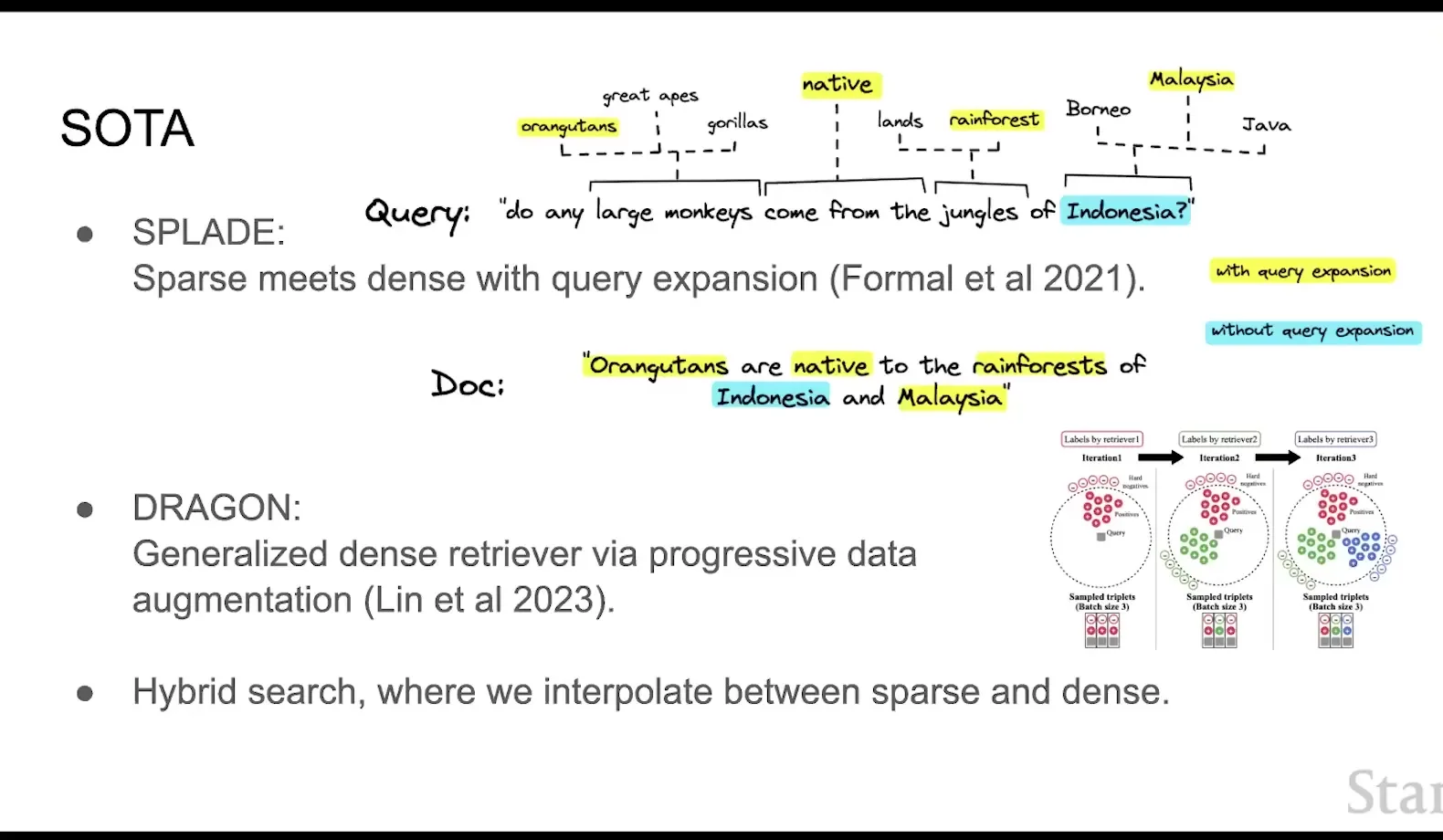
来源:Stanford 课堂视频 00:24:57
读图:Sparse meets dense 的两种路径
SPLADE 把 semantic expansion 写回高维 sparse vocabulary;hybrid search 则保留独立 BM25 与 dense retriever,再融合排名。前者共享一个 learned sparse representation,后者允许不同系统各自更新和过滤。
Reciprocal Rank Fusion
给多个检索器 \(r\in\mathcal{R}\),文档 \(d\) 的融合分数可写为
其中 \(c\) 是平滑常数。RRF 不要求不同 retriever 的原始分数同尺度,只利用排名,因此是实用的 hybrid baseline。
def hybrid_retrieve(query, corpus, top_k=8):
    sparse_candidates = bm25.search(query, limit=200)
    dense_scores = dense_encoder.score(query, sparse_candidates)
    reranked = sort_by_score(sparse_candidates, dense_scores)
    return reranked[:top_k]
课堂提示
讲者当时称 DRAGON/DragonPlus 是很好的 off-the-shelf dense retriever,并观察开发者普遍采用 hybrid search。讲义保留这是 2023 年课堂判断,不把它写成 2026 年永久排名。
本章小结
Sparse retrieval 强在 exact terms 与成熟倒排索引,dense retrieval 强在语义召回,ColBERT 用更大 index 换取 token-level interaction,hybrid search 则把多种信号融合。选择 retriever 要从 query 类型、domain、index 规模、更新频率和 generator utility 出发。
让 Retriever 适应 Frozen Generator
有了强 retriever,下一步仍不是结束:通用 relevance score 未必等于某个 generator 的 usefulness。课堂用 RePlug 与 in-context RALM 展示两条中间路线——保持 generator 冻结,利用其 likelihood 或最终任务 loss 训练 retriever/reranker。
Contextualizing the Retriever for the Generator
架构页用火焰标记 retrieval side:目标是让 query encoder 和 retriever 找到“能让这个 generator 更好回答”的文档,而不仅是通用语义相似文档。若 generator 是 GPT-4 式 black-box API,训练接口会受到可见 log-probability 与调用成本限制。
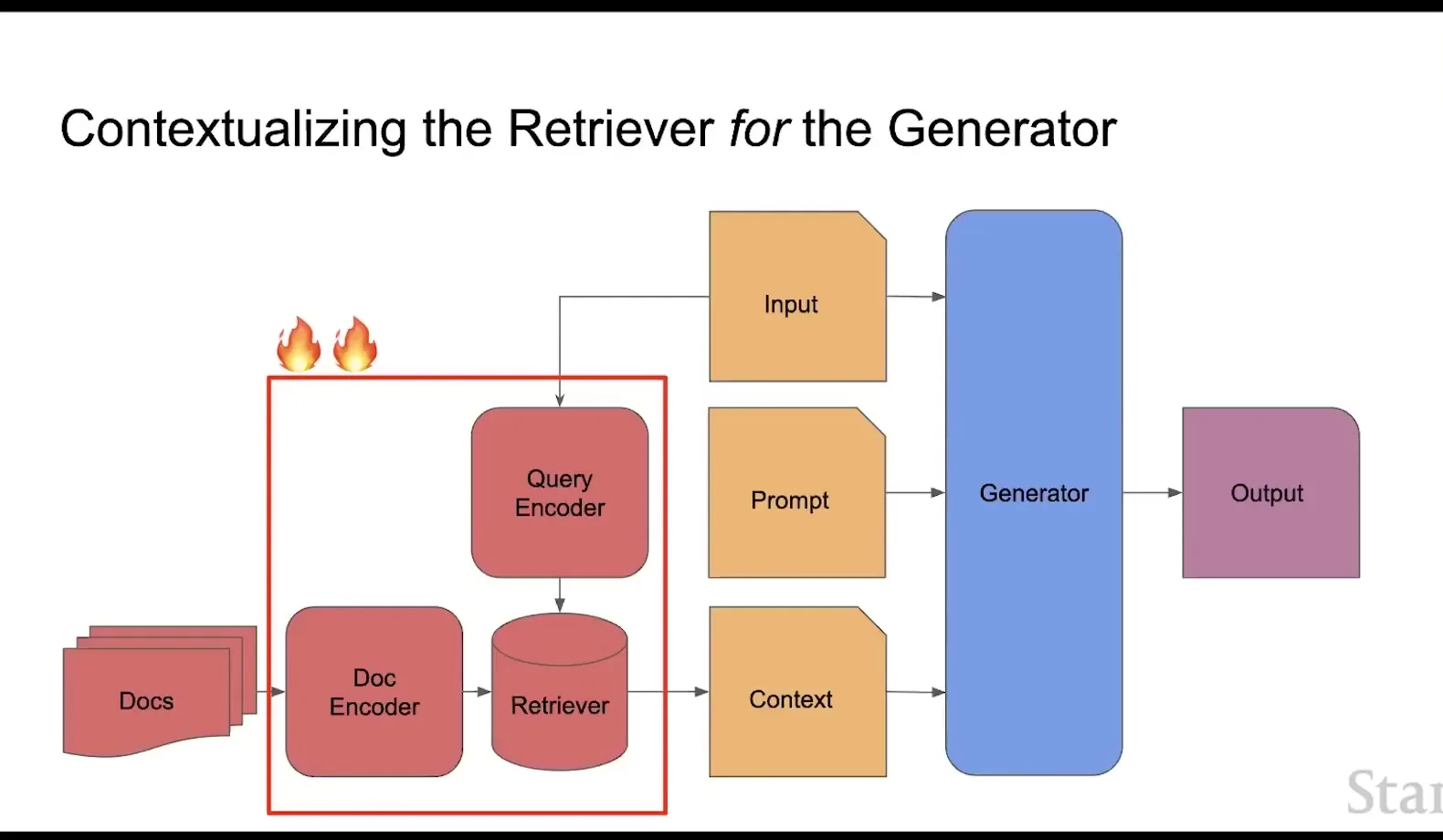
来源:Stanford 课堂视频 00:25:24
三种 generator access level
| 访问级别 | 可用信号 | 可训练范围 |
|---|---|---|
| Text-only API | 最终文本、可能有评分器 | 黑盒搜索、偏好优化、外部 reranker |
| Log-probability API | 正确答案 likelihood;perplexity(交叉熵的指数,可理解为每 token 的有效候选数,越低越好) | RePlug 式 generator-aware retriever |
| Full weights | 梯度、hidden states、attention | Joint retriever–generator training |
RePlug:用语言模型 likelihood 监督 retriever
RePlug 对 top-\(k\) 文档归一化 retrieval scores,再分别把每份文档交给 frozen LM,观察正确 continuation 的 likelihood。训练目标让 retriever distribution 接近 generator utility distribution,因此无需反向传播进入 generator。
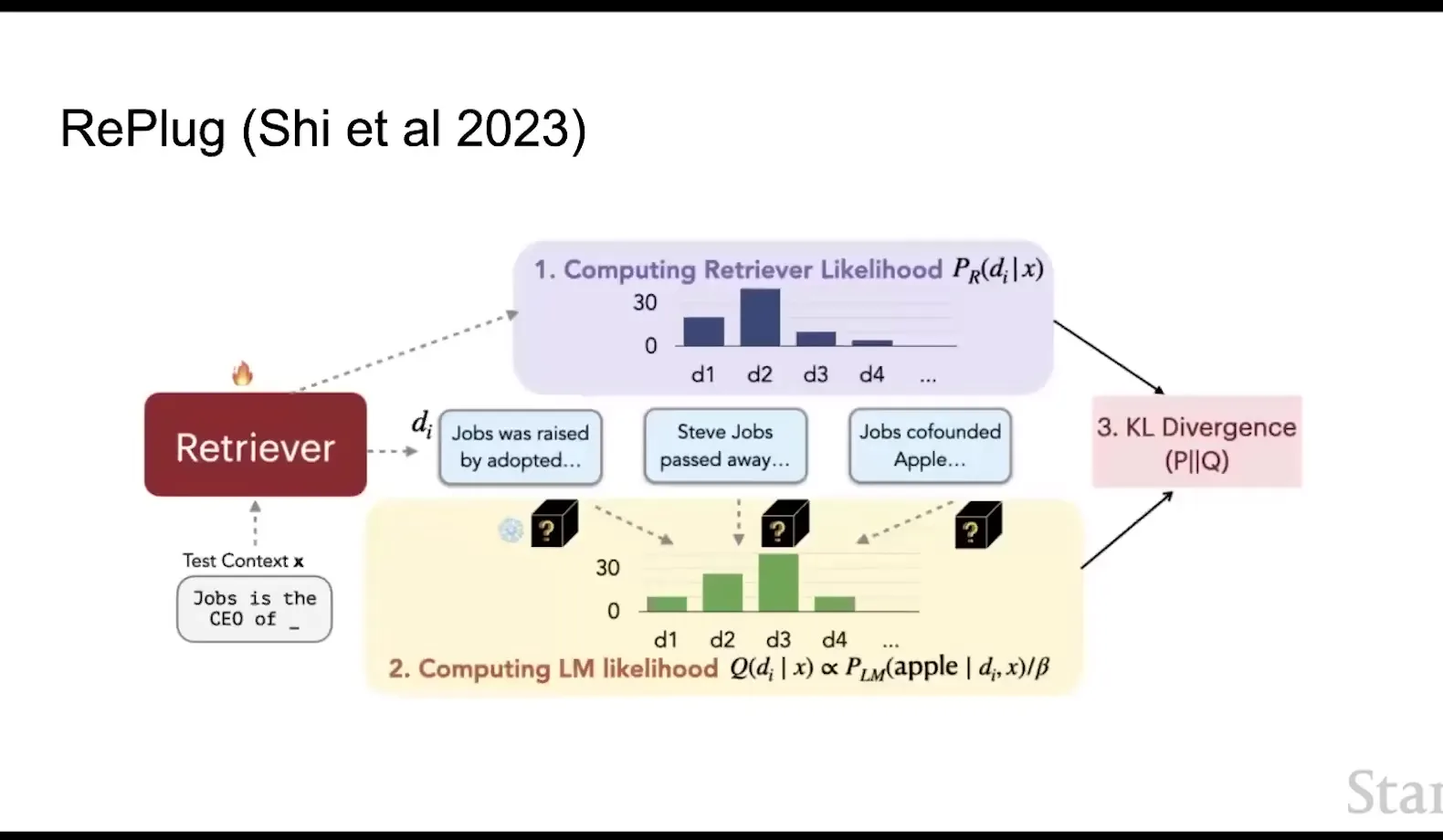
来源:Stanford 课堂视频 00:26:42
RePlug 的 distribution matching
令 retriever 对文档的概率为
令 frozen LM 在文档 \(d_i\) 条件下对目标 \(y\) 的分数归一化为 \(p_G(d_i\mid x,y)\)。训练可最小化
Retriever 学到哪份文档能降低 LM perplexity,而 generator 参数保持不变。
课堂提示
Kiela 称 RePlug 的想法 “super simple” 且适用于多种 generator,只要能够获得 perplexity 或 token likelihood。关键是训练 dense encoder,而不是修改黑盒 LM。
In-Context RALM:BM25 召回,learned reranker 精排
In-Context RALM slide 展示更朴素的 frozen RAG:先用 BM25 找候选,把文档放进 context;随后训练一个 reranker,使高排名文档更能提高冻结 LM 对目标 token 的概率。Stop-gradient 阻止 LM 参数更新,梯度只进入 rank function。
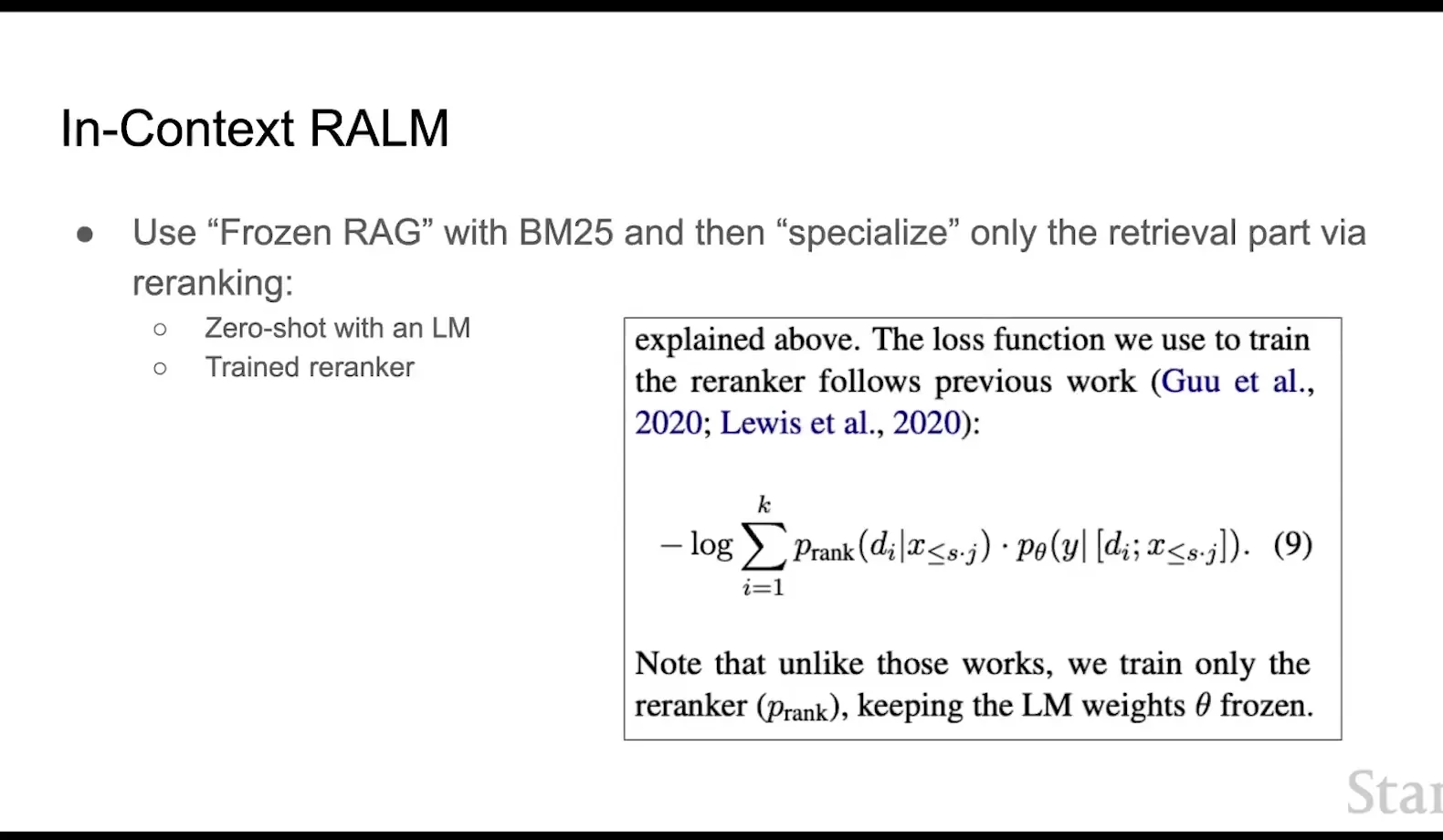
来源:Stanford 课堂视频 00:26:48
读图:Recall 与 precision 分工
BM25 用低成本扩大候选集合,reranker 在较小集合上使用更昂贵的 cross-encoder 或 task-aware score。这样保留 exact lexical recall,同时让最终排序靠近 generator objective;但若 BM25 没召回关键文档,reranker 无法补救。
Retrieve–Rerank–Generate 的显式三阶段管线
最后一张架构图在 retriever 与 context 之间加入绿色 reranker。这个额外组件让系统可以独立控制 recall depth、reranking depth 和 final context size,也带来新的 calibration 与 latency 问题。
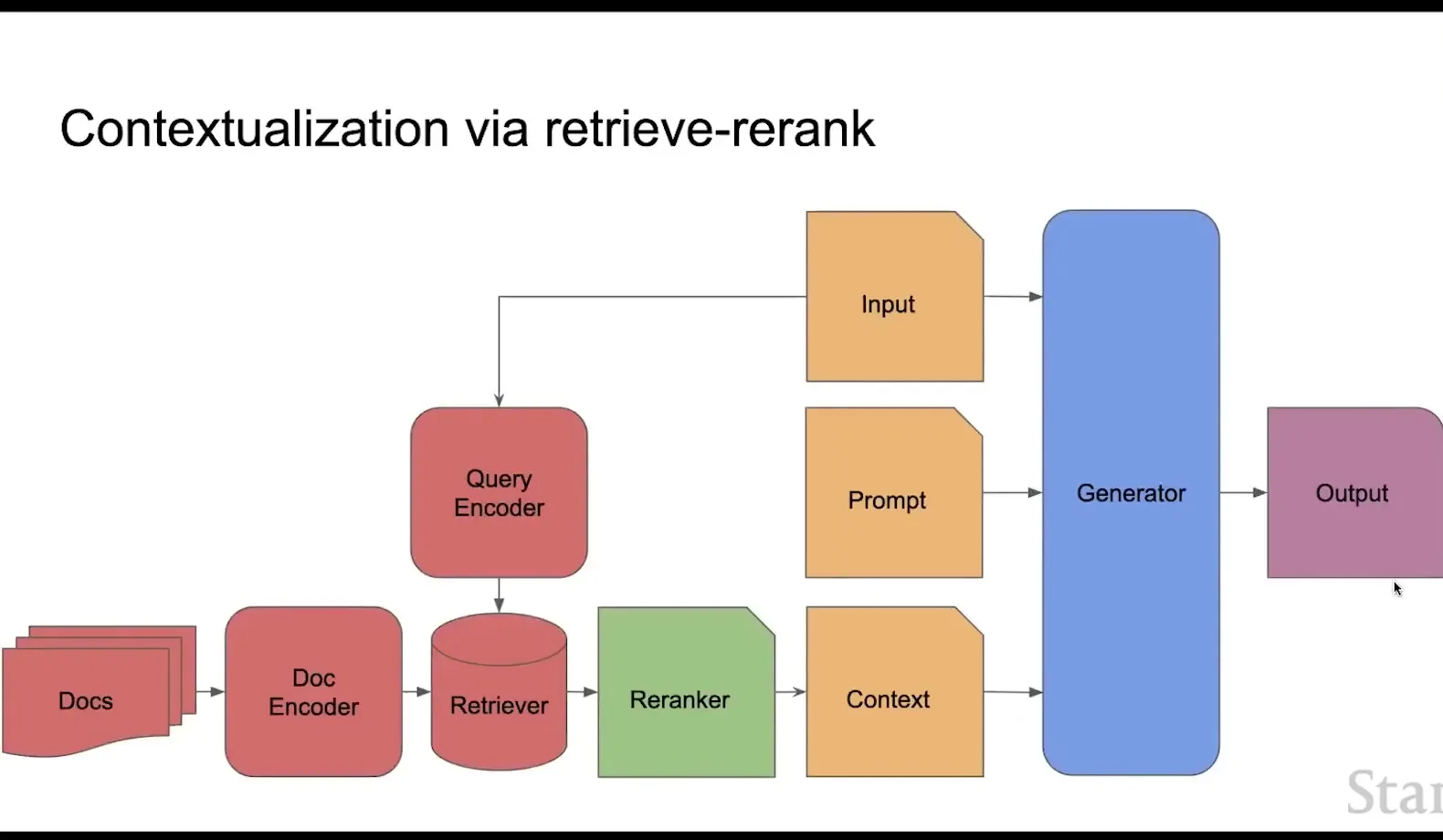
来源:Stanford 课堂视频 00:28:39
三种集合大小不要混淆
设初始 corpus 大小为 \(N\),retriever 返回 \(k_r\) 个候选,reranker 保留 \(k_c\) 个 context chunks,通常
\(k_r\) 太小会损害 recall,太大增加 reranking cost;\(k_c\) 太大增加 prompt cost 与 Lost-in-the-Middle 风险,太小则可能缺证据。
Reranker 分数仍不是事实可信度
Reranker 衡量 query/task relevance,不自动判断来源是否权威、是否过期或是否被 prompt injection 污染。Production corpus 还需要 source policy、metadata filters 和访问控制。
课堂提示
课堂把这一阶段描述为“slowly progressing”到更适配生成任务的系统:先不碰 generator,通过 BM25、dense retriever 或 BERT reranker 把 gradients 引入 retrieval pipeline。
本章小结
RePlug 和 in-context RALM 都在 frozen generator 条件下学习 retrieval side。前者对齐 retriever 与 LM likelihood distribution,后者用 BM25 recall 加 learned reranker。它们是 frozen RAG 与 fully joint training 之间的重要中间层。
Contextualizing the Whole System:从松耦合到共同优化
前一章仍把 generator 冻结,只训练 retrieval side。课堂接着把红框扩展到 retriever、context 与 generator,追问为什么要让彼此独立训练的组件勉强拼接。RAG、FiD、kNN-LM、RETRO 等方法的差异可以沿两条轴阅读:证据在何时检索,以及生成器在何处融合证据。
Contextualization of Both
架构页把 query encoder、retriever、context 与 generator 同时放入红框,表示最终任务 loss 可以影响更多组件。Joint training 的理想是让 retriever 找到 generator 真正会用的文档,让 generator 学会在证据不足或冲突时采取可预测行为。
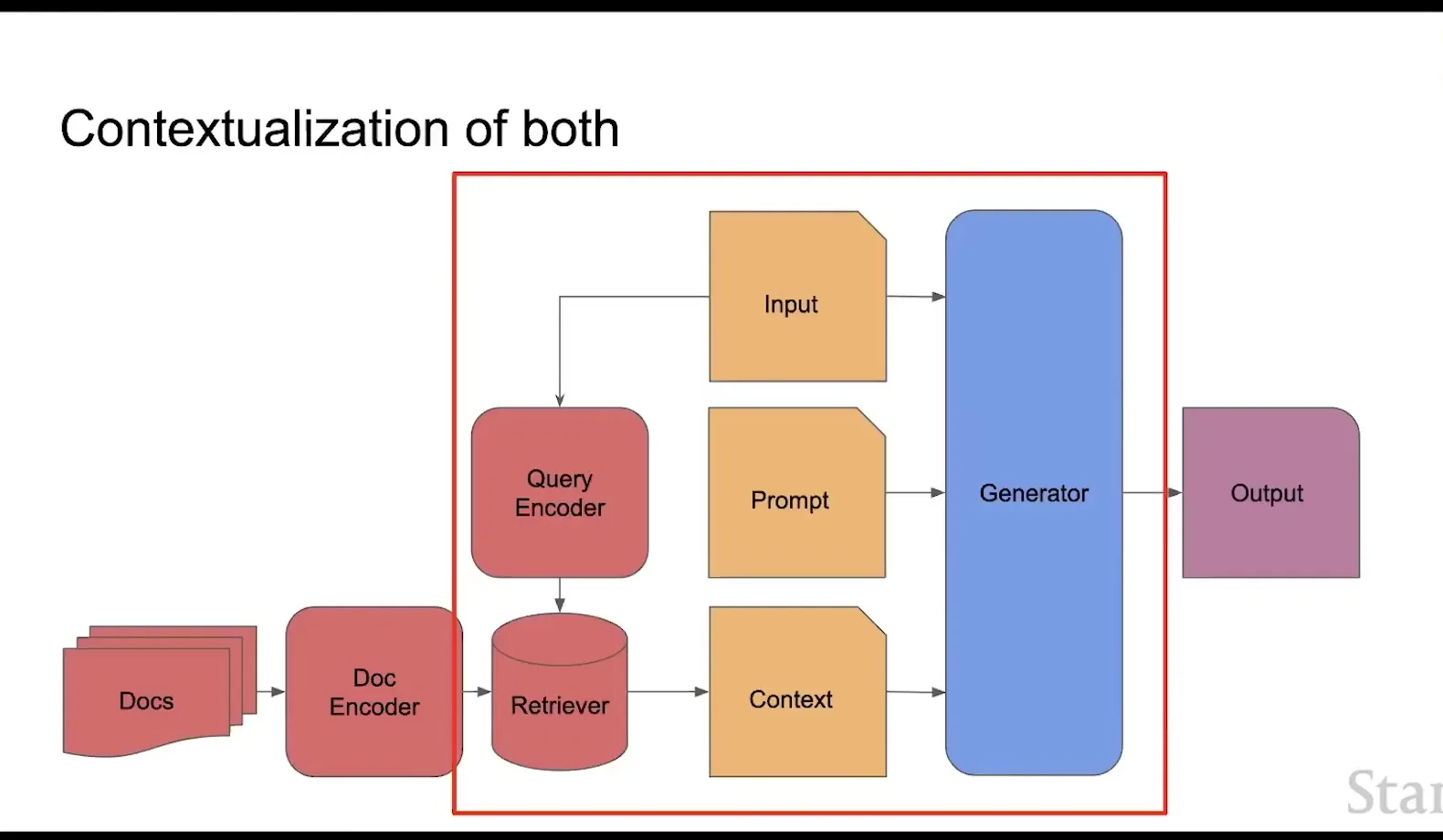
来源:Stanford 课堂视频 00:30:06
读图:Joint 不一定意味着每步同步更新全部参数
大规模 document encoder 无法在每个 batch 后立刻重编码整个 corpus,因此实际系统常冻结部分参数、异步刷新 index、只更新 query side,或交替训练 retriever 与 generator。Joint objective 描述信号耦合,implementation 可以是近似的。
课堂提示
讲者的核心批评是:如果 retriever、document encoder 与 generator 都在不同目标上独立训练,它们只是被迫合作。更好的方向是让 gradients 或 task signal 尽可能贯穿整套系统。
Original RAG:对 latent document 做 marginalization
RAG architecture slide 展示 query encoder 从 Wikipedia index 取 top documents,generator 对每个 document 计算输出概率,再把 document 作为 latent variable 边缘化。它比直接拼接所有文档更明确地区分 retrieval probability 与 generation probability。
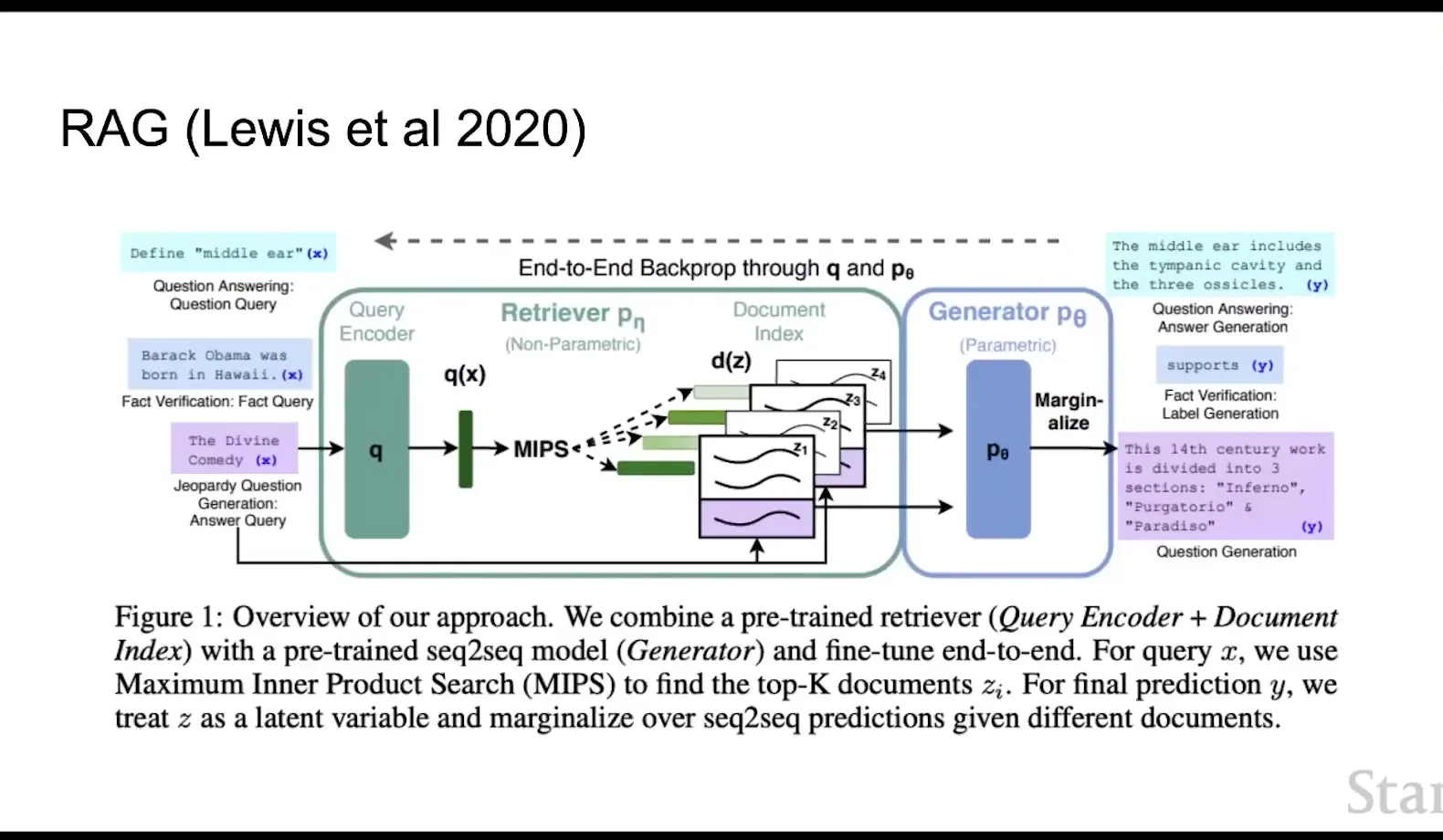
来源:Stanford 课堂视频 00:30:51
读图:Document 是 latent variable
系统没有把一份 retrieved document 当作确定真相,而是对多个 \(z\) 加权。Retriever 提供 \(p_\eta(z\mid x)\),generator 提供 \(p_\theta(y\mid x,z)\);两者共同决定答案,retriever 的概率也能收到最终 task loss。
RAG-Sequence 与 RAG-Token
Equation slide 区分两种 marginalization。RAG-Sequence 为整段输出选择同一 latent document;RAG-Token 允许每个 output token 从不同 document mixture 获得支持。后者更灵活,也需要更多检索/融合计算并更难解释整段来源。
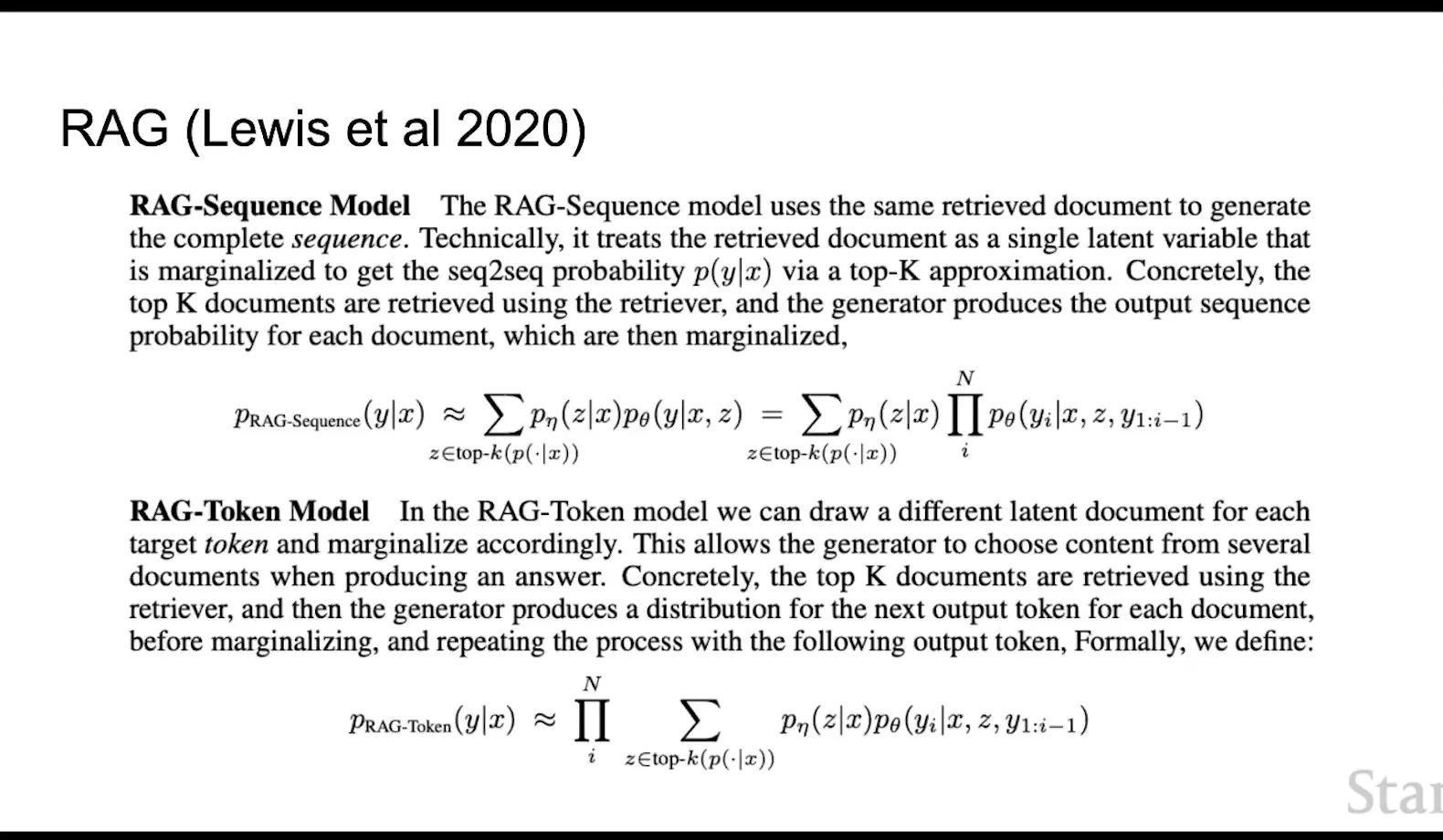
来源:Stanford 课堂视频 00:31:27
两种 RAG likelihood
RAG-Sequence 近似为
而 RAG-Token 把求和放进每个 token:
\(\eta\) 是 retriever 参数,\(\theta\) 是 generator 参数。两者的来源解释粒度不同。
Freezing Suboptimal:表格与 Frankenstein 隐喻
Ablation table 比较 BM25、DPR、RAG 与 generator/retriever 是否冻结。课堂结论不是“某一列数字永远最佳”,而是 independent freezing 通常损失任务性能;组件越能接收共同目标信号,越可能形成有效协作。本节把 benchmark table 与随后出现的 Frankenstein 隐喻放在一起,先读控制实验,再解释错配机制。
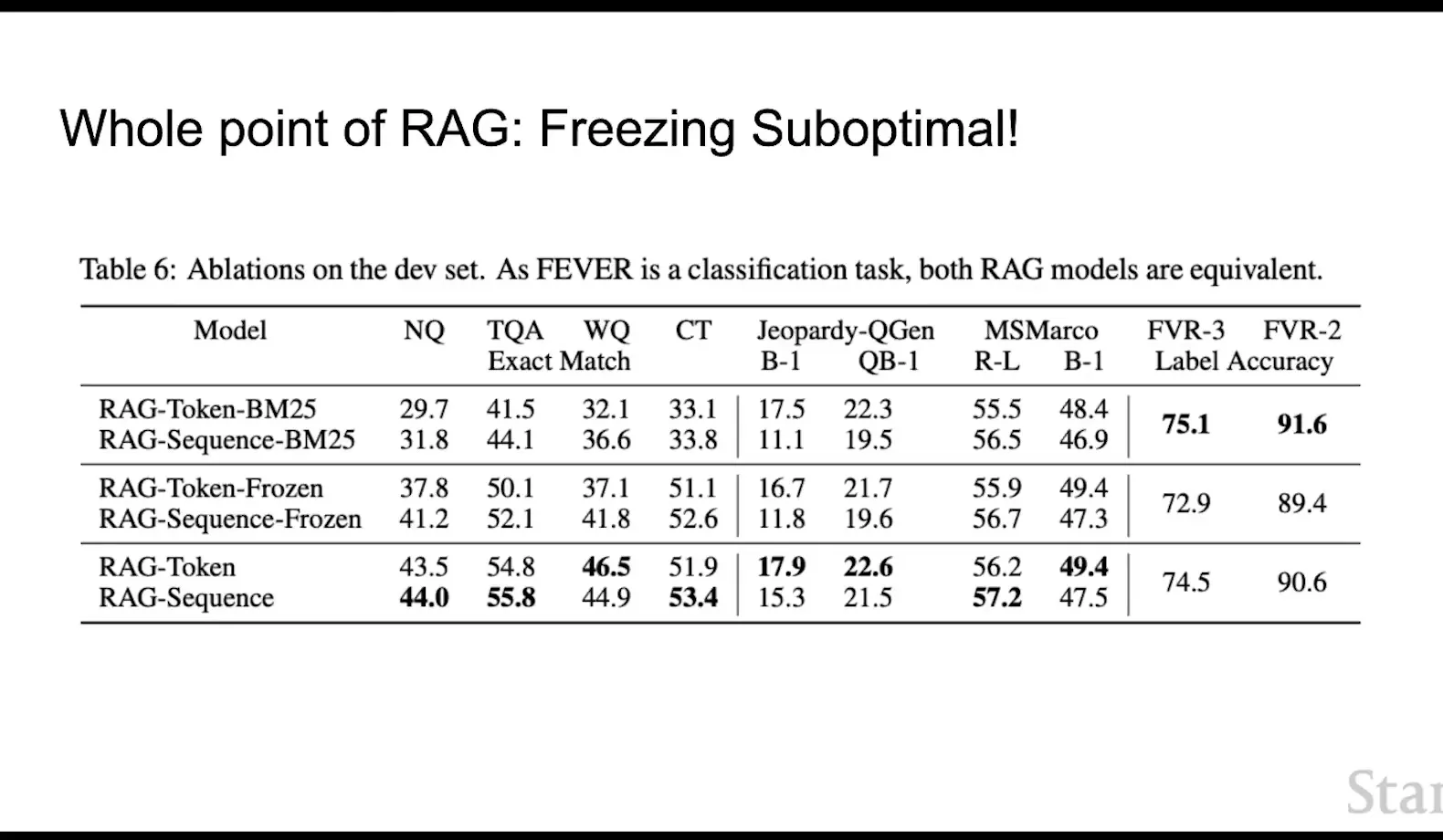
来源:Stanford 课堂视频 00:31:51
读表:先看控制变量,再看绝对分数
比较行时要确认 generator size、retrieval corpus、training data 与 evaluation metric 一致。表格支持“冻结会限制适配”这一方向性结论,却不证明所有 jointly trained RAG 都优于所有 frozen RAG;数据规模与模型强度仍会改变结果。
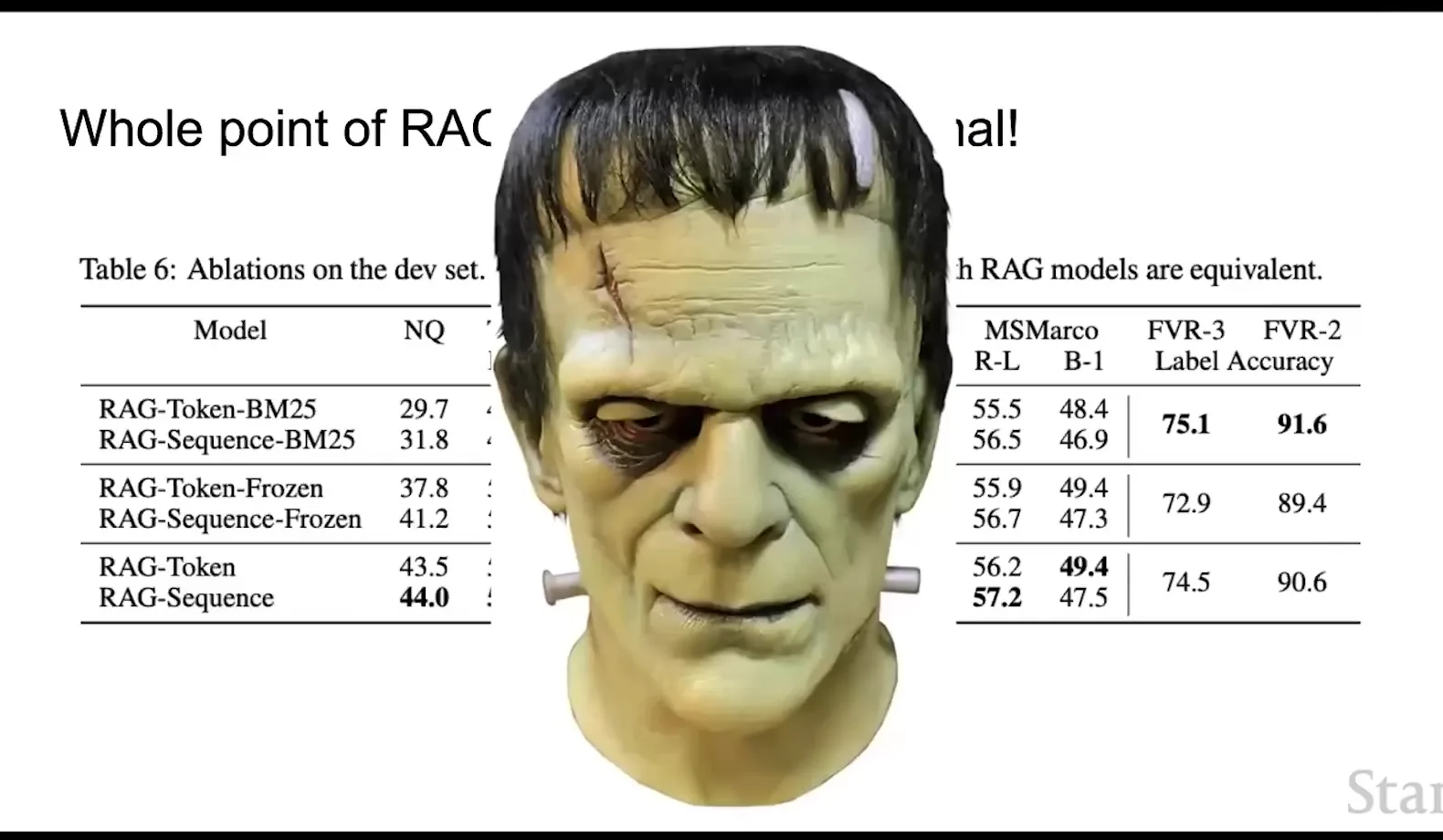
来源:Stanford 课堂视频 00:32:15
Frankenstein 问题的三种错配
- Score mismatch:retriever relevance 不等于 generator utility;
- Representation mismatch:chunk 粒度与 generator attention/fusion 不匹配;
- Objective mismatch:retrieval benchmark、language modeling 与 downstream task 分别优化。
Joint training 的价值是减少错配,不是消除数据错误或推理错误。
课堂提示
讲者在 ablation table 上叠加 Frankenstein 头像,明确说“whole point of RAG: freezing is suboptimal”。这个玩笑揭示真正观点:各组件能运行,不代表它们是一套经过共同优化的系统。
FiD:在 Decoder 中融合多 passage 表示
Fusion-in-Decoder 独立编码每个 retrieved passage 与 question,再让 decoder cross-attend 所有 passage representations。它避免把长文档在 encoder 输入端直接拼接,允许每个 passage 先形成自己的表示。
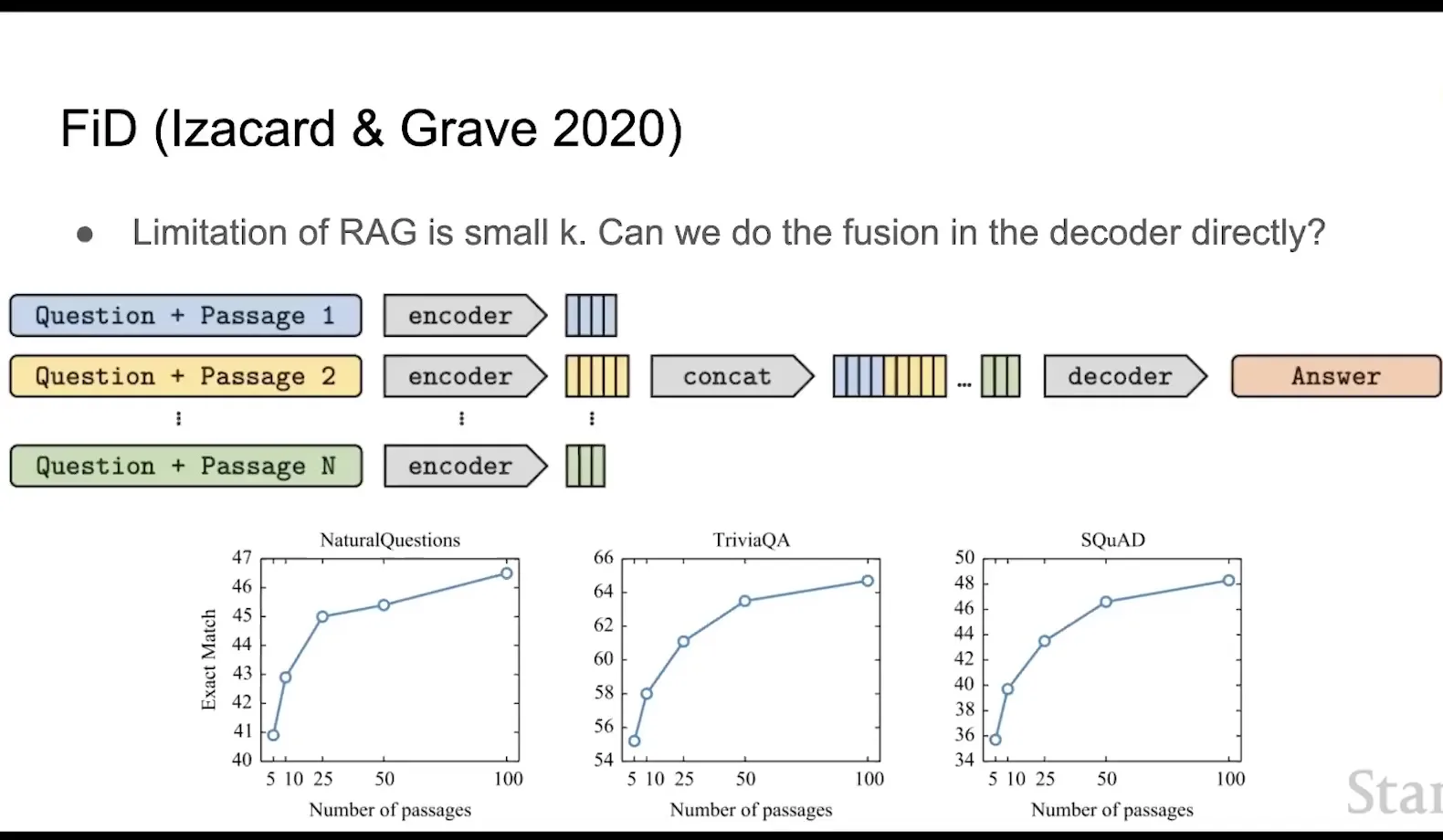
来源:Stanford 课堂视频 00:33:21
读图:Fusion location 决定计算形状
Early fusion 在 encoder 前拼接文本,简单但长度快速增长;FiD 让 encoder 对 passage 并行,decoder 才融合,open-domain QA 表现强。它主要改进 evidence fusion,并不自动训练 retriever。
kNN-LM:推理时在 datastore 中寻找相似 hidden state
kNN-LM 把训练语料 token 的 hidden representation 与 next token 存入 datastore。推理时用当前 context representation 检索近邻,得到 non-parametric token distribution,再与 parametric LM distribution 插值。
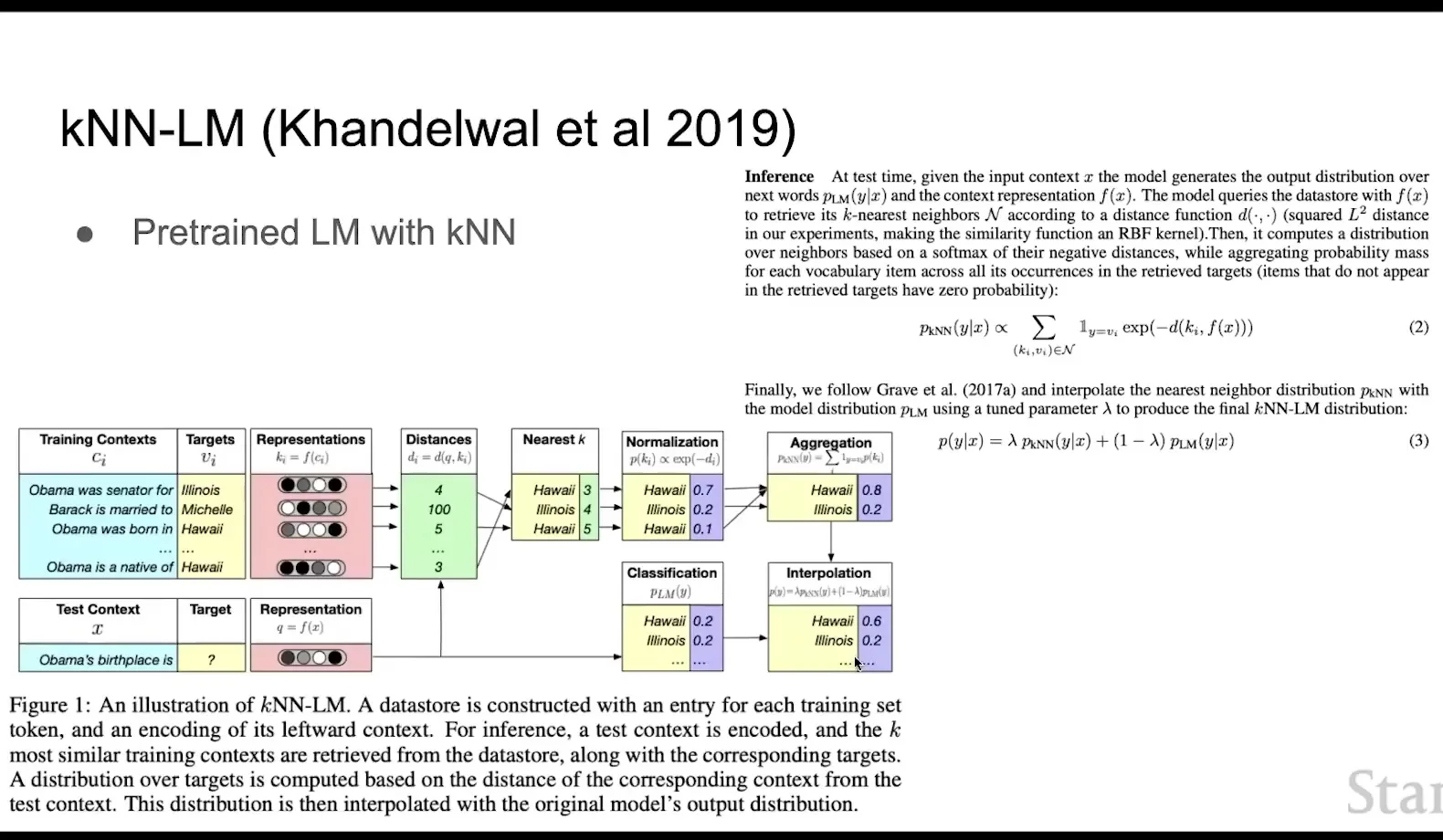
来源:Stanford 课堂视频 00:33:42
Parametric 与 kNN distribution 插值
若 \(p_{LM}(w\mid x)\) 是模型分布,\(p_{kNN}(w\mid x)\) 是近邻投票分布,则
\(\lambda\) 控制外部 memory 影响。Datastore 可以更新或换域,但查询每个 token 会增加 latency 与存储带宽。
RETRO:从预训练开始让模型依赖外部 memory
RETRO 把训练序列切成 chunks,为每个 chunk 检索邻近文本,并通过 chunked cross-attention 注入 decoder。它不只是 inference-time prompt augmentation,而是在 pretraining 中让模型学会利用大规模 external memory。
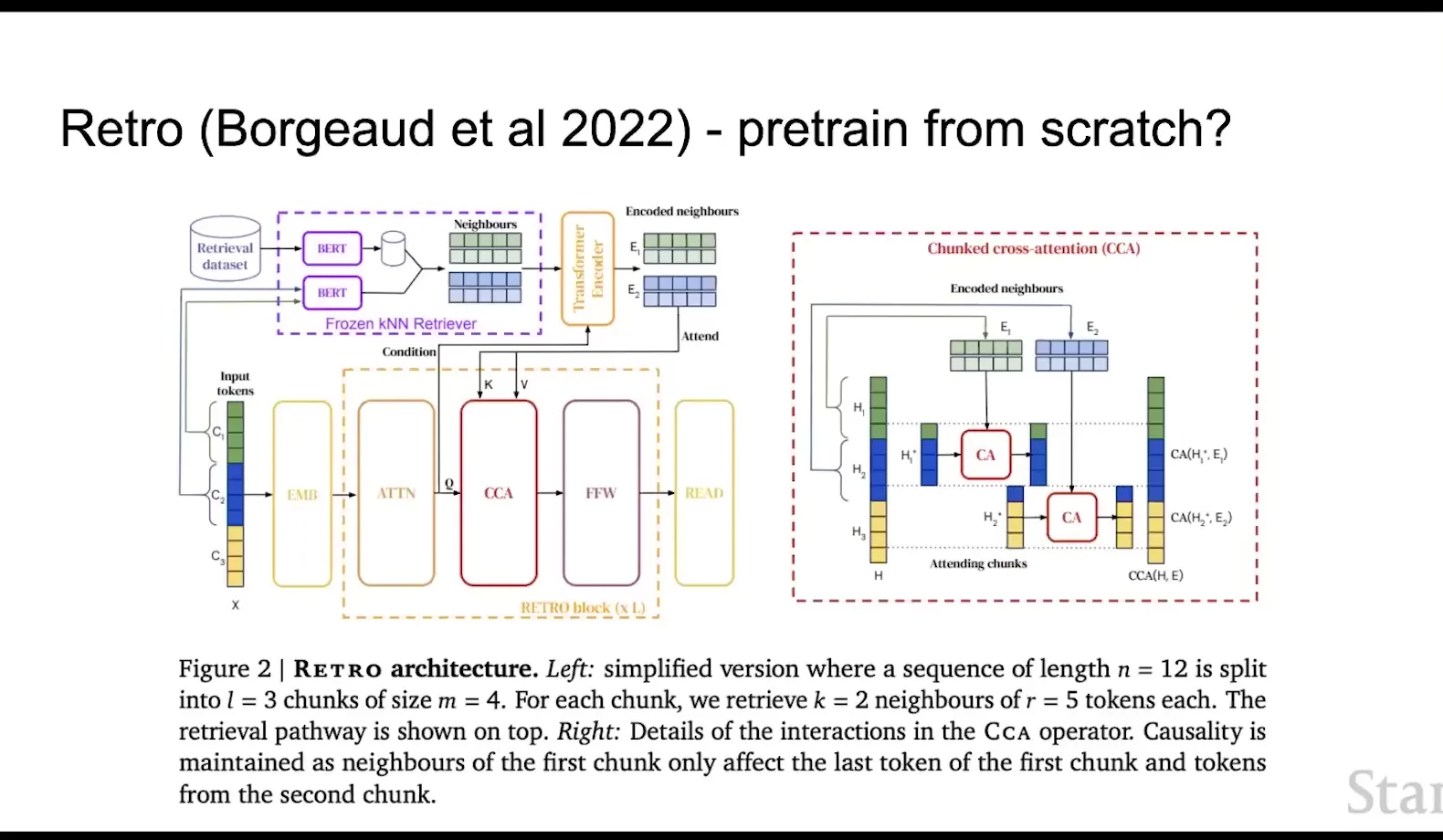
来源:Stanford 课堂视频 00:35:27
读图:Causality 与 chunk boundary
当前 chunk 的生成只能使用允许的历史与 retrieved neighbors,不能泄漏未来 token。Chunk size、neighbor count 和 retrieval latency 共同决定 memory coverage 与训练成本;文档切分因此成为模型架构的一部分。
参数与 datastore 的容量分工
若 parametric model 规模为 \(P\)、external datastore token 数为 \(M\),系统容量不再只由 \(P\) 衡量。RETRO 的观点是用较小 \(P\) 配合大 \(M\) 获得更强 factual recall;但每次访问 \(M\) 产生额外 search 与 cross-attention 成本。
RETRO++ 与混合架构
RETRO++ slide 展示在 RETRO 基础上结合 in-context RAG 风格的混合系统,并用结果表讨论参数规模和任务性能。它说明 architecture space 不是 frozen versus joint 的二元分类,retrieval 可以同时出现在 pretraining 与 inference context。
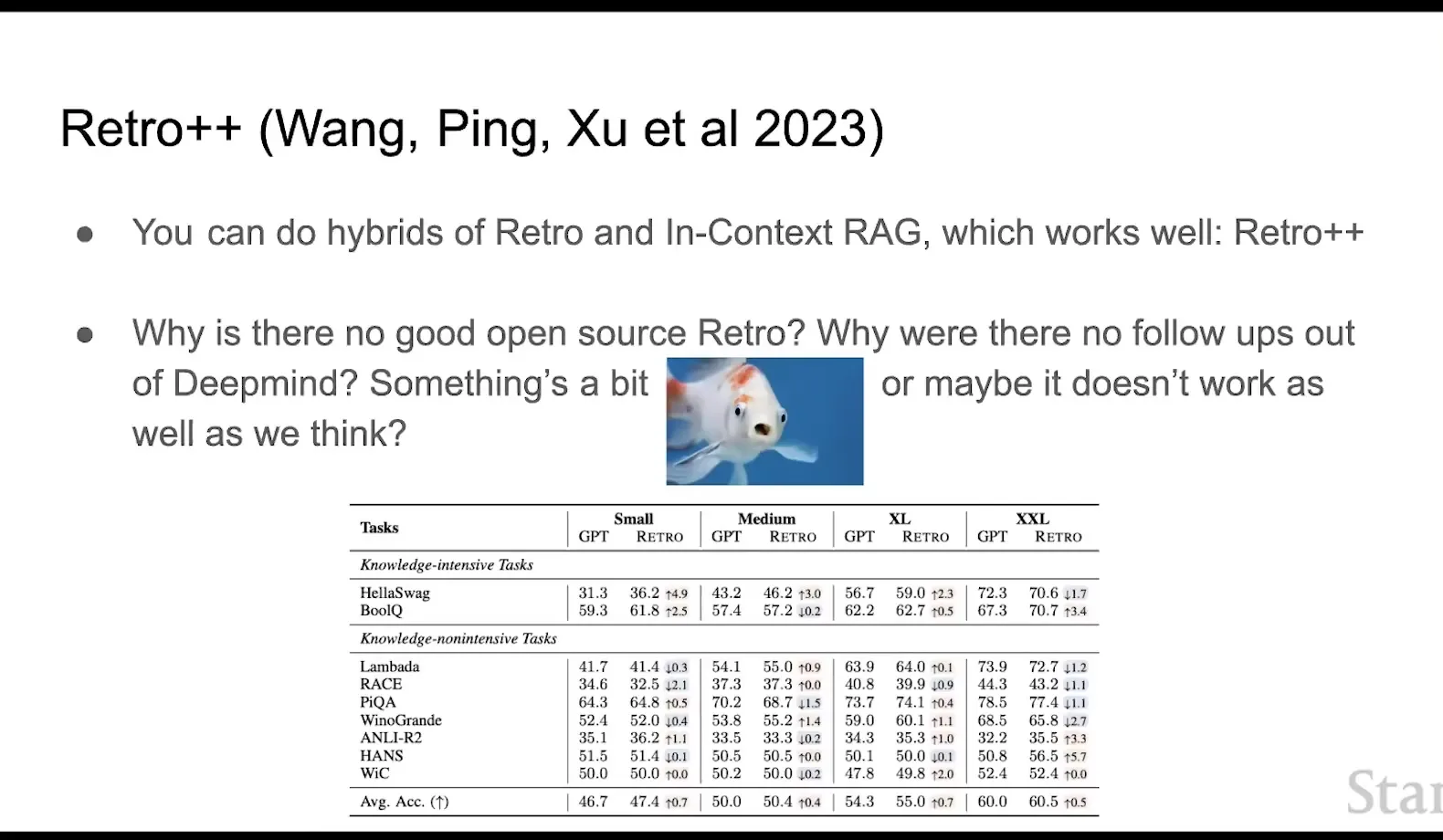
来源:Stanford 课堂视频 00:37:24
读表:Hybrid architecture 需要报告两类 retrieval
应分别说明预训练 datastore、测试时 index、是否同一 corpus、是否更新 retriever、以及 generator 是否见过相同 retrieval format。否则“用了 RETRO++”不足以复现实验或比较成本。
Contextualization All the Way
最后一张 architecture slide 把 retrieval side 与 generator 全部圈入红框,作为进入 REALM/Atlas 的转场。它代表目标:不仅把文档放进 context,还要联合考虑 representation、retrieval objective、fusion 与 language-model training。
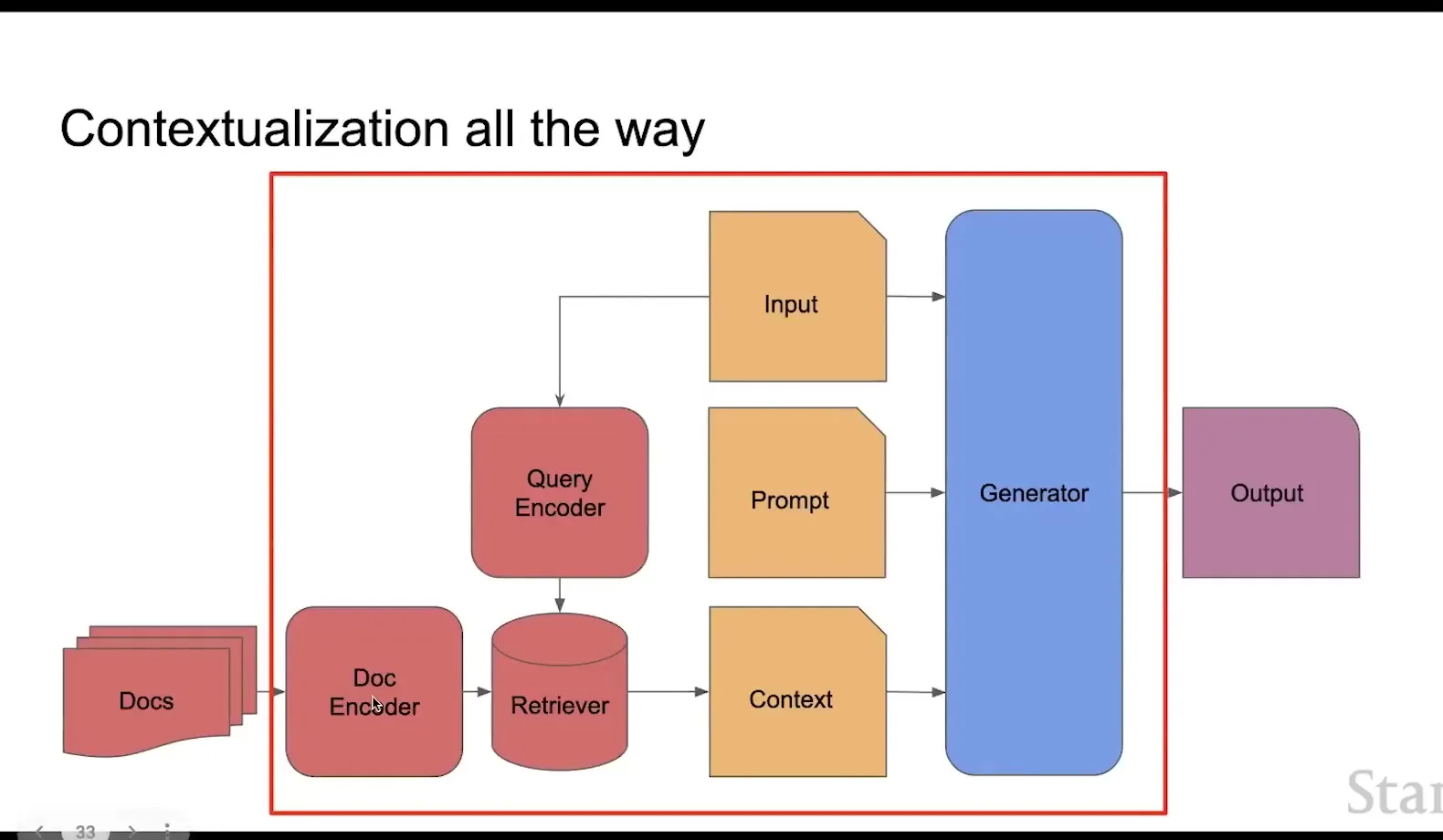
来源:Stanford 课堂视频 00:38:00
架构比较的四问
看到任何 RAG 模型,先问:
- retrieval 发生在 pretraining、fine-tuning 还是 inference?
- retriever/document encoder/generator 哪些参数更新?
- evidence 在 prompt、encoder、decoder 还是 token distribution 中融合?
- index 何时重建,训练与部署 corpus 是否一致?
这四问比只记模型名称更能迁移到新系统。
课堂提示
课堂从 RAG、FiD、kNN-LM 到 RETRO 的顺序,是在逐步展示 retrieval 能进入不同层级:输入 context、decoder attention、token distribution 或 pretraining architecture。
本章小结
Joint RAG 把 documents 视为 latent variables,让最终任务信号影响 retrieval 与 generation。FiD 改变 fusion location,kNN-LM 在 token distribution 层融合 memory,RETRO 从预训练开始使用 external datastore。系统设计需要同时描述 retrieval timing、fusion point、updated parameters 与 index lifecycle。
REALM 与 Atlas:端到端愿景中的工程近似
Fully joint training 面临一个物理约束:document encoder 一变,整个 corpus embedding 都可能需要重算。REALM 和 Atlas 的重要性不仅在模型结果,也在它们如何用异步更新、近似目标和多种 retriever losses 让大规模系统可训练。
REALM:异步刷新外部知识表示
REALM slide 展示 masked language model、knowledge retriever 与 knowledge-augmented encoder。它在 pretraining 中根据 masked token likelihood 学 retrieval,同时通过异步 index refresh 处理 document embeddings 随参数变化的问题。
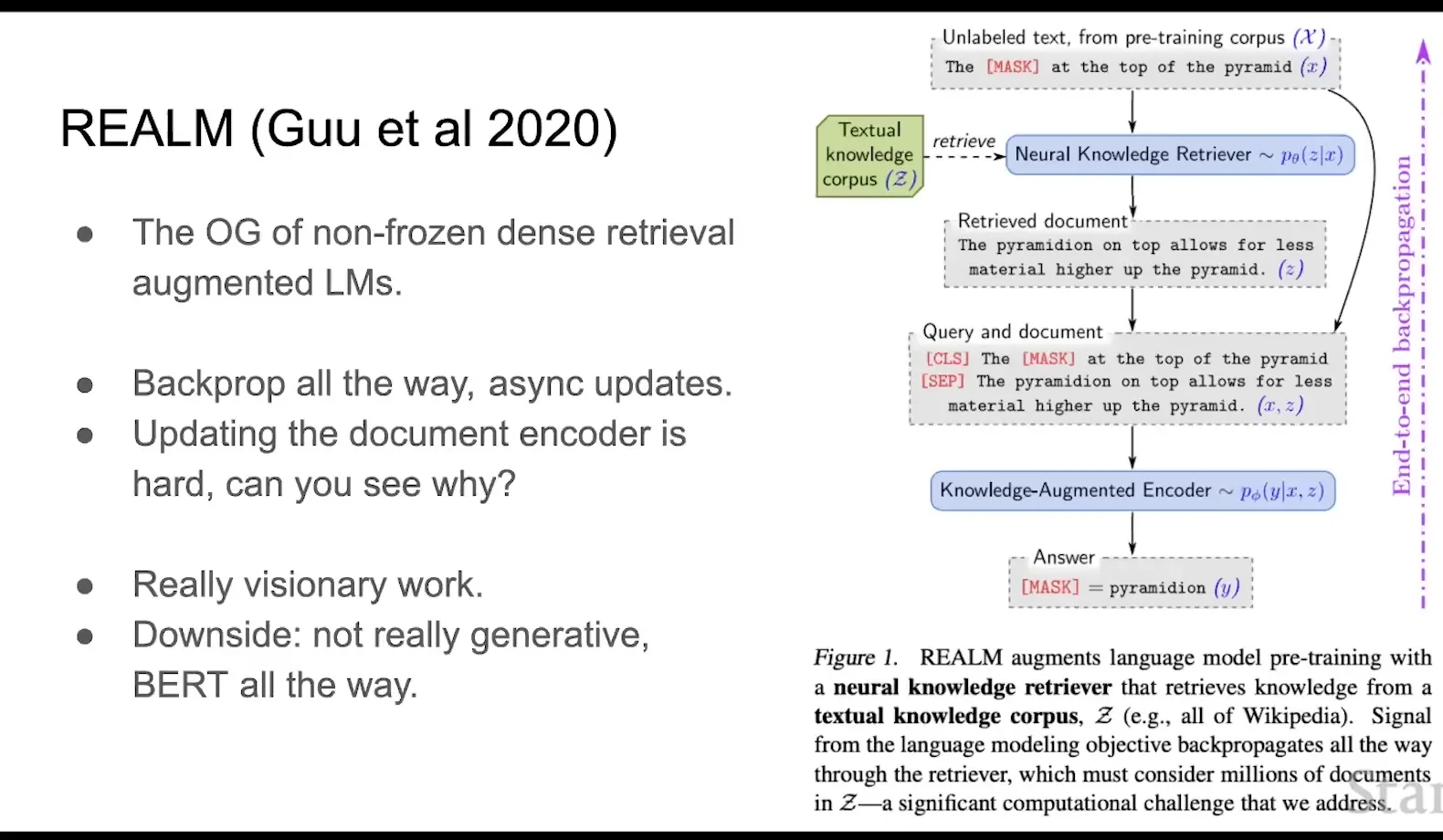
来源:Stanford 课堂视频 00:40:30
REALM 的 latent retrieval objective
对 masked target \(y\) 与 input \(x\),可写成
Retriever 没有直接 passage label,也能从 masked-token likelihood 获得信号;top-\(k\) 与 stale index 使训练成为近似。
for step, batch in enumerate(training_data):
    docs = index.search(query_encoder(batch))
    loss = retrieval_augmented_loss(batch, docs)
    update(query_encoder, generator, loss)
    if step % refresh_interval == 0:
        new_vectors = document_encoder.encode(corpus_snapshot)
        index.swap_in(new_vectors)
Stale index 是优化误差来源
训练时 query encoder 已更新,而 index 仍由旧 document encoder 产生,retrieval distribution 会滞后。Refresh 太频繁代价巨大,太慢则 signal mismatch;异步重建是在 freshness 与 throughput 之间取舍。
课堂提示
Kiela 说 REALM “really visionary”,同时指出其 downside:系统复杂、仍是 BERT-style encoder,而且 index 更新必须异步。赞美与限制需要一起保留。
Atlas:Retriever 可以用哪些目标学习
Atlas Deep Dive 第一页列出 retriever updates:FiD-style attention distillation、EMDR\(^2\)、likelihood distillation 与 leave-one-out。它们都尝试回答“哪份 passage 对 generator 有贡献”,但使用不同 proxy。
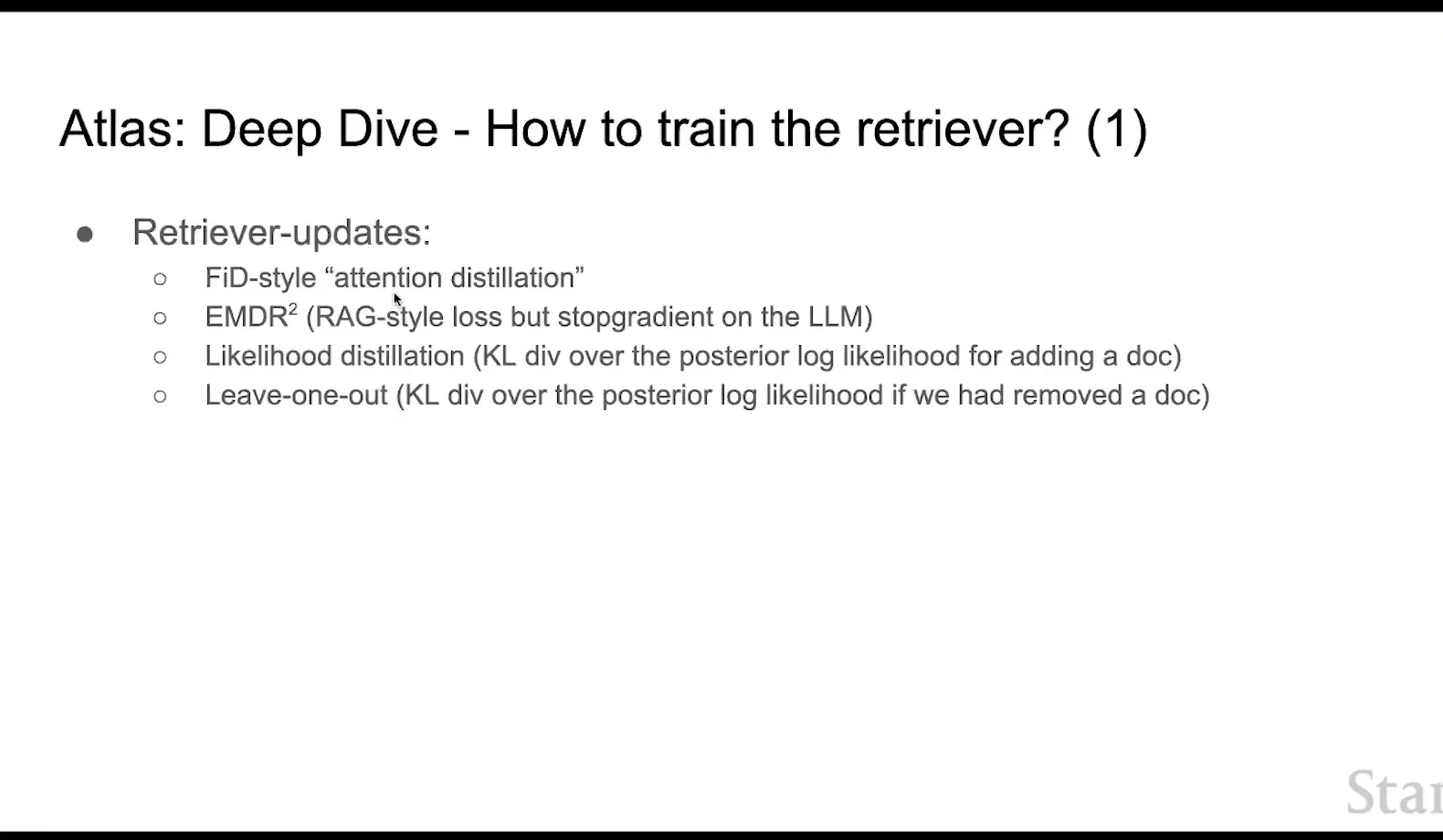
来源:Stanford 课堂视频 00:41:15
术语消化:Atlas loss functions
| 目标 | 核心信号 |
|---|---|
| Attention distillation | 用 FiD decoder 对 passage 的 attention 作为 teacher score |
| EMDR\(^2\) | 对 latent documents marginalize,使 answer likelihood 训练 retriever |
| Likelihood distillation | 比较每份 document 对目标 sequence likelihood 的贡献 |
| Leave-one-out | 移除某 document 后 loss 变差多少,估计边际贡献 |
Retriever Update Derivations
第二页放大 Atlas 论文中的公式和示意图,强调 retriever score 与 generator likelihood 的结合。Dense retriever 的 top-\(k\) selection 不可直接对离散检索求导,因此方法通常在候选集合上定义可微分 surrogate。
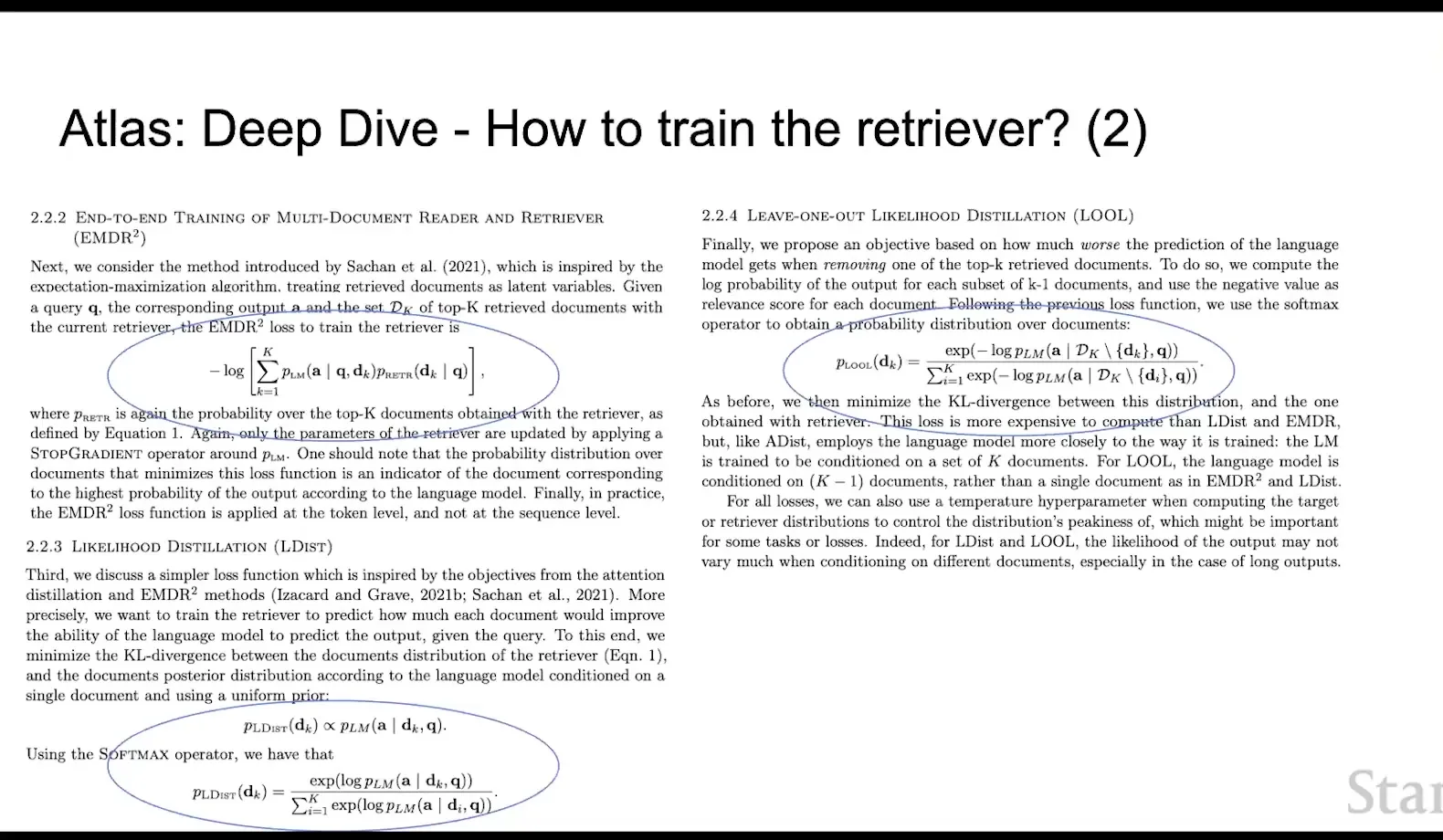
来源:Stanford 课堂视频 00:42:09
Surrogate objective 的边界
对已检索候选 \(\mathcal{Z}_k\),常见形式是
梯度能重排 \(\mathcal{Z}_k\) 内文档,却不能直接学习从未被召回的文档;初始 retriever recall 仍决定上限。
Loss Function Comparison
Atlas Loss Functions table 比较 closed-book、no joint pre-training、FiD distillation、EMDR\(^2\)、perplexity distillation、LOO 等方法在 64-shot、1024-shot 与多个任务上的表现。不同 loss 没有在所有列统一获胜,说明 retriever supervision 与数据规模相互作用。
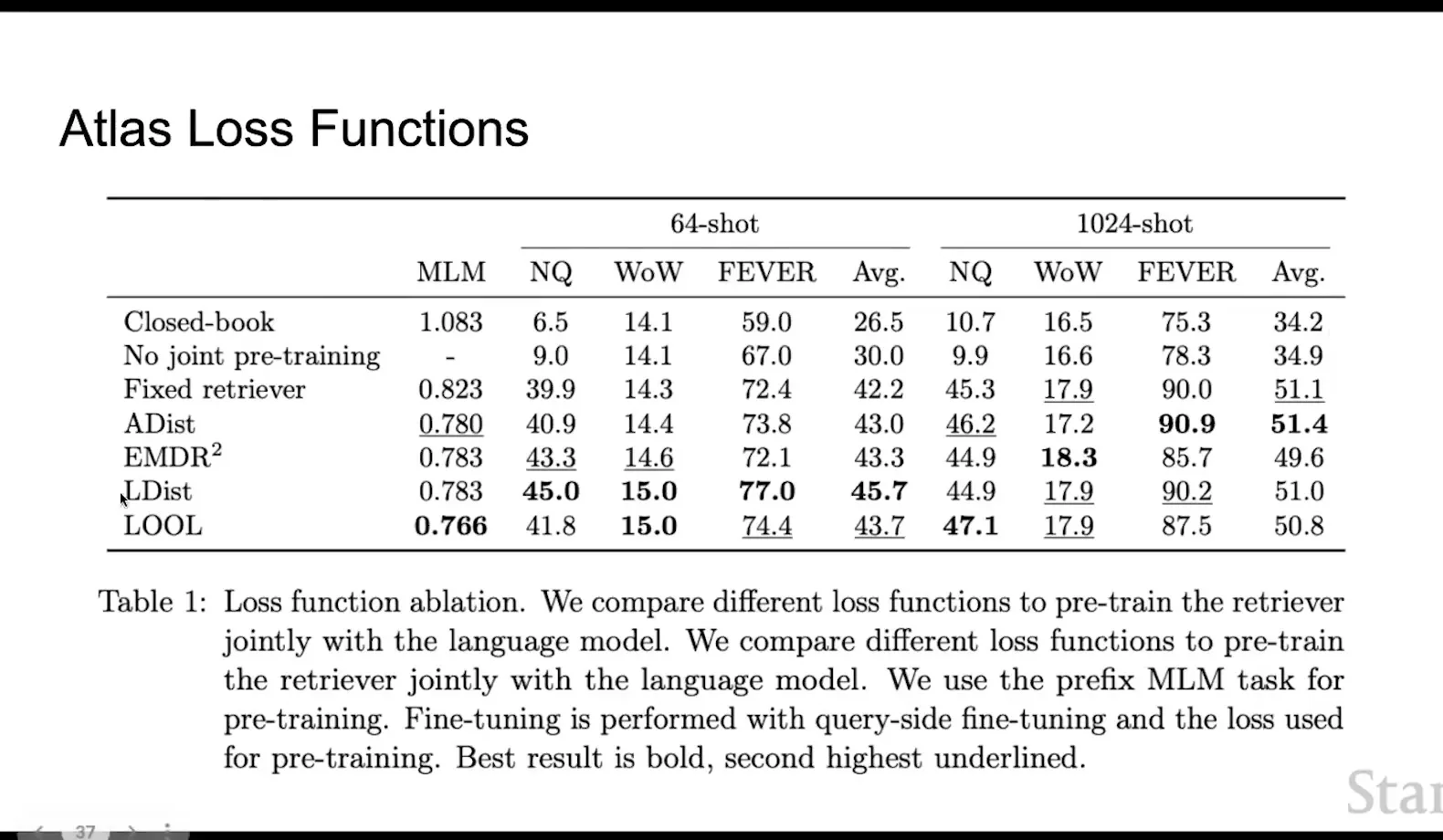
来源:Stanford 课堂视频 00:42:36
读表:不要用单列平均值替代机制分析
先看 closed-book 与 retrieval 的整体差距,再比较 no-joint-pretraining 和各 retriever loss;同时观察 64-shot 与 1024-shot 是否改变排名。表格更适合支持“retrieval 与 joint training 有价值”,而不是宣布一个 loss 永久最优。
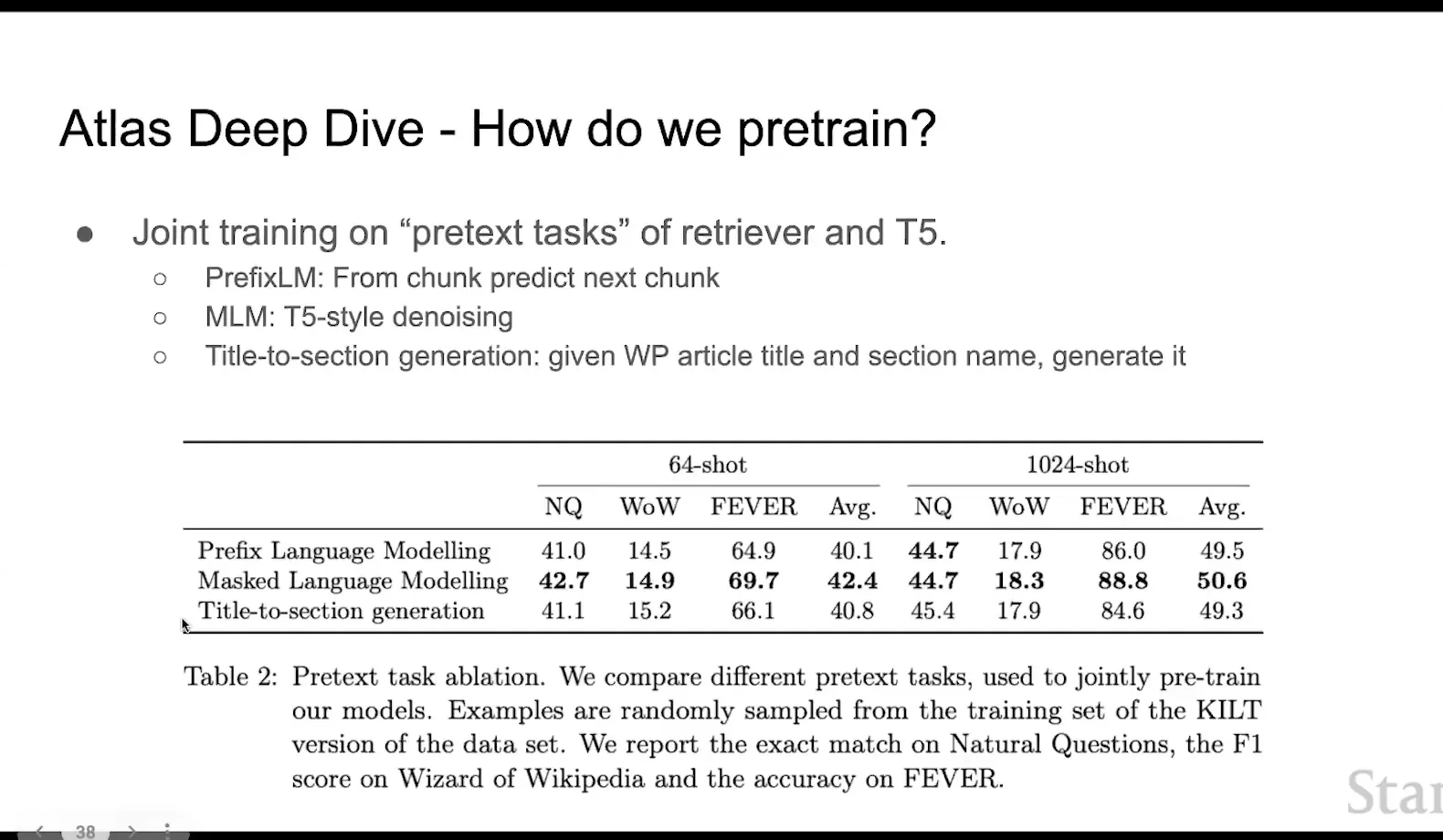
Atlas Pretraining:语言任务与检索共同训练
Atlas pretraining slide 列出 prefix LM、masked LM、title-to-section generation 等 pretext tasks,并比较 joint 与 fixed retriever。它说明 retrieval-augmented pretraining 需要选择既训练语言能力、又迫使模型利用外部文档的任务。
来源:Stanford 课堂视频 00:43:33
读图:Pretext task 要避免模型走捷径
若 target 可从 local context 直接预测,模型可能忽略 retrieved passages。Title-to-section、masked spans 或 knowledge-intensive objectives 让外部 evidence 更有用;但数据构造也可能引入 answer leakage。
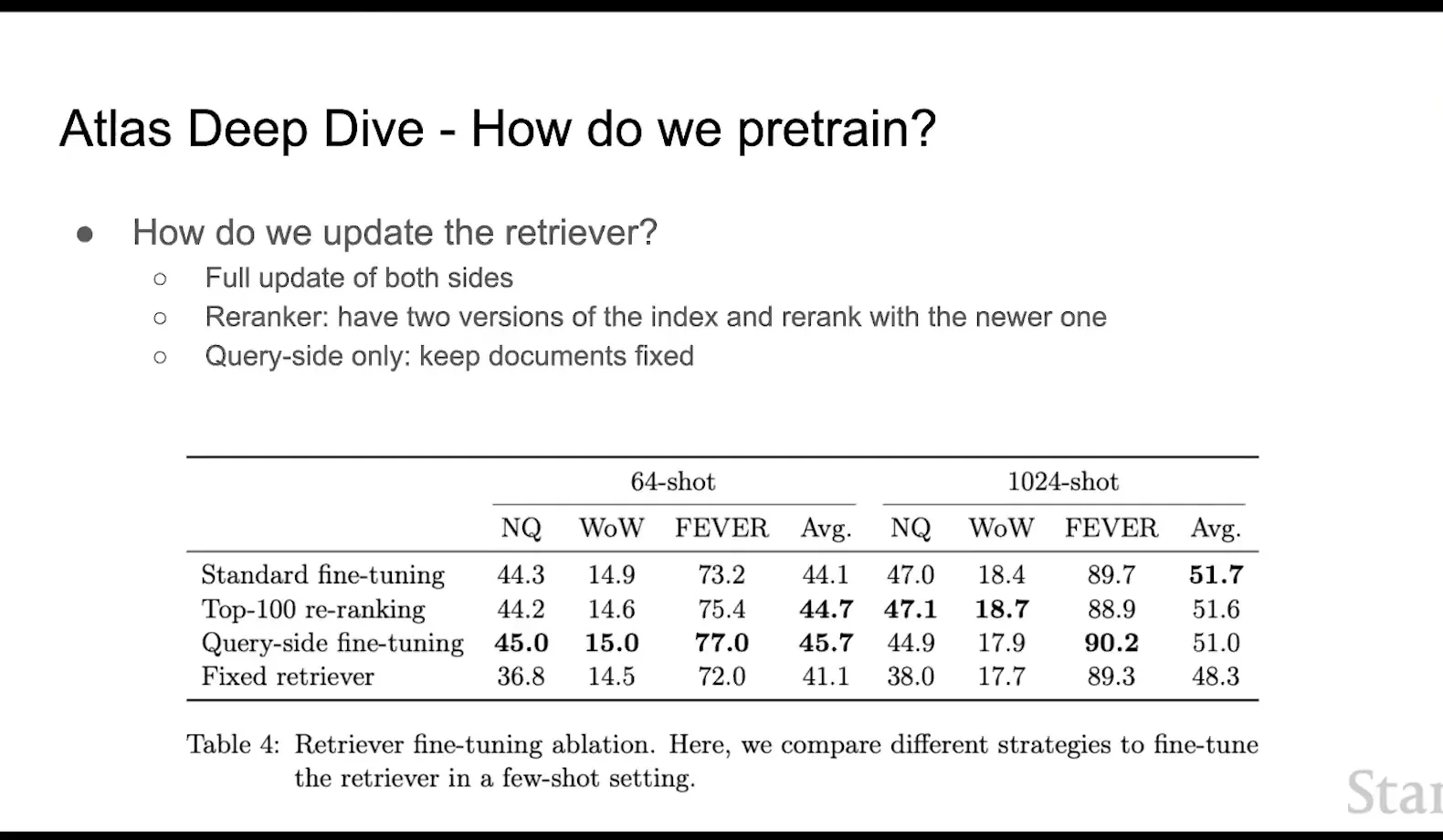
更新 Query Side 还是 Full Retriever
Update-results slide 比较 standard fine-tuning、top-100 reranking、query-side fine-tuning 与 fixed retriever,在 64-shot/1024-shot 下的结果。课堂 Q&A 进一步指出:对 Natural Questions、FEVER 等 narrow knowledge-intensive tasks,强 DPR index 加 query-side update 可能足够;更广 general language modeling 可能需要 document-side adaptation。
来源:Stanford 课堂视频 00:44:42
读表:Query-only 的适用条件
当 corpus representation 已与任务相近,query encoder 主要学习如何进入现有 index;若 domain、chunk semantics 或 language distribution 改变,固定 document embeddings 可能成为瓶颈。部署时应先测 recall failure 属于 query 还是 corpus representation。
课堂提示
Q&A 中讲者没有给出“永远更新哪一边”的答案:知识密集小数据任务可只动 query side,扩展到 general LM 或新 domain 时 document encoder 更可能需要改变。
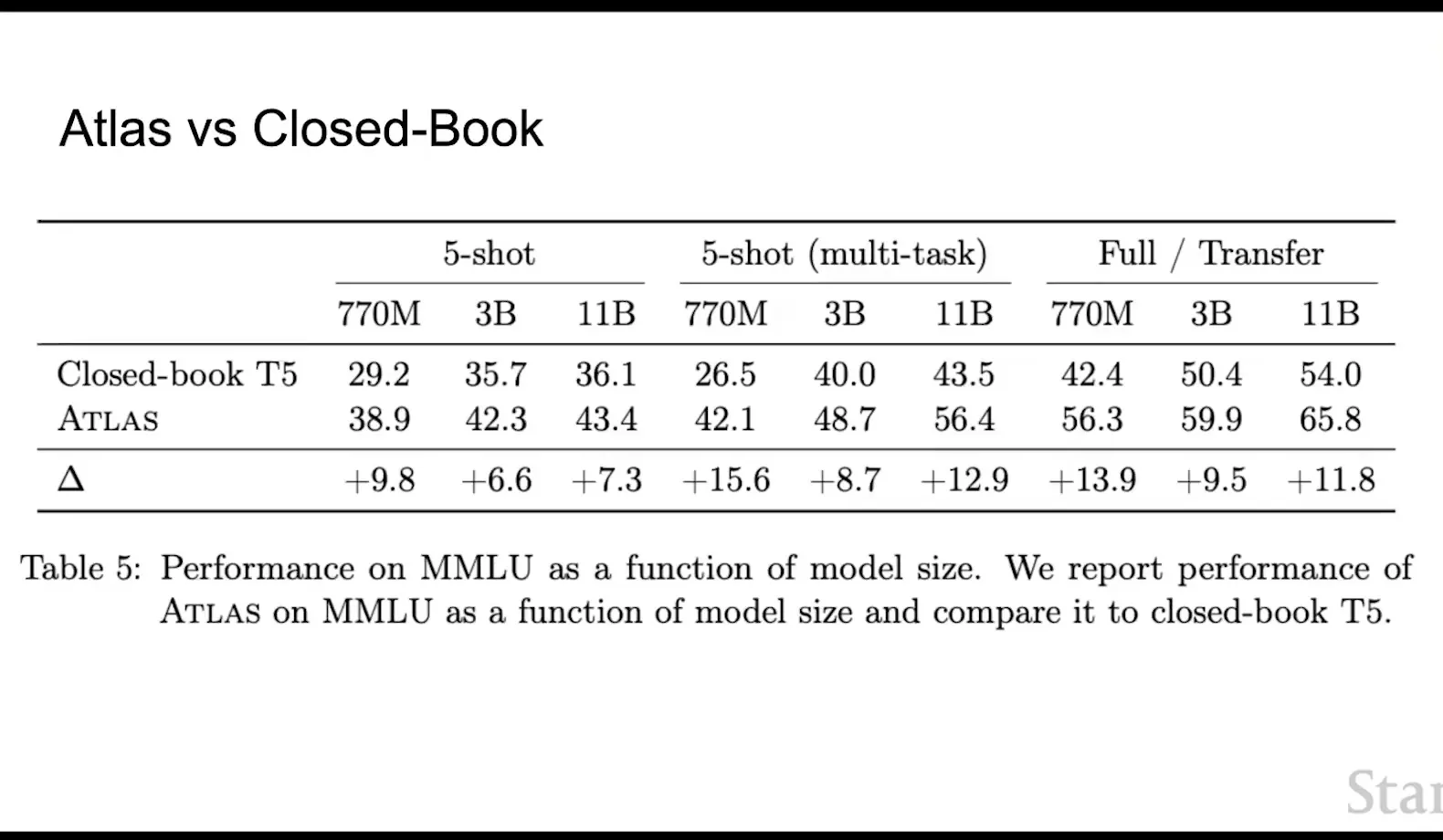
Atlas versus Closed-Book
最后的 scaling table 比较 Atlas 与 closed-book 模型在 5-shot、multi-task 与 full transfer 下的表现。Retrieval 让较小参数模型访问更大 external memory,因此参数量不再是唯一知识容量指标。
来源:Stanford 课堂视频 00:45:06
Model size 与 system capacity 分开报告
RAG 系统至少应报告 generator parameters \(P_G\)、retriever parameters \(P_R\)、index size \(M\)、retrieval calls \(C_R\) 和 input tokens \(T_C\)。只说“770M model”会隐藏外部 datastore 与 online compute。
本章小结
REALM 与 Atlas 表明 joint RAG 需要工程近似:异步 index refresh、候选集合 surrogate、query-only updates 与多种 distillation objectives。端到端不是一句口号,而是明确哪些 signal 穿过哪些组件,以及计算上为什么必须截断。
Open Questions:何时检索、怎样扩展、证据是否被使用
课堂在 Atlas 后进入开放问题,并穿插学生 Q&A。这里的重点从“哪个架构更强”转向动态 policy、scaling、legal-risk motivation、context position、tool use 与 instruction tuning。很多问题直到今天仍不能用单一 benchmark 回答。
RAG 与 Long Context 不是完全相反
学生问超长 context 是否会取代 RAG。讲者回答,把整本 Harry Potter 放进 context 只为寻找猫头鹰名字非常低效;而长上下文方法为了扩展 attention 往往引入 sparsity,本质上也在选择少量相关连接。
Long context 与 retrieval 的共同问题
两者都要决定“哪些 token 值得计算”。Long context 把选择放在 attention pattern 或 cache 管理中,RAG 把选择放在 external index;最终都面对 relevance、latency、position bias 与 evidence verification。
课堂提示
课堂判断是:如果长上下文真正扩到巨大规模,它会越来越像 sparse/non-parametric retrieval,而不是无代价地对所有 token 做 full attention。
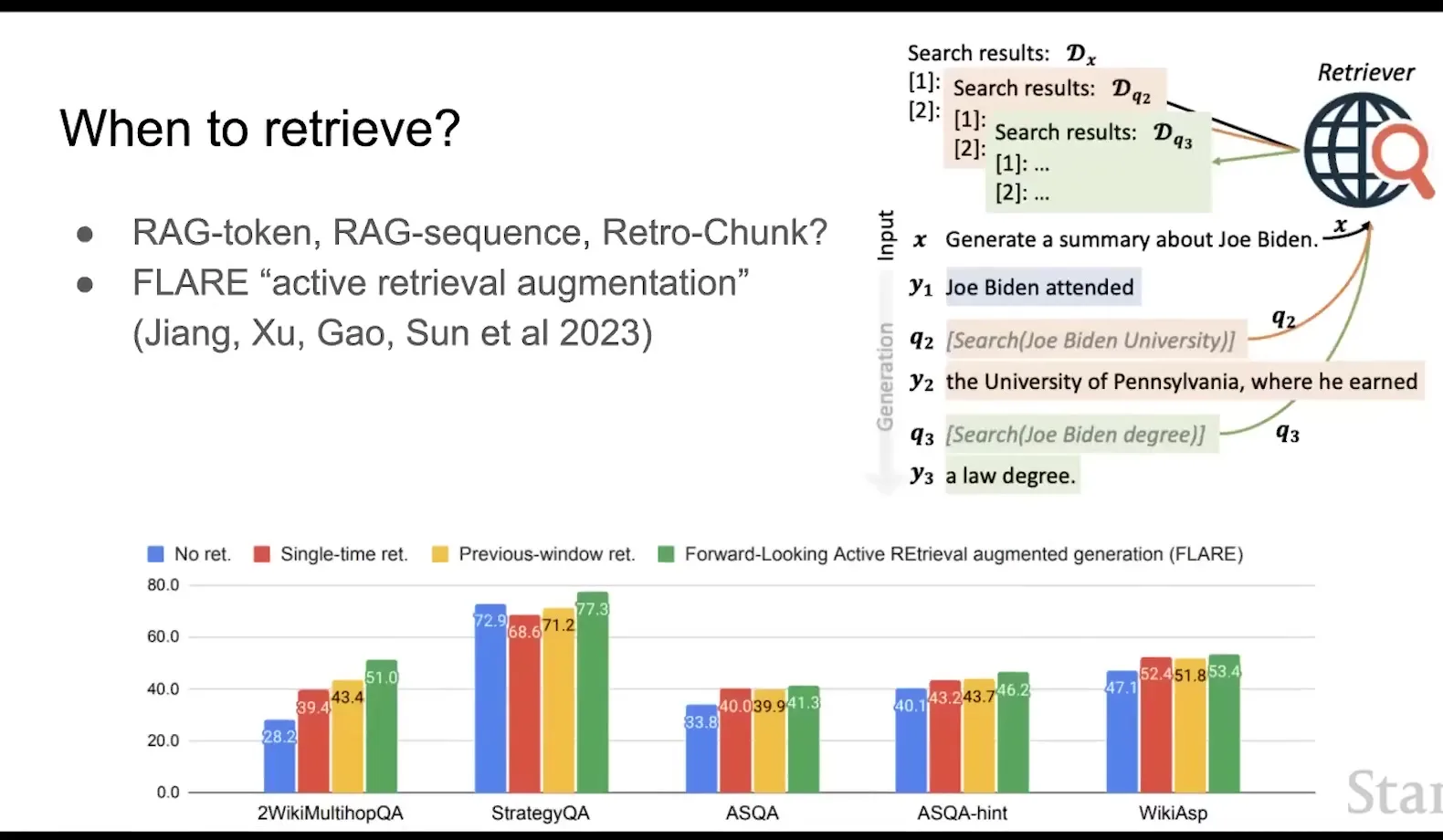
When to Retrieve:把检索变成策略
每个 token 都检索会浪费 compute,只在开头检索一次又可能错过后续知识需求。FLARE 让模型根据生成置信度或未来内容主动决定何时搜索、搜索什么,使 retrieval 从固定 pipeline 变成 sequential policy。
来源:Stanford 课堂视频 00:56:36
Retrieval policy 的成本目标
令动作 \(a_t\in\{\text{retrieve},\text{continue}\}\),检索成本为 \(c_R\),错误成本为 \(c_E\),可优化
Policy 要学习在信息价值高于检索成本时调用工具,而不是把更多 retrieval calls 当作天然更好。
How to Train at Scale
Scale slide 讨论 full async update、query-only update、TRIME/近似方法,以及用 BM25 构造相似 batch 后做 in-batch training。Index 越大,document-side full refresh 越贵,因此 hard-negative sampling、memory bank 与 reranker 成为重要近似。
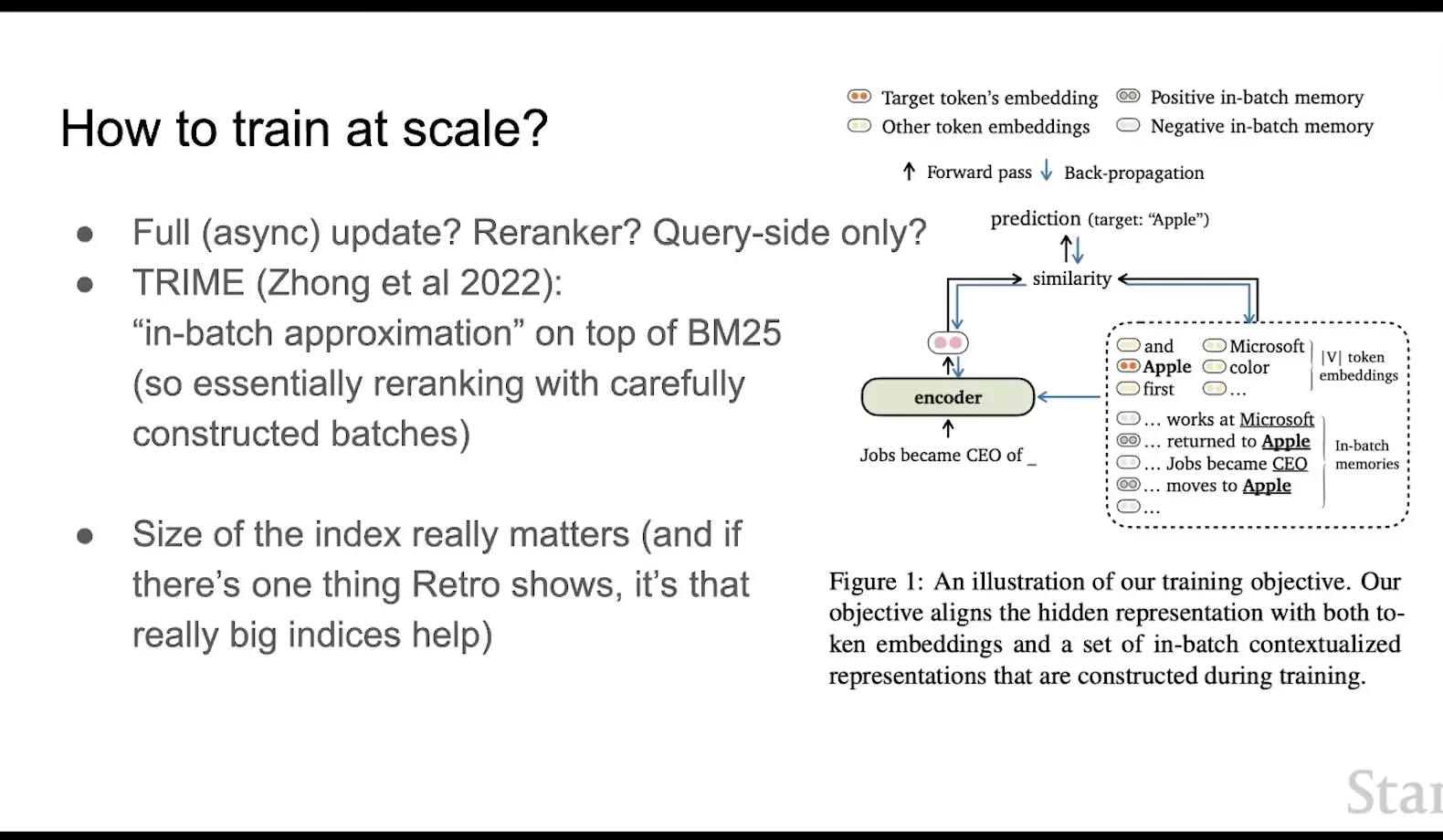
来源:Stanford 课堂视频 00:57:39
读图:In-batch negatives 节省什么
一个 batch 中其他 documents 可作为 negatives,避免每个 query 单独搜索大量负例;memory bank 扩大负例集合。风险是 false negatives:语义相关文档被当成负例,会扭曲 representation。
SILO:把 legal-risk motivation 放进架构
SILO 提出在较安全、许可更清晰的数据上训练 parametric model,再在测试时从 non-parametric datastore 访问更广内容。课堂把它视为应对 copyright provenance 与 legal risk 的优雅方向,但并未声称 index 中的内容因此免于法律责任。
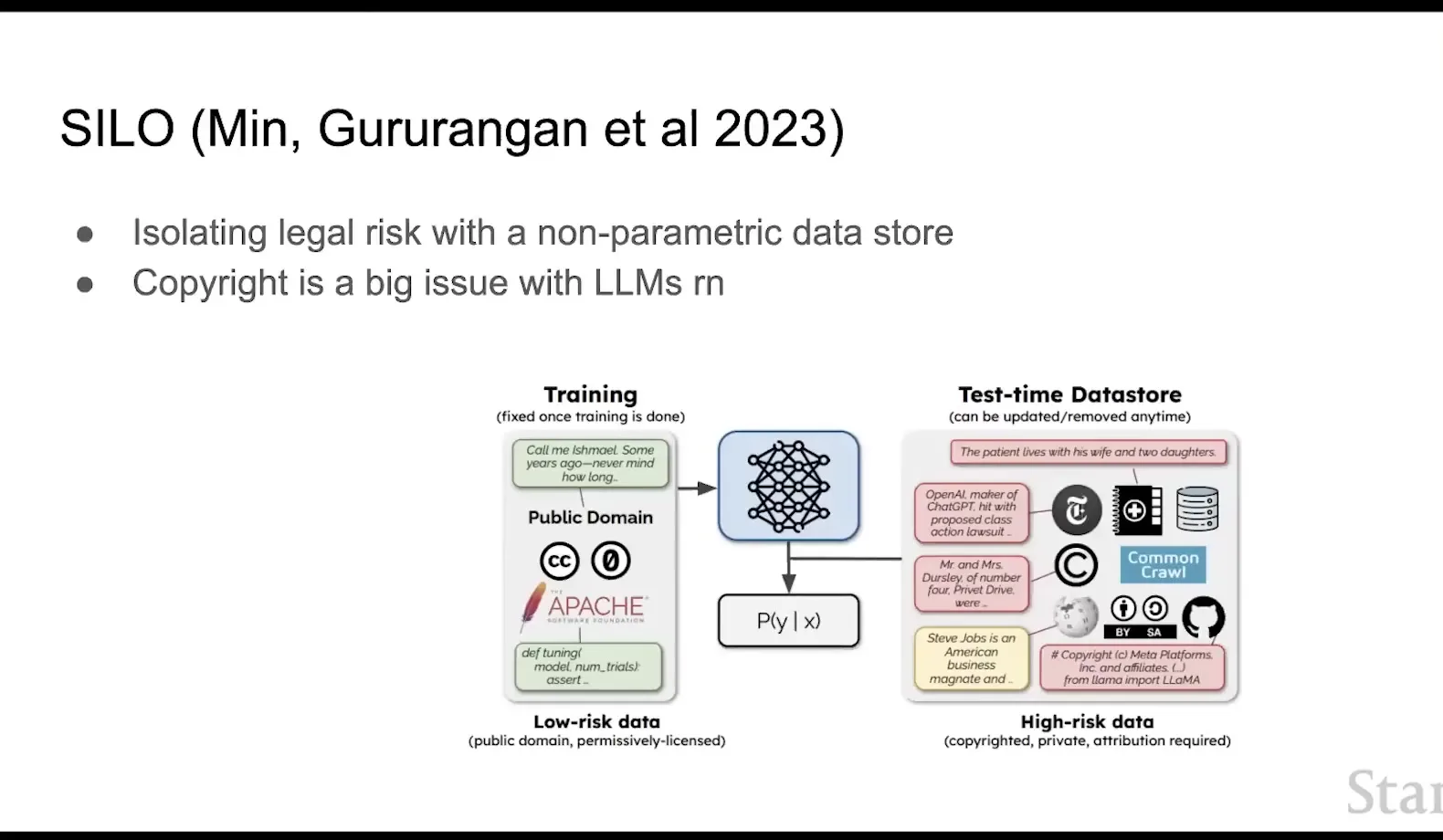
来源:Stanford 课堂视频 00:58:45
Architecture 不会自动解决法律问题
Datastore 仍需考虑授权、访问、日志、删除、输出引用和用户数据;retrieved content 也可能被模型改写。SILO 的研究价值是把训练数据与 test-time knowledge 分离,便于替换和审计,不是法律结论。
课堂提示
讲者把 SILO 与当时针对模型训练数据来源的诉讼联系起来,强调 parametric model 可以在 public-domain 数据上训练,再从更高风险 index 检索。讲义保留其 motivation,并明确不把它升级为合规保证。
Lost in the Middle:检索正确也可能使用失败
Lost-in-the-Middle slide 的曲线显示 relevant document 位于 context 开头或结尾时更易被使用,放在中间性能下降。若 generator 完全遵守 retriever ranking,位置变化不应如此显著;这证明 evidence placement 与 attention behavior 是独立 failure mode。
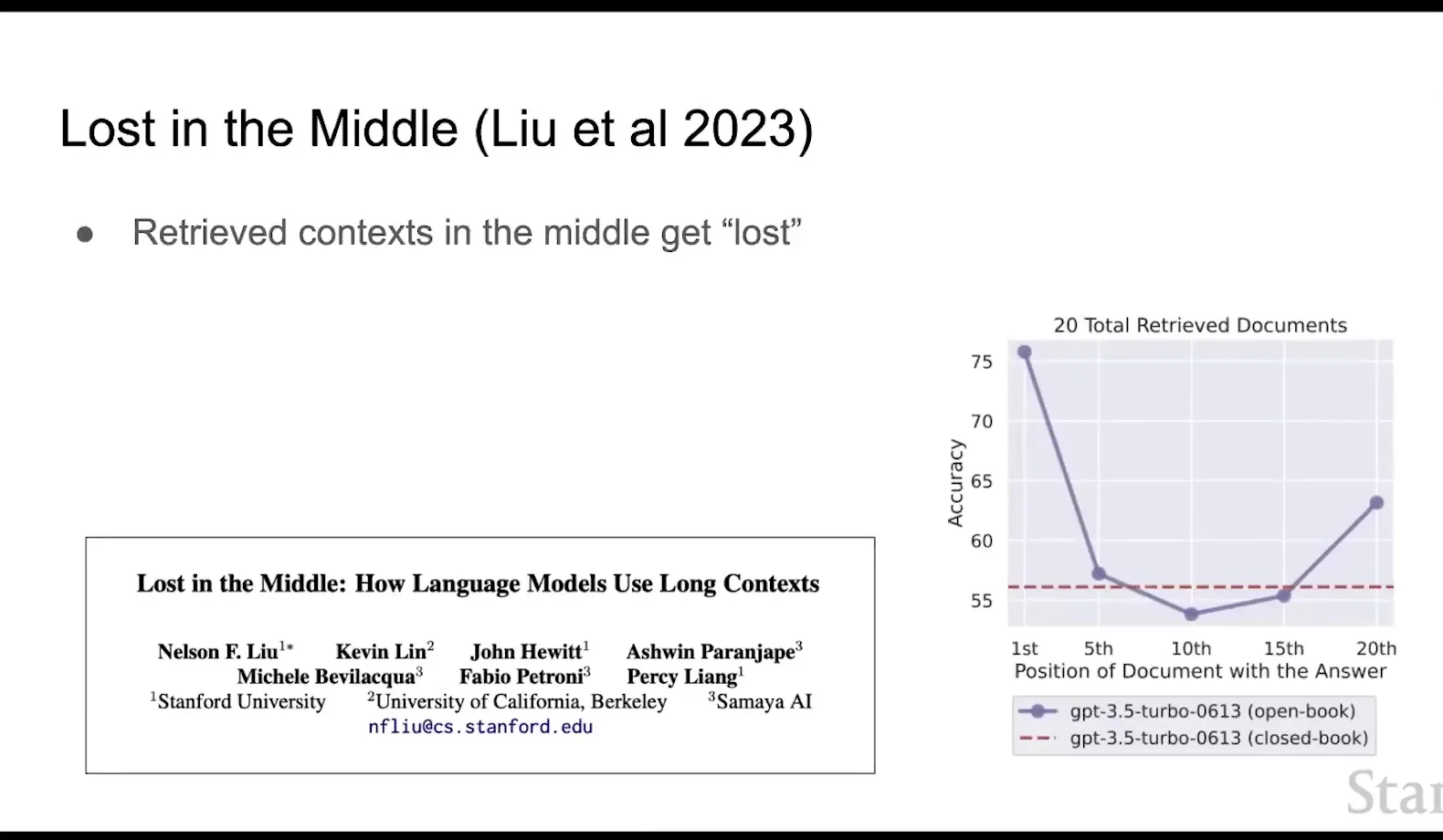
来源:Stanford 课堂视频 01:00:45
读图:U-shaped curve 说明什么
横轴是 relevant document 在 20 个 retrieved documents 中的位置,纵轴是任务表现。开头/结尾高、中间低,说明模型具有 position bias。它不证明中间文档永远无效,而是要求 reranking、context packing 与 evaluation 同时考虑位置。
Retrieval recall 与 answer grounding 要分层测
可记录:关键 evidence 是否进入 top-\(k\)、是否进入最终 prompt、位于什么位置、答案是否引用它、输出是否与 evidence 一致。只看 final exact match 无法定位是 search、packing 还是 generation 失败。
Toolformer:Retrieval 是更一般的 Tool Use
Toolformer slide 把 search API 放在 calculator、calendar、translation 等工具集合中。Language model 可以学习何时插入 API call、读取返回值并继续生成;retrieval 因而是 tool augmentation 的一个实例。
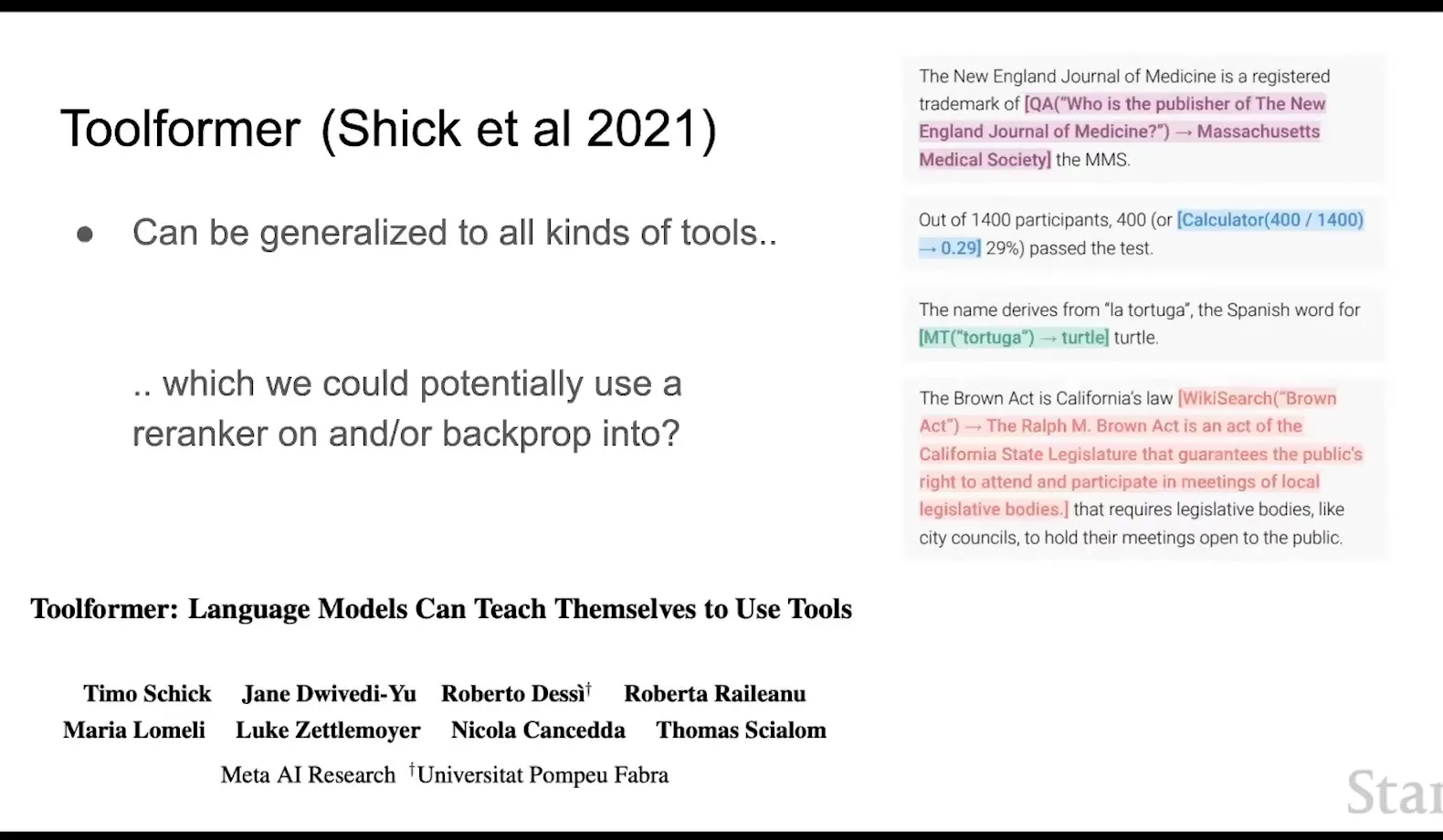
来源:Stanford 课堂视频 01:01:57
读图:从 RAG 到 Agent 的接口变化
固定 RAG 每个请求都调用检索;tool-using LM 可以选择 search、calculator 或其他 API。系统新增 action selection、argument generation、tool error handling 与 permission boundary,问题从静态 architecture 扩展为 sequential decision making。
课堂提示
讲者说,active web search 不一定访问自有 index;更一般地,LM 是 tool user,retrieval 只是众多工具之一,而真正学习动作选择可能需要 RL。
Self-RAG:Retrieve、Generate、Critique
Self-RAG 让单一 LM 生成 reflection tokens,决定是否检索、评估 evidence relevance、生成答案并 critique support/utility。它试图把 active retrieval 与自我评价纳入同一训练框架。本节承接 Toolformer 的动作选择,并进一步追问同一个模型如何判断证据质量与答案支持度。
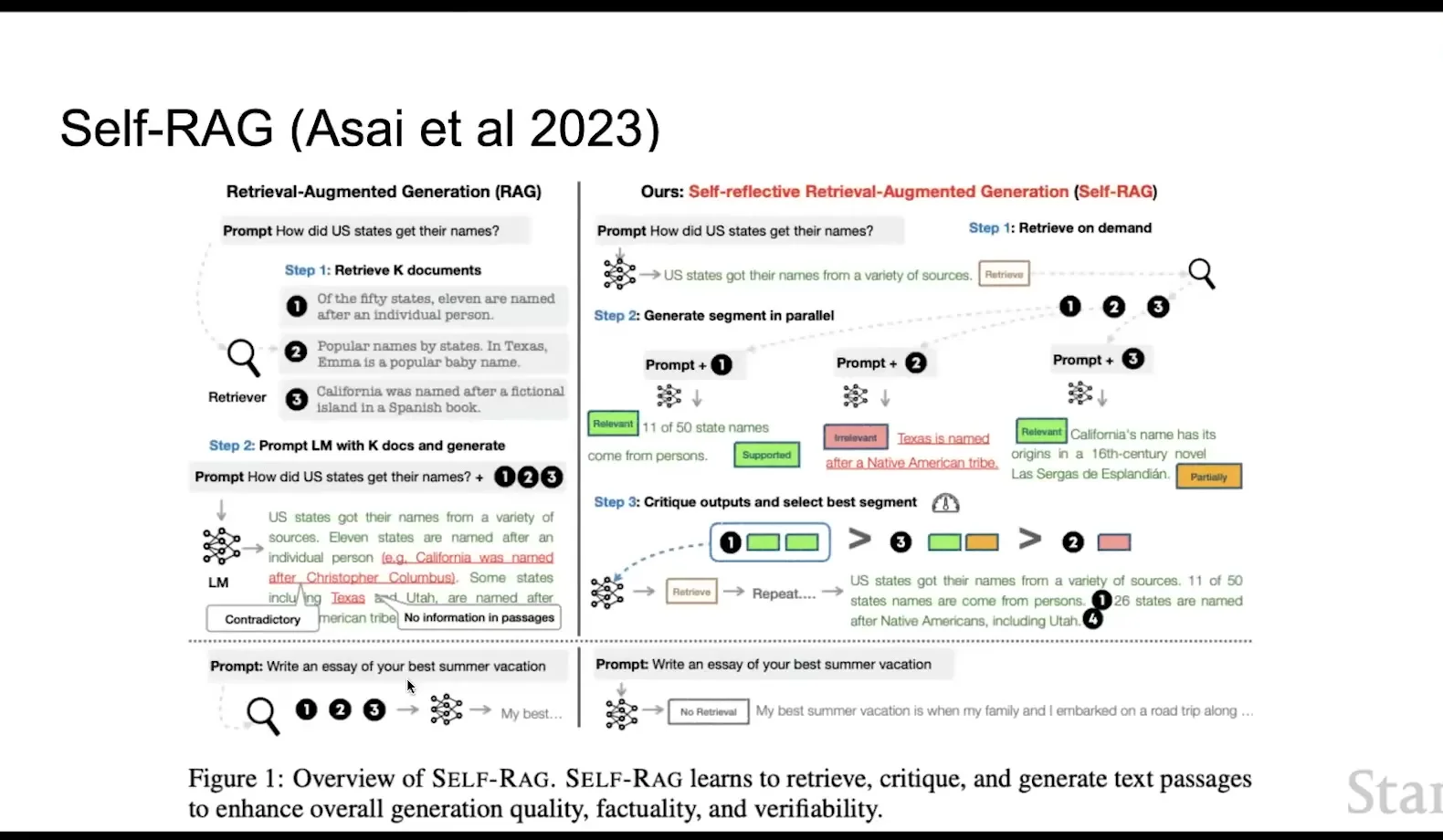
来源:Stanford 课堂视频 01:02:15
Self-reflection 仍需外部评测
Critique token 是模型预测,不是事实 oracle。系统应分别验证 retrieval decision、source relevance、claim support 与 final utility;模型自评可作为 feature,却不能取代 held-out labels、human review 或可执行 verifier。
state = initialize(question)
while not state.finished and state.steps < max_steps:
    if policy.needs_evidence(state):
        docs = search(state.query)
        docs = rerank_and_filter(docs, source_policy)
        state.add_evidence(docs)
    draft = generator.continue_answer(state)
    verdict = verify_claims(draft, state.evidence)
    state = revise_or_finish(state, draft, verdict)
return state.answer
Instruction Tuning the Entire RAG System
Instruction-tuning slide 对比 InstructRetro 与 RA-DIT:过去指令数据主要训练 generator,retriever 不一定理解“比较、引用、只使用指定来源”等任务意图。Dual instruction tuning 同时适配 retrieval 与 generation,使整套系统遵循 instruction。
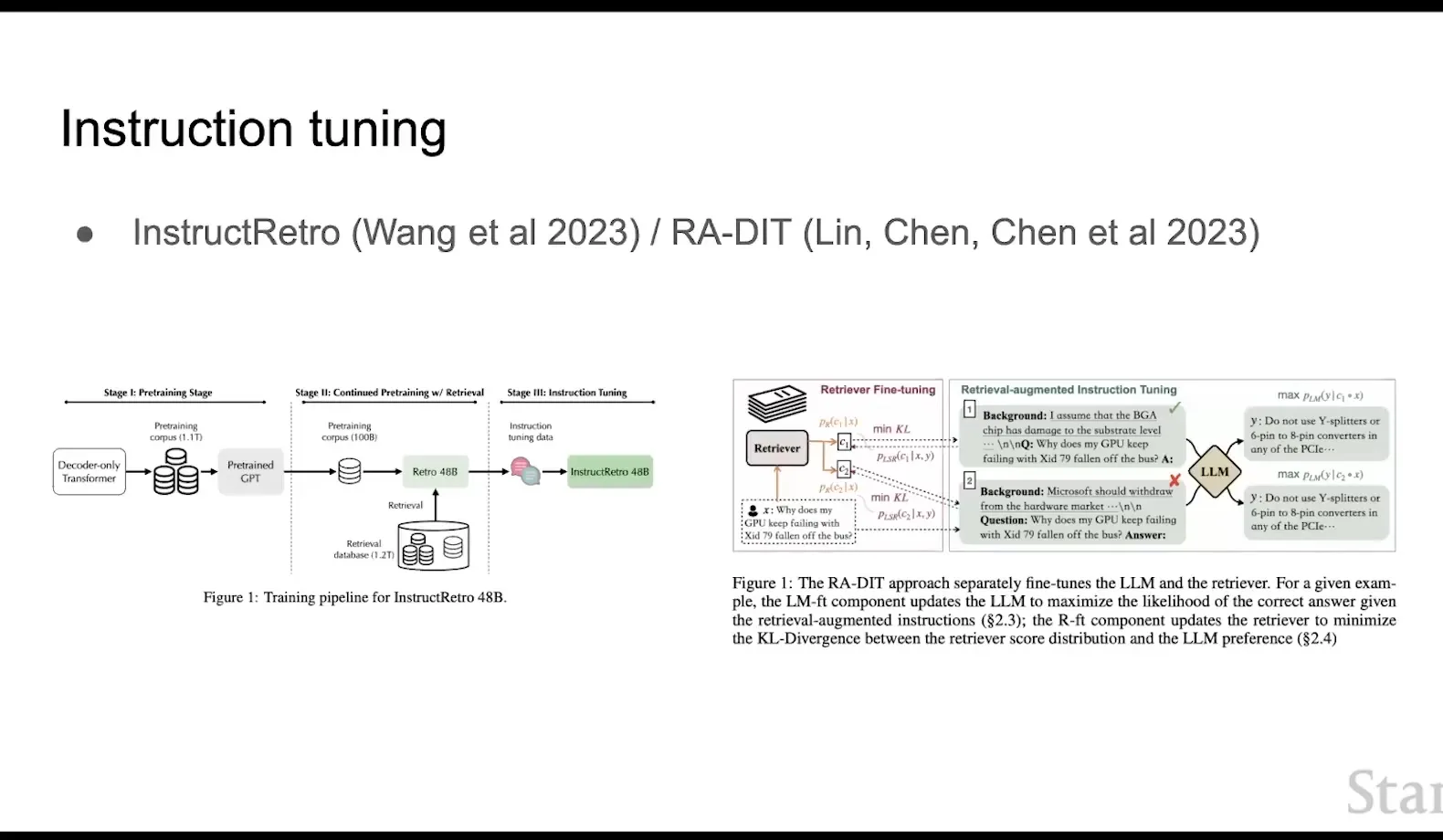
来源:Stanford 课堂视频 01:03:03
Instruction 对 Retriever 也有语义
“Give a counterargument”、“use peer-reviewed sources” 与 “summarize this document” 需要不同 evidence。若 retriever 只看 topic similarity,可能返回主题相关却不满足 task operator 的文档;instruction-aware query representation 可减少这种错配。
Advanced Frozen RAG:Developer Community 的实用创新
即使不做 joint training,开发者也构建了 child-parent recursive retriever、hybrid search/RRF、zero-shot LLM reranker 与 HyDE。HyDE 先让模型生成 hypothetical document,再用它的 embedding 搜真实文档,课堂称其为“用 hallucination 修复 hallucination”的有趣想法。
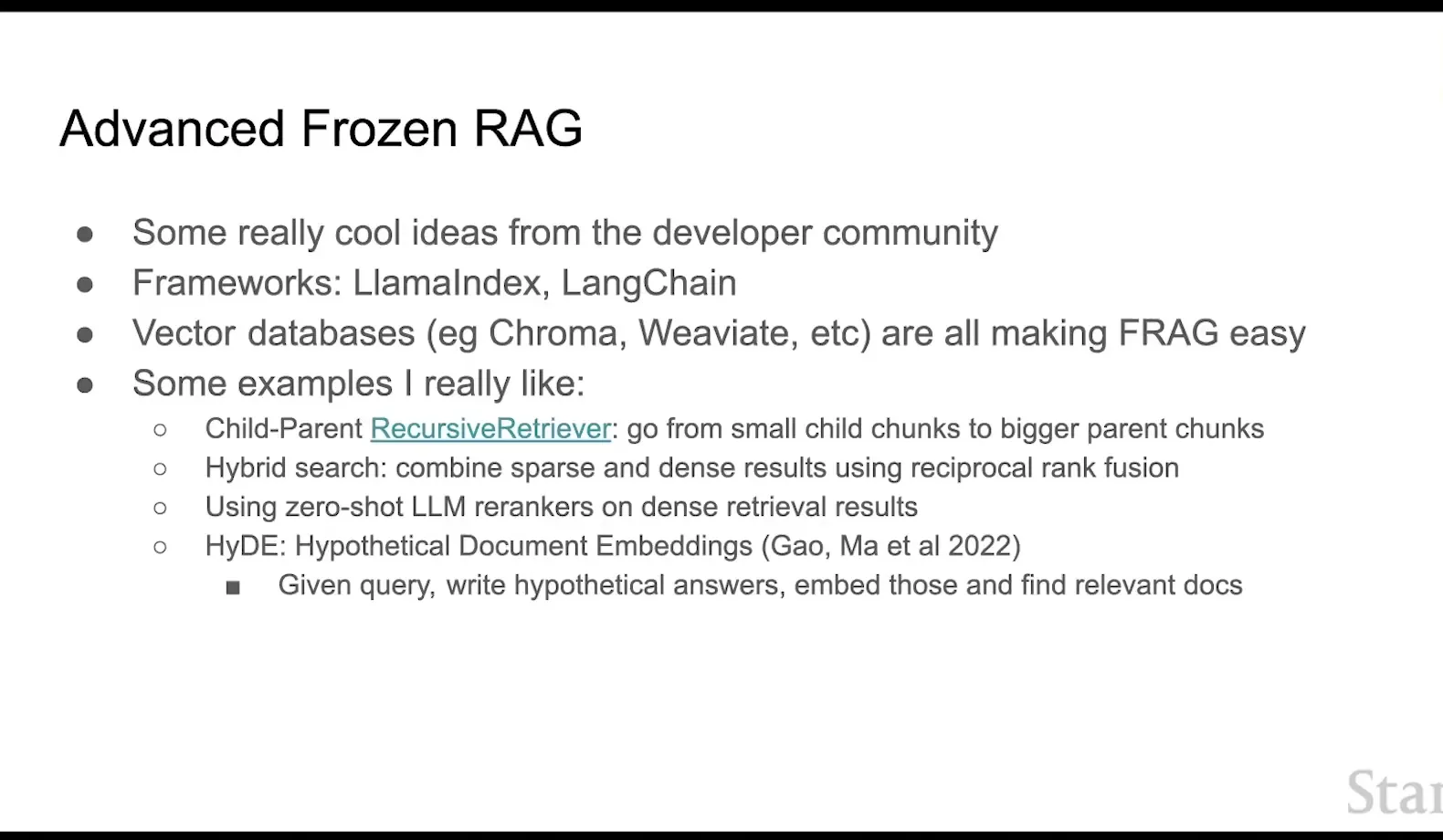
来源:Stanford 课堂视频 01:04:30
术语消化:四个 advanced frozen patterns
| 模式 | 机制 |
|---|---|
| Child-parent retrieval | 用小 chunk 精确召回,再扩展到父段落提供完整 context |
| Hybrid/RRF | 合并 BM25 与 dense ranking,兼顾 exact 和 semantic match |
| LLM reranker | 让强 LM 在小候选集上比较 relevance,成本较高 |
| HyDE | 先生成 hypothetical answer/document,再用其 embedding 检索真实证据 |
HyDE 的 hypothetical text 不是证据
它只用来构造更丰富的 query representation;最终回答仍应引用真实 retrieved documents。若直接把 hypothetical document 当事实,会把 retrieval query expansion 变成自证循环。
课堂提示
讲者一方面批评 frozen RAG 的 Frankenstein 属性,另一方面肯定 LlamaIndex、LangChain、Chroma、Weaviate 等开发者生态做出的实用创新。研究方向与工程 baseline 可以同时成立。
本章小结
Open questions 集中在 policy 与系统边界:何时检索、怎样扩展 retriever、如何处理 legal-risk motivation、怎样保证证据真正被 generator 使用,以及 retrieval 如何成为 tool use。Frozen RAG 仍有强工程技巧,但 joint learning 与可分层 evaluation 决定其上限。
Future:Evaluation、Multimodal RAG 与 RAG 2.0
最后部分把课程收束到系统研究议程:从零 joint pretraining 仍不足,scaling law、chunker、encoder、database、synthetic data 与 evaluation 都可学习或重新设计;RAG 还可跨越文本进入图像和多模态;最终目标是优化整个 cost–quality system。
Open Questions:还有哪些层没有被优化
Open Questions slide 询问 joint pretraining、scaling laws、reranker/chunker、bi-encoder 之外的表示、database convergence、synthetic data 与 evaluation。它说明“RAG 已解决”远非事实,现有系统仍大量依赖手工切分和弱代理指标。
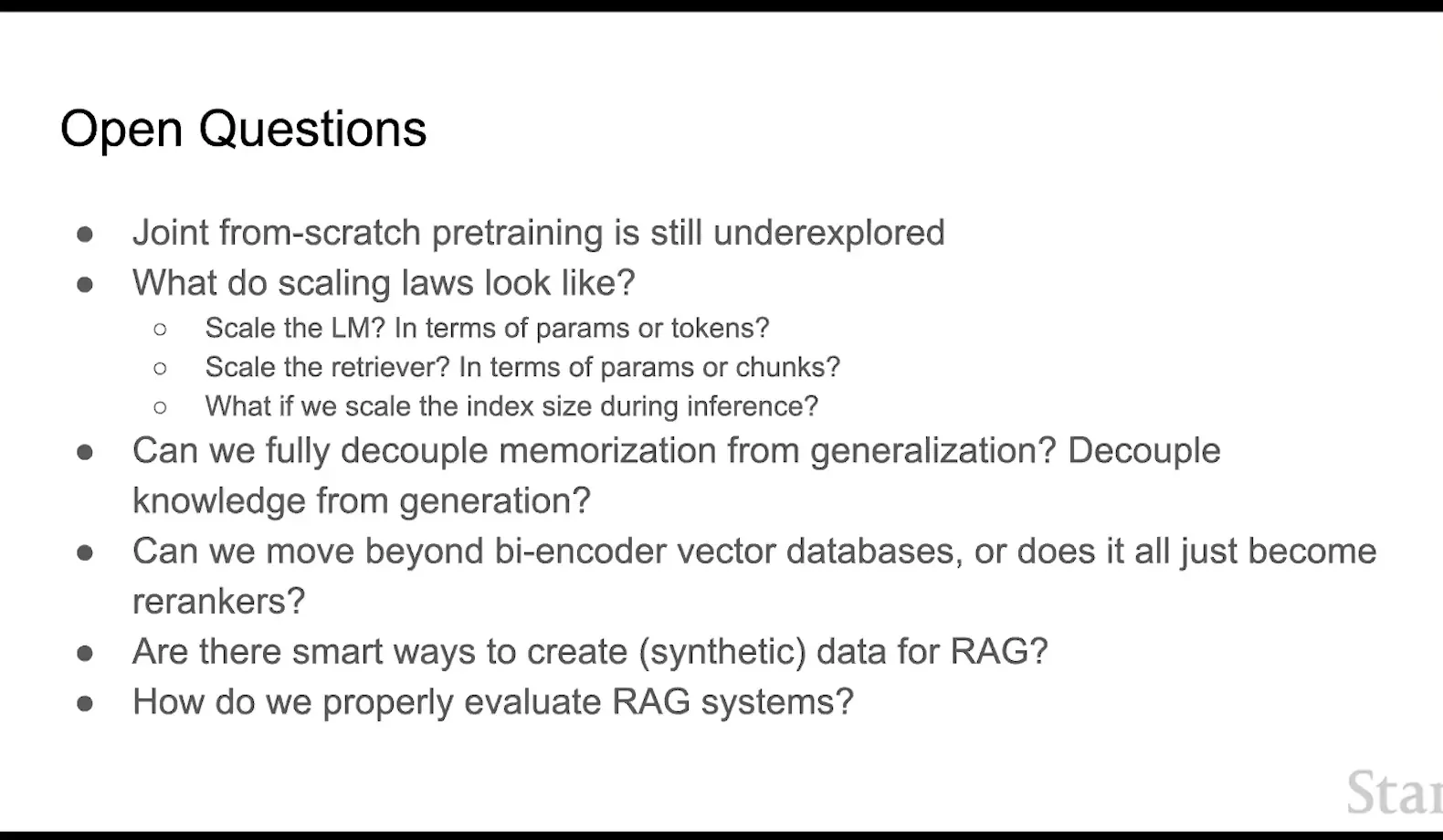
来源:Stanford 课堂视频 01:07:36
RAG Evaluation 的分层矩阵
| 层级 | 指标示例 | 典型盲点 |
|---|---|---|
| Retrieval | Recall@\(k\), MRR, nDCG | relevance label 不等于 generator utility |
| Packing | evidence coverage、position | 忽略 duplicate 与 token budget |
| Generation | correctness、citation、faithfulness | 正确答案可能来自参数记忆 |
| System | latency、cost、freshness、access control | 平均值掩盖尾延迟与高风险错误 |
课堂提示
讲者批评当前 RAG evaluation 很弱:downstream performance 看不到 retrieval 在哪里出错,把 retrieval accuracy 与 LM accuracy 做 harmonic mean 也缺少可靠数据集支持。
Vector Database 会不会并入普通 Database
在口头开放问题中,讲者怀疑专用 vector database 是否会长期独立存在:BM25 更高效,reranker 可能补足语义;传统数据库正在加入向量检索能力,向量数据库厂商也在补充 sparse retrieval 与 metadata filtering。这是 2023 年的产业判断,应作为架构趋势讨论,而不能当作当前市场事实。
不要把课堂预测写成产品结论
数据库实现、硬件、索引算法和供应商能力变化很快。讲义只保留抽象问题:未来系统是否需要统一管理 sparse、dense、metadata、transactions 与 access control,而不声称某类产品已消失或胜出。
Multimodal RAG
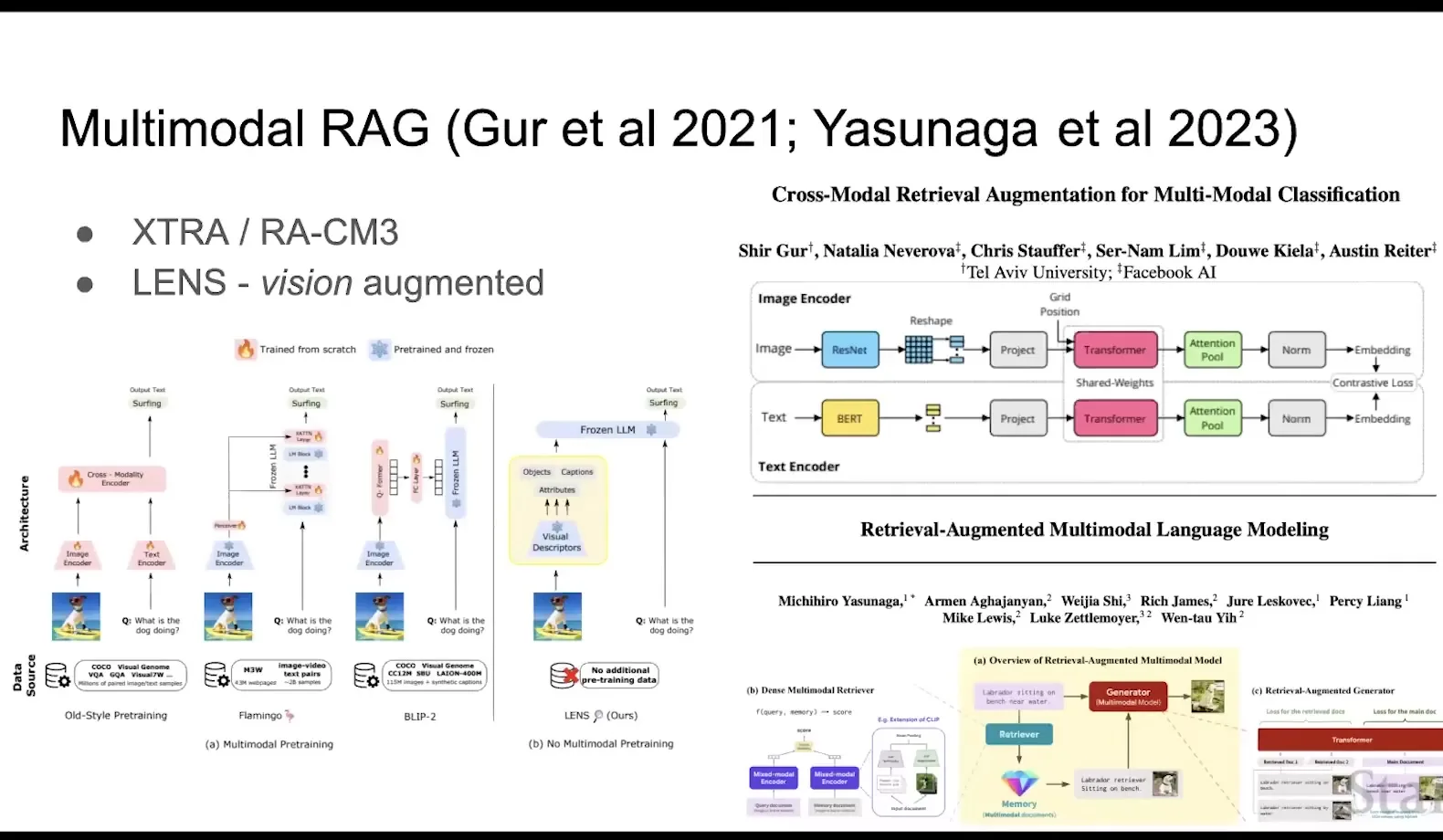
Multimodal slide 展示 cross-modal retrieval augmentation 与 visual question answering pipeline。文本 query 可以检索图像、图像可以检索文本,或者 vision pipeline 先生成结构化描述,再把结果交给 frozen LM。
来源:Stanford 课堂视频 01:08:45
读图:Multimodal RAG 需要对齐三种空间
系统至少要对齐 query representation、retrieved modality representation 与 generator input representation。图像相似不等于回答相关,caption 也可能丢失视觉细节;因此需要 cross-modal retriever、modality adapter 和 task-level evaluation。
视觉检索结果也可能成为错误证据
相似图片可能来自不同时间、地点或对象,OCR/caption 可能出错。Multimodal grounding 需要 provenance、时间与实体核对,不能因为“有图”就提高证据等级。
课堂提示
Kiela 把 multimodality 视为自然延伸:为什么 RAG 只停留在 text?他引用 LENS 与 cross-modal work,强调 frozen LM 也能通过外部 vision pipeline 获得视觉能力。
RAG 2.0:Systems over Models
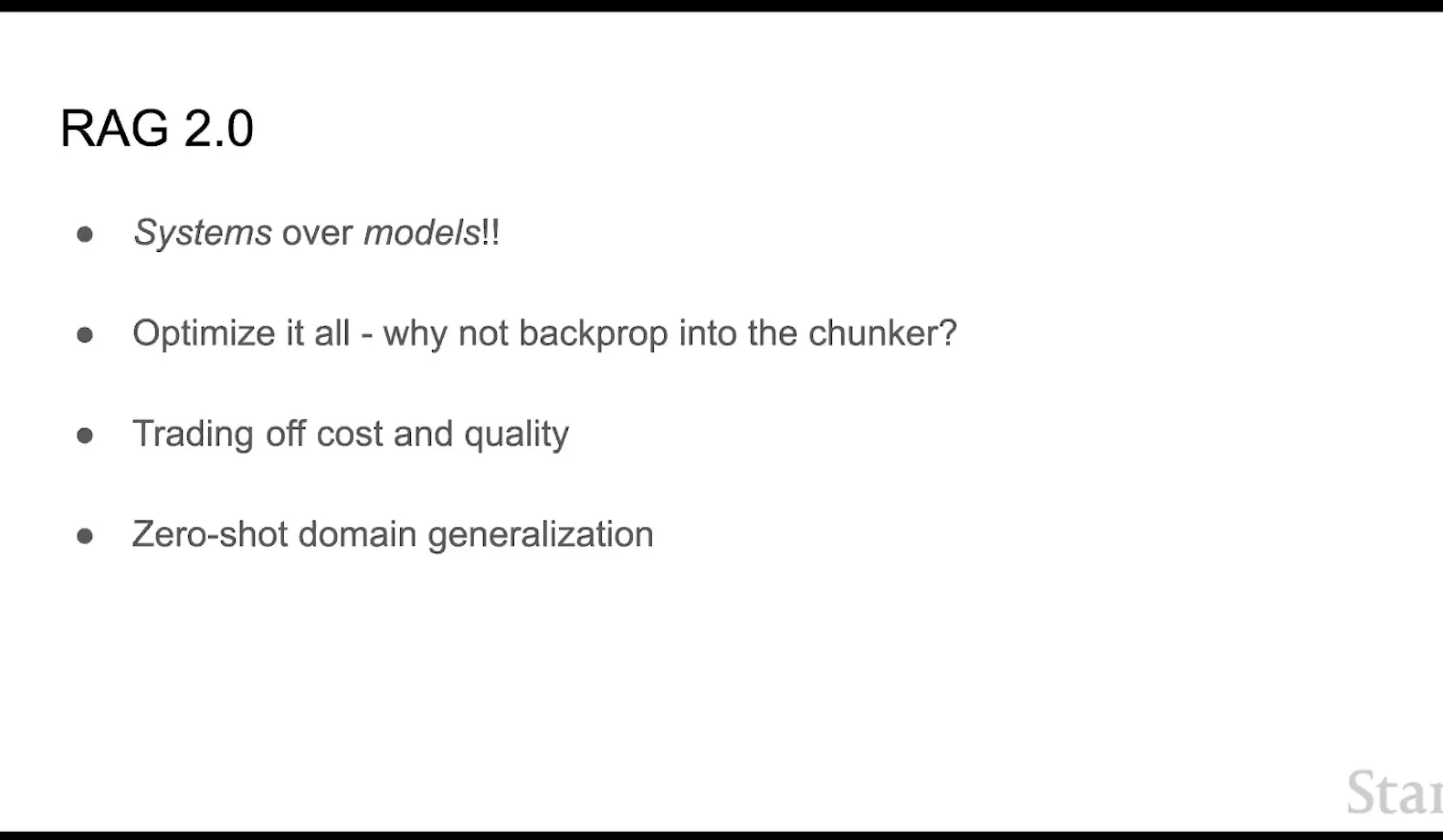
最终 slide 用四点收束:systems over models、optimize it all、trade cost and quality、zero-shot domain generalization。RAG 2.0 不是一个固定图,而是一种 optimization stance:retriever、chunker、reranker、generator、index、data 与 serving 不应被永久分割。
来源:Stanford 课堂视频 01:10:12
Cost–Quality 的系统目标
可把部署目标抽象为
其中 \(Q\) 是任务质量,\(L\) 是 latency,\(C\) 是 compute/storage cost,\(R\) 是风险或不可信输出;\(\pi\) 包含 retrieval policy。只优化 LM accuracy 不能决定系统最优解。
课堂提示
讲者把 RAG 2.0 概括为 “systems over models”,甚至建议反向传播到 chunker。核心不是所有模块必须同时更新,而是任何手工边界都应接受“是否可学习、是否值得优化”的检验。
Closing Q&A:Hybrid、Fine-tuning 与 Retrieval Hardware
最后 Q&A 给出三个实践判断。第一,BM25 可先 cast a wide net,再用 dense reranker 收窄。第二,domain adaptation 最终会组合 retrieval、fine-tuning 与 adapters,而不是永远二选一。第三,讲者提到 dedicated retrieval hardware 的产业可能性,但没有给出可公开验证的型号或 benchmark,因此只记录为 speaker speculation。
Retrieval 与 Fine-tuning 解决不同状态
Fine-tuning 改变 parameters,适合行为、格式、领域表示与稳定技能;retrieval 改变 per-request evidence,适合频繁更新、私有数据与 attribution。RAG 2.0 可以在领域任务上 fine-tune 整个 retrieval-augmented system,同时保留可更新 index。
课堂提示
讲者明确说,最终大家可能会把 retrieval、end-to-end fine-tuning 和 adapters 全部结合起来。真正问题变成怎样高效组合,而不是争论只能选择一种。
Hallucination、Generic Error 与 Ground Truth
课程最重要的 spoken-only 段落出现在最后四分钟。讲者不满领域把所有错误都叫 hallucination:普通计算错误、误解问题与 evidence contradiction 应分开;hallucination 至少需要相对于某个 ground truth 或 retrieved evidence 定义。
三类失败的区分
| 类型 | 判定 | 例子 |
|---|---|---|
| Generic error | 输出不满足任务答案或计算规则 | 算错数、漏约束、格式错误 |
| Unsupported claim | 没有足够 evidence 支持 | index 无相关来源却给出确定陈述 |
| Evidence contradiction | 输出与选定 ground truth/source 冲突 | 文档说 A,答案声称非 A |
Ground truth 选择本身是系统决策
Index 可以只允许 peer-reviewed papers,也可以包含 arXiv、企业文档或开放网页;不同 source policy 会给出不同“可信事实”。RAG 让这一选择显式化,但错误或恶意 source 仍会让 grounded answer 错误。
课堂提示
讲者说,frozen GPT-4 即使接入 RePlug 仍可能忽略 evidence;若把知识全部移到外部 index、模型只负责语言与 reasoning,理论上更容易强制 grounding,但这是方向性极限而非已经实现的保证。
课堂提示
他进一步说,creative writing 有时需要“hallucinate”,而 factual task 要更强 grounding;理想系统应有 grounding knob。Temperature 只改变 sampling distribution,即使低温也可能稳定地产生错误,不能充当 grounding control。
本章小结
Future RAG 需要联合 evaluation、database、multimodal retrieval、chunking、instruction 与 serving。RAG 2.0 的最终观点是优化整套 system,并清楚指定 source of truth、grounding strength、cost 和 risk;检索与 fine-tuning 是互补工具,temperature 不是事实性开关。
总结与延伸
这堂课用一条连续谱组织了 retrieval-augmented language models:从 frozen BM25/vector search,把文档拼进 prompt;到 RePlug/reranker 让 retrieval 适配 frozen LM;再到 RAG、REALM、Atlas 与 RETRO 让 task signal 进入更多组件;最后把 retrieval 推广为 active tool use、multimodal memory 与 systems-over-models。
统一比较框架
任何 RAG 系统都可以用五元组描述:corpus/index \(I\)、retrieval policy \(\pi\)、retriever parameters \(\theta_R\)、fusion mechanism \(F\)、generator parameters \(\theta_G\)。比较论文或产品时,应报告这五项的训练状态、部署状态与成本,而不是只说“用了 RAG”。
本讲的十条可执行结论
- 把 hallucination、generic error 与 evidence contradiction 分开评测;
- 同时报告 retrieval recall、evidence position、utilization 与 final correctness;
- exact entity 优先保留 sparse signal,语义召回再用 dense/late interaction;
- Frozen RAG 是强 baseline,但要记录 score/objective mismatch;
- 选择 RePlug、reranker 或 joint training 取决于 generator access level;
- 报告哪些参数更新、index 何时刷新、corpus 是否变化;
- 控制 \(k_r\)、\(k_c\) 与 context position,避免盲目扩大 prompt;
- Active retrieval 要优化 information value 与 retrieval cost;
- Fine-tuning 改行为与表示,retrieval 改 per-request evidence,两者可组合;
- Source policy、provenance、permissions 与 evaluation 属于 RAG architecture。
复现实验时应该记录什么
至少记录 corpus snapshot、license/provenance、chunk size/overlap、embedding model、index type、retriever top-\(k\)、reranker、context packing、generator version、prompt、updated parameters、index refresh cadence、latency/cost 和 evaluation set。缺少这些信息,即使模型名称相同也难以复现。
不要把 2023 年课堂快照写成 2026 年产品事实
本讲对 off-the-shelf retriever、vector database、hardware 与产业趋势的评价发生在 2023-12-05。讲义保留机制与历史判断,不据此断言 2026 年的当前产品能力、市场格局或法律结论。
拓展阅读
建议按机制顺序阅读:DPR/ColBERT 理解 retrieval representation;RAG/FiD 理解 evidence marginalization 与 fusion;kNN-LM/RETRO 理解 non-parametric memory 如何进入 language modeling;REALM/Atlas 理解 joint training 的近似;RePlug/In-Context RALM 理解 frozen generator;FLARE/Self-RAG/Toolformer 理解 active retrieval 与 tool use;SILO/Lost-in-the-Middle 理解数据边界与 evidence utilization。
最终小结
Retrieval augmentation 的价值不只是“给模型更多文本”,而是把知识状态、更新、来源与计算从单一参数模型中拆出来。高质量 RAG 必须让 retriever、context、generator 与 source policy 对齐,并用分层 evaluation 证明:正确证据被找到、被放在可用位置、被生成器真正使用,最终输出也满足任务和 ground truth。