Lecture 32:LLM 预训练幕后——StarCoder 数据、治理与评测

来源与核心问题:好模型的幕后不是一条训练命令
旧稿没有填写 canonical video URL,只把 YouTube thumbnail 重复当成唯一课程图,并把 71 页官方 deck 压成短篇概述。本讲现以讲者个人官网直链的 Google Slides、Stanford Online 官方录像 jm2hyJLFfN8、官方 en-US 人工字幕和 BigCode/StarCoder primary sources 为依据。全部 71 页 slides 已落盘;其中 58 页包含独立教学内容,其余仅为分隔、动画中间态、完成标记、重复页或致谢。
课程不是“数据最重要”一句话,而是问题链
标题把 StarCoder 标成 use case,意味着课程的目标不是复述一个模型配置,而是用代码模型回答一般预训练问题:要多少数据、从哪里找、如何过滤、如何治理、怎样评估、何时相信 benchmark。后文每一章都沿着这个 question–answer 结构展开。
来源:Loubna Ben Allal 官方 deck,第 1 页
来源:Loubna Ben Allal 官方 deck,第 2 页
本讲的六个交付问题
- 在给定 compute 下,模型参数与训练 token 怎样分配?
- raw web/code/synthetic sources 怎样转成可训练 corpus?
- filter 直觉怎样通过小模型 ablation 验证?
- license、opt-out、PII 与 decontamination 如何进入 pipeline?
- repository/file/commit/notebook 怎样格式化成训练 sequence?
- leaderboard 如何避免 contamination、单一 benchmark 与时间泄漏?
课堂提示
00:00:50–00:02:10,Ben Allal 说整场报告只有一个“很 loaded”的问题,slides 会不断提出子问题再回答。StarCoder 是把抽象原则落到真实项目的案例。
Open-model 进展:权重开放带来哪些实际能力
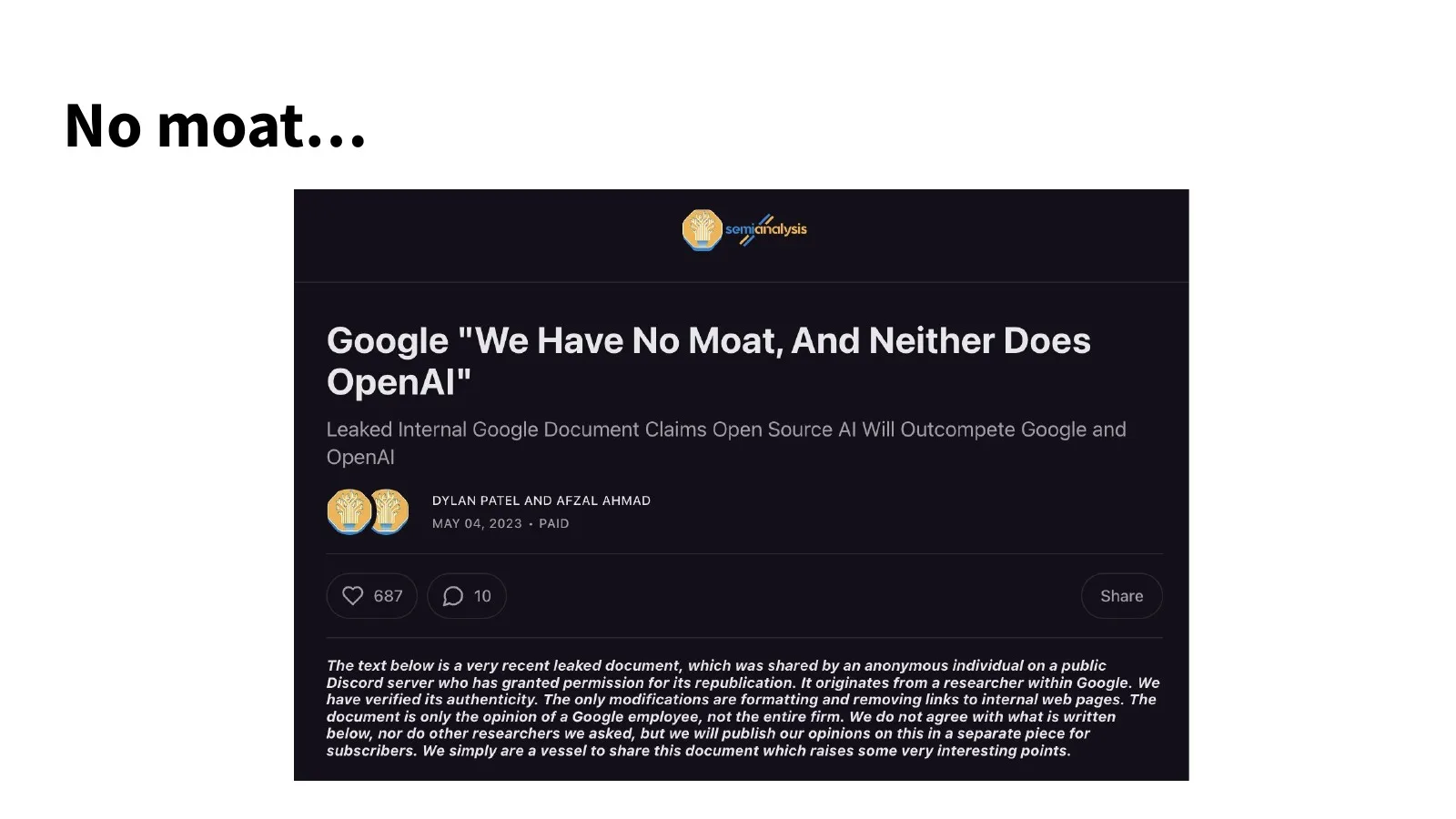
2023 年流传的 “No Moat” memo 代表一种判断:闭源领先并不意味着开源永远无法追赶。课堂引用它不是为了宣布竞争结束,而是解释为什么公开 weights 会产生新的 deployment/fine-tuning ecosystem。
来源:Loubna Ben Allal 官方 deck,第 3 页
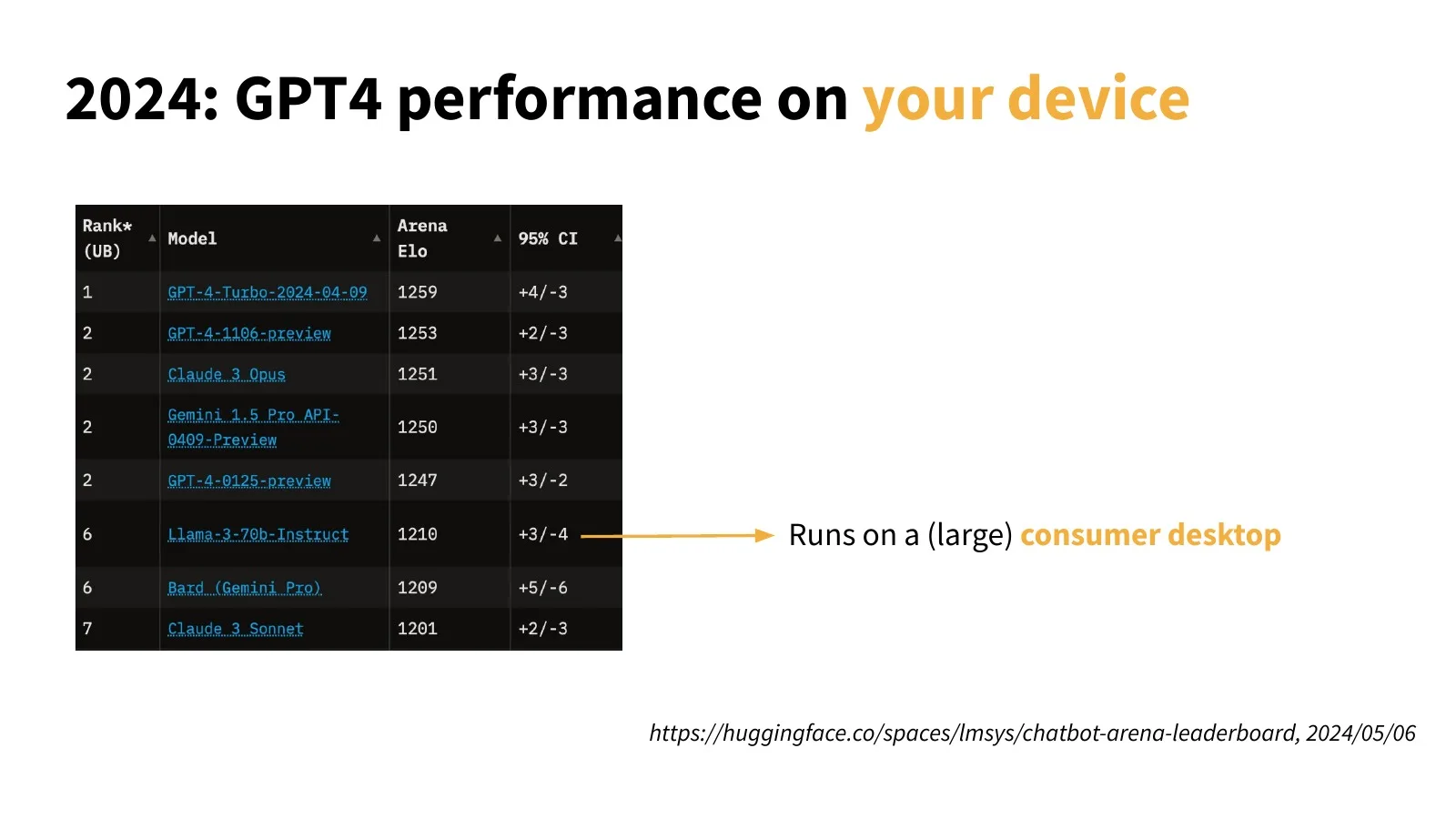
开放 weights 后,quantization 可以降低 memory footprint,本地 runtime 可以在 consumer hardware 上部署,parameter-efficient fine-tuning 可以针对组织数据做定制。这些价值不等于模型在所有任务上达到闭源系统能力,而是可检查、可改造、可私有部署的选择空间更大。
来源:Loubna Ben Allal 官方 deck,第 4 页
“性能接近”必须绑定版本、指标与日期
slide 是 2024 年 5 月快照。Arena、MMLU、coding、安全、长上下文、tool use、latency 与 cost 会给出不同排序;本讲不把某张表上的接近改写成通用 parity。
课堂提示
00:02:10–00:03:20,讲者强调 open weights 的直接收益是 quantization、consumer deployment 与社区 fine-tuning,而不是一句抽象的“开源更好”。
Open releases 在增加,但训练透明度仍不足
Gemma、Mistral 等公开模型让 open ecosystem 扩大;Arena 图也显示 2023 到 2024 年 open/closed gap 缩小。读这两页时应先看它们回答的问题:第一页是供给增长,第二页是特定人类偏好评测协议下的趋势。
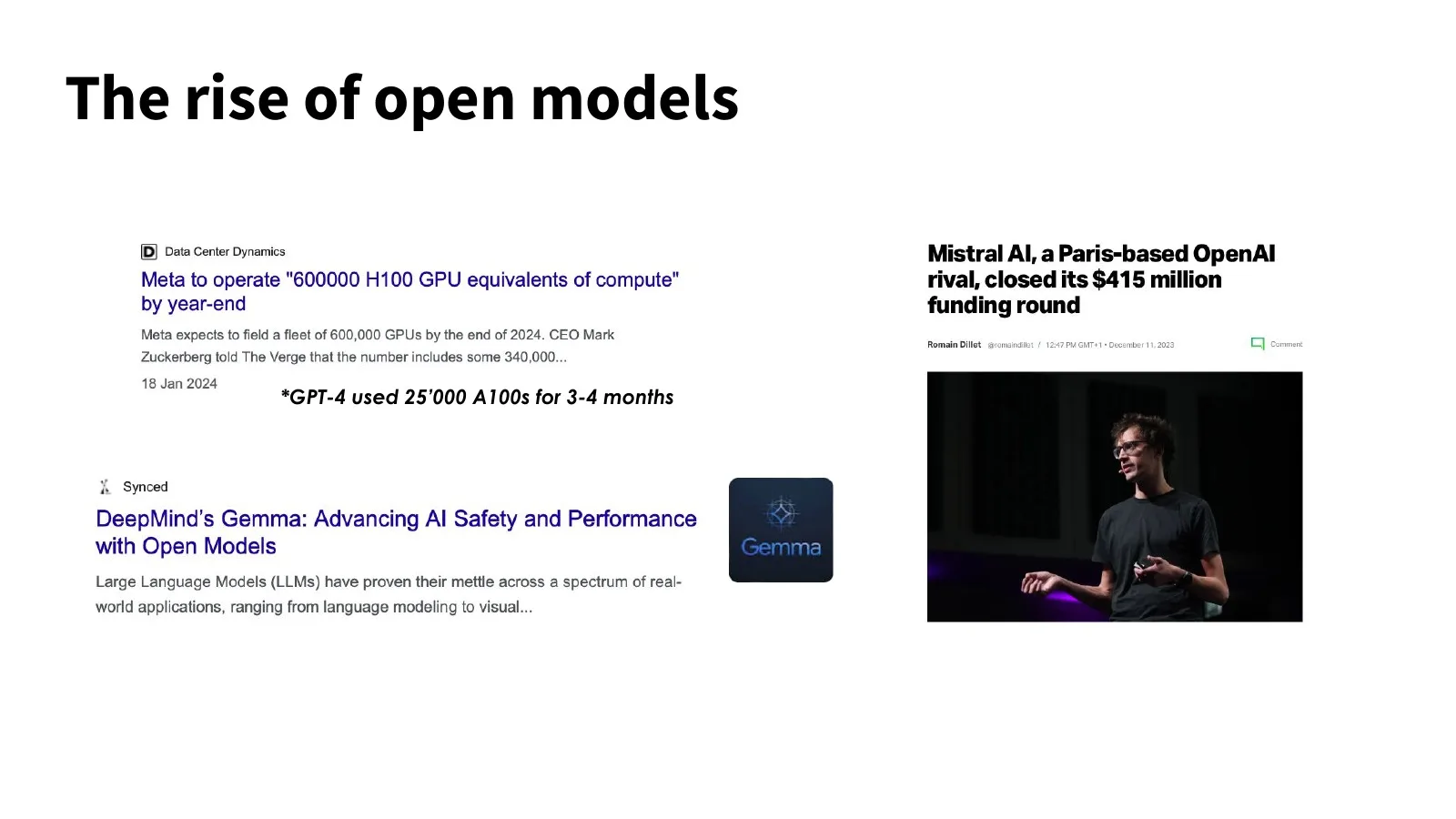
来源:Loubna Ben Allal 官方 deck,第 5 页
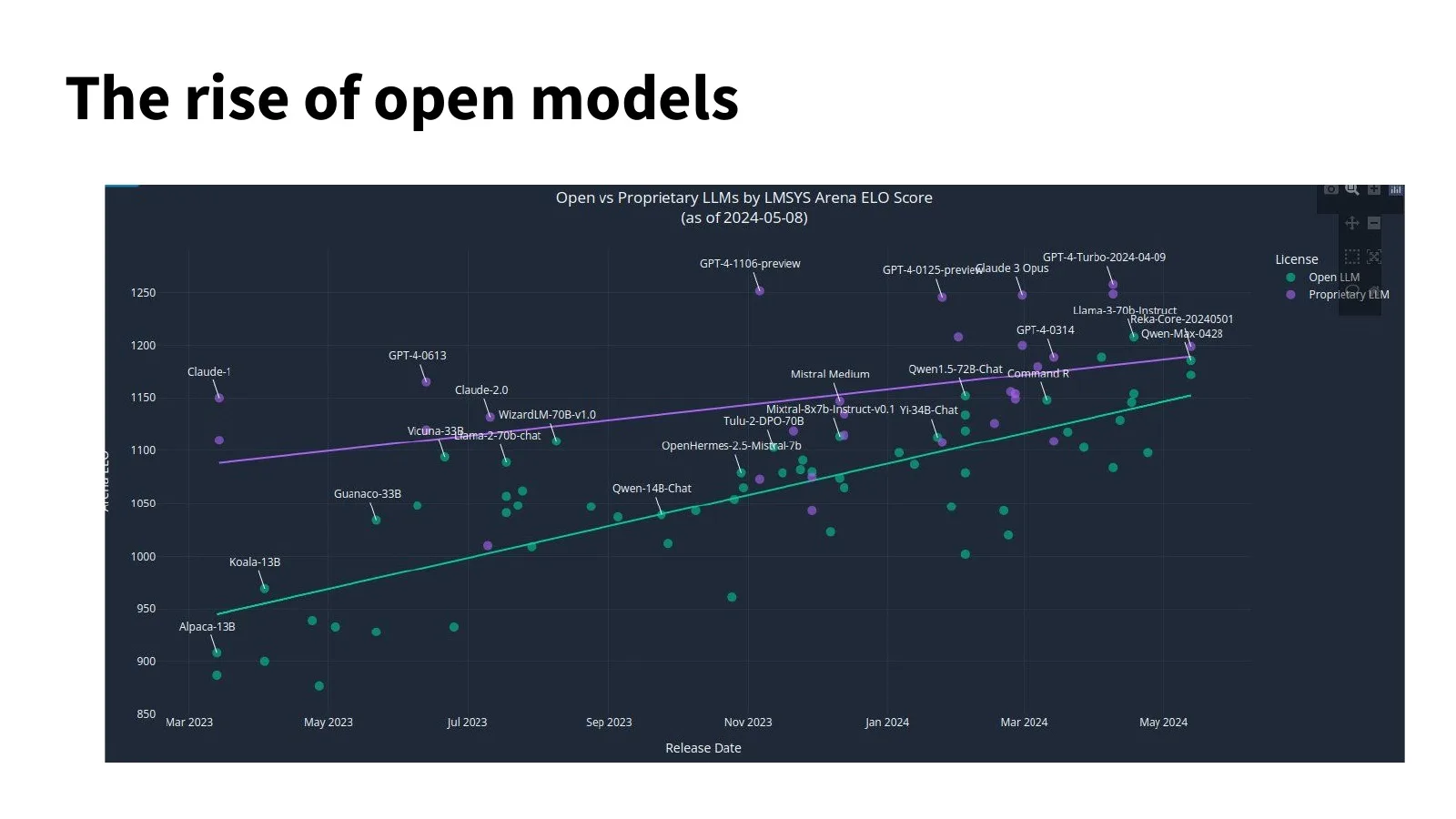
来源:Loubna Ben Allal 官方 deck,第 6 页
Arena 证据能说明什么
Arena 用用户 pairwise preference 形成 Elo-like ranking,适合衡量交互式回答偏好;它不能单独衡量训练数据合法性、事实可靠性、rare-language coverage、code execution correctness 或部署成本。趋势可参考,能力边界仍需多维评估。
为什么公开权重却不公开数据与 recipe
讲者给出两个现实原因:一是 disclosure 可能引发 license/copyright scrutiny,二是团队希望保留 competitive edge。这使模型 weights 可以下载,却无法回答样本从何而来、filter 怎么选、token 数怎样配、evaluation 是否泄漏。
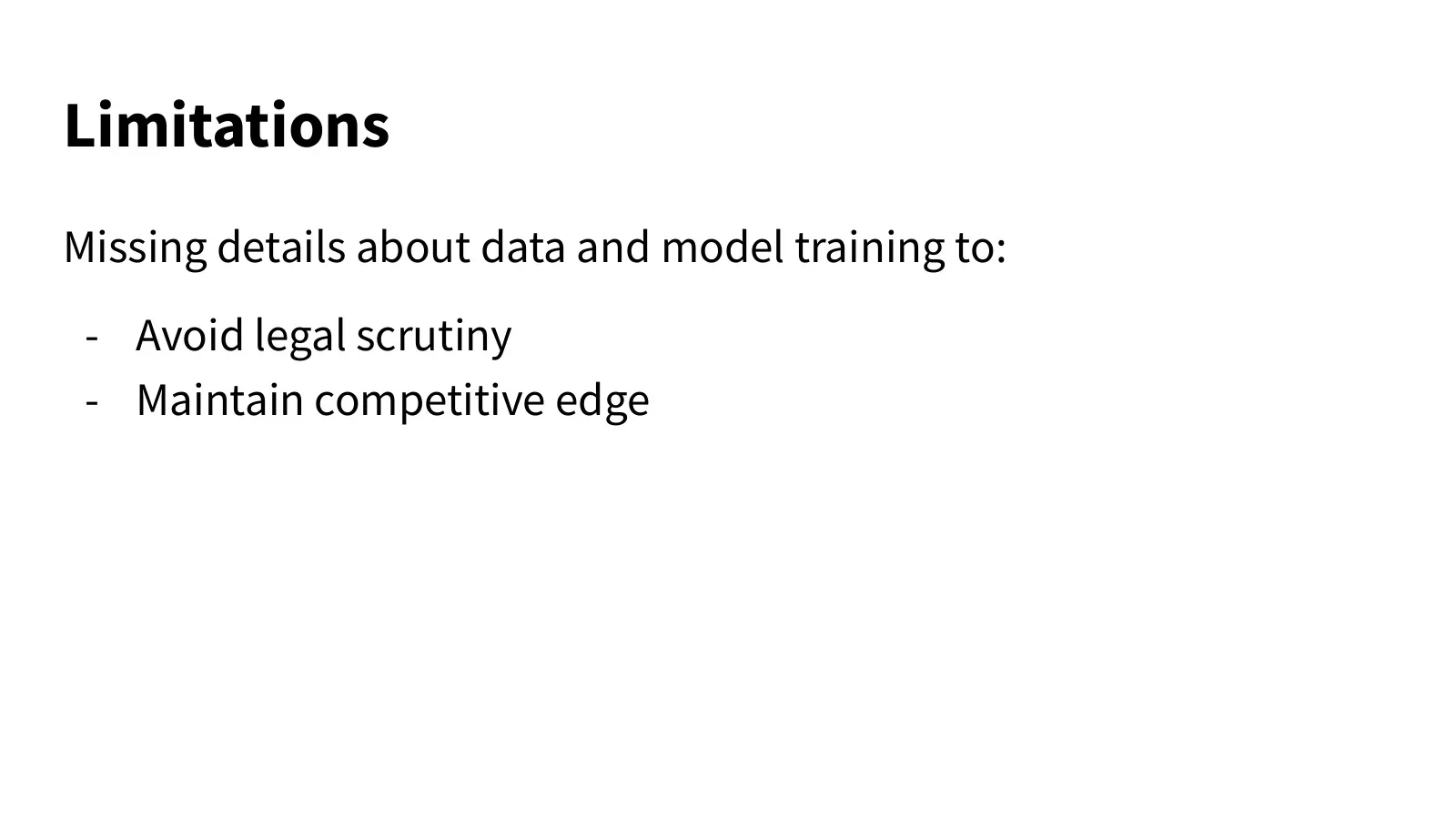
来源:Loubna Ben Allal 官方 deck,第 7 页
不可复现不是“文档少一点”
若缺少 dataset version、dedup threshold、sampling weights、tokenizer、training tokens、optimizer schedule、benchmark decontamination 和 seeds,研究者无法定位性能来自 architecture、data 还是评测泄漏,也无法可靠复用治理选择。
课堂提示
00:04:10–00:05:05,讲者把不披露的法律与竞争原因直接说出。她并未因此放弃总结公共规律,而是强调需要从多个公开 release 拼出 evidence。
Model、GPUs、Data:三角形里本讲选择 data
Transformer、Mamba、MoE 都可能成为 model 选项,GPU 决定 budget 上限;但在相近 architecture 与 training technique 下,数据质量和 mixture 常成为固定预算内的主要差异。这里的“data backbone”是课程的 focus,不是声称 architecture 和 hardware 无关。
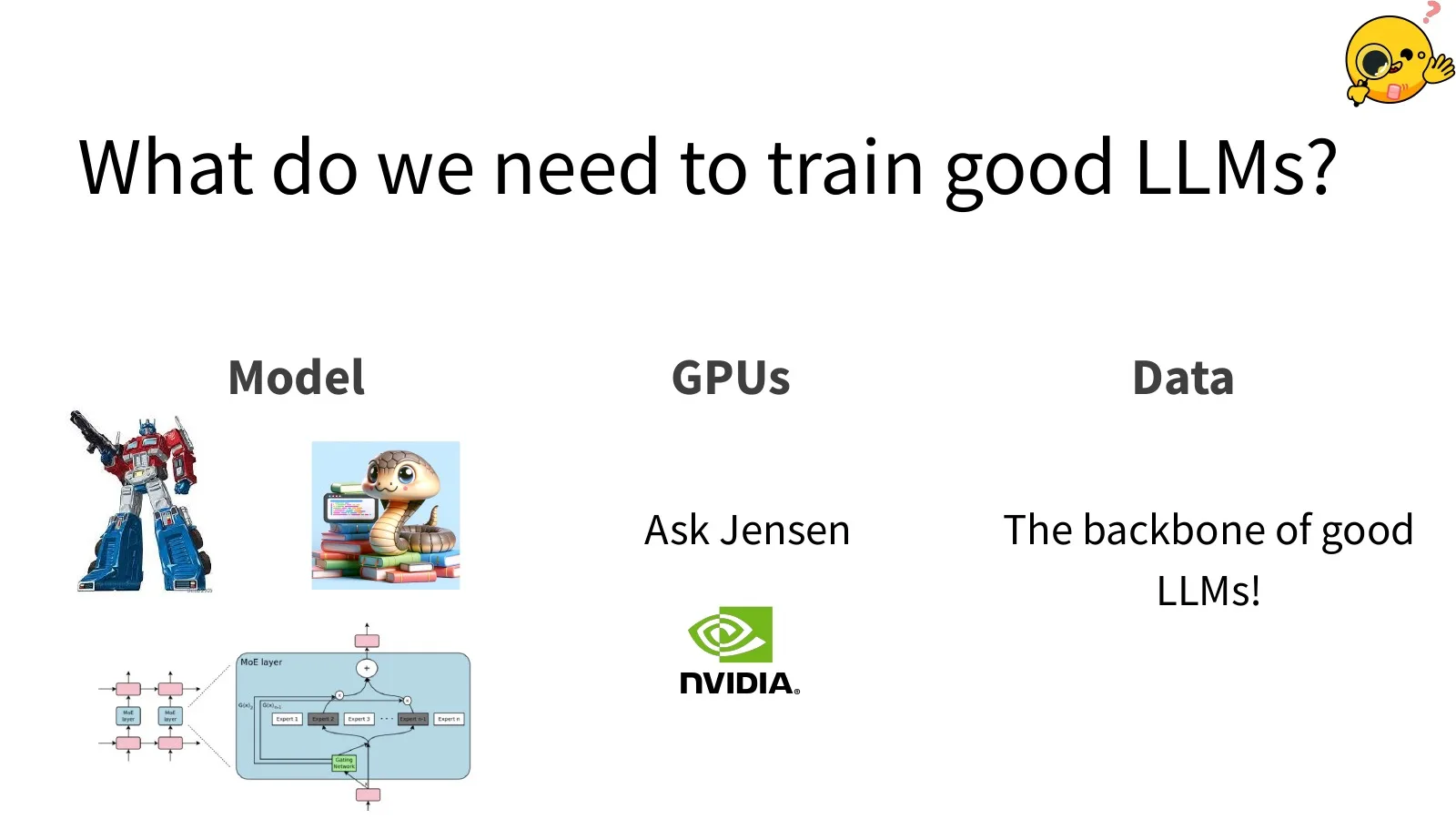
来源:Loubna Ben Allal 官方 deck,第 11 页
把三者写成约束优化
可把训练目标粗略写为
其中 \(\mathcal{D}\) 是数据与 mixture,\(r\) 是训练 recipe,\(B,S\) 分别是训练与服务预算。课程主要优化 \(\mathcal{D}\),但约束仍来自模型和 GPU。
课堂提示
00:05:05–00:06:20,讲者说 architecture/techniques 越来越相似,所以“给定预算下”数据让模型拉开差距。限定词是 given budget,而不是任何规模都只看数据。
本章小结
Open weights 扩大部署和定制空间,但训练透明度仍是主要缺口。课程因此把预训练还原成受 compute、serving、data、governance 和 evaluation 共同约束的工程,而 StarCoder 提供可检查的端到端案例。
要多少数据:Scaling law 与生命周期成本
决定数据源之前,先要估算需要多少 tokens。Scaling law 的价值是给预算分配提供经验曲线;它的局限是训练 loss 的 optimum 不自动等于部署成本、数据受限和 domain-specific performance 的 optimum。
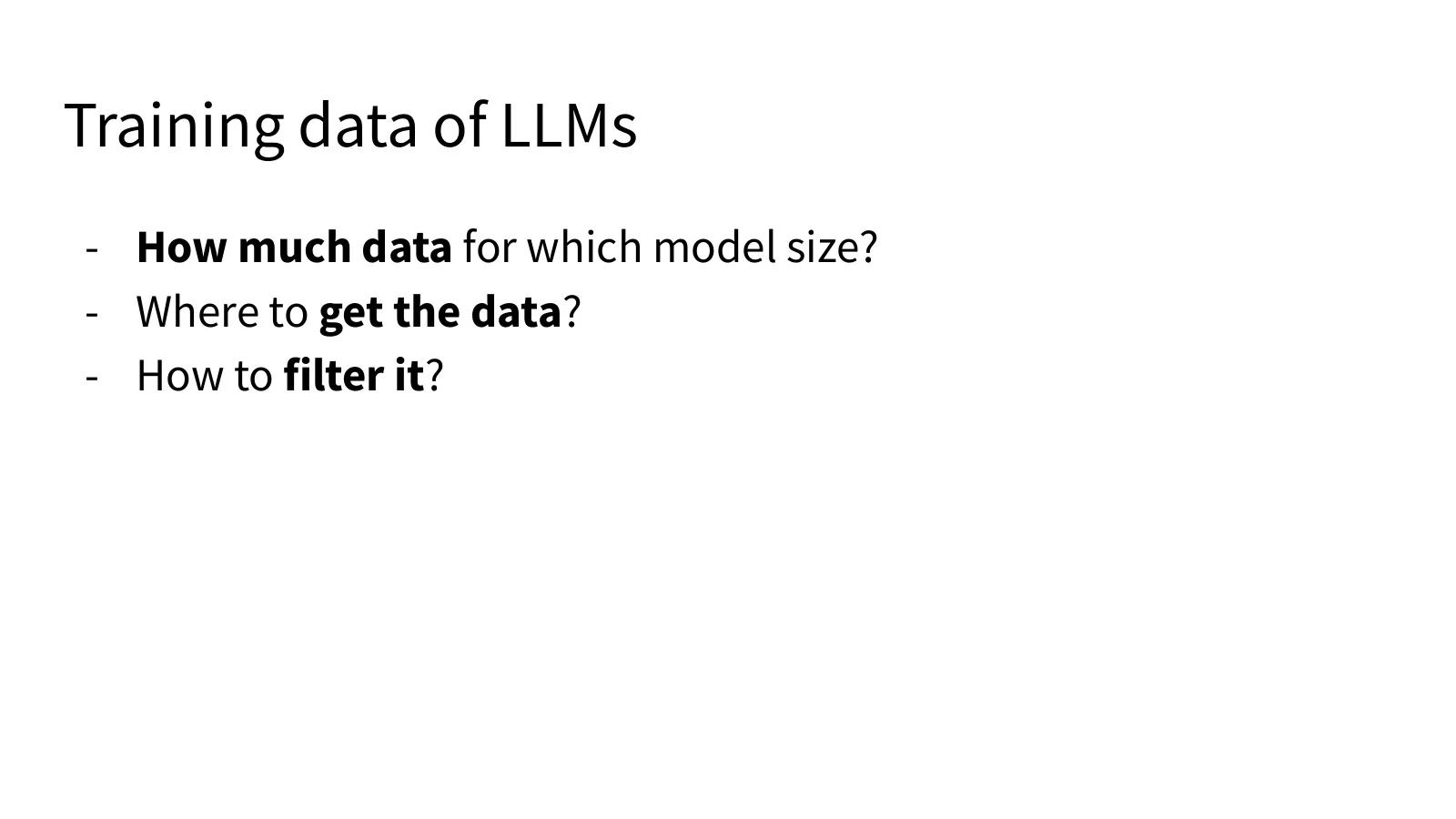
三个问题:多少、哪里、怎样过滤
上一章把模型、GPU 与数据放进同一个约束问题;本节开始拆解数据变量。读图时应把三个问句看成有依赖的 pipeline:数据量决定 collection 规模,来源决定 provenance 与 domain,filter 决定 quality/diversity;三者相互作用,不能先固定一个再把其他视为清洁步骤。
来源:Loubna Ben Allal 官方 deck,第 13 页
Raw data、retained data 与 training tokens 要区分
Raw bytes 是抓取体量;retained bytes 是 filter/dedup 后文件;unique tokens 是 tokenizer 后去重统计;training tokens 还包含 epochs/repeats 与 mixture sampling。报告“3T tokens”若不说明是哪一层,无法复现。
Scaling law:在参数与 tokens 之间分配 compute
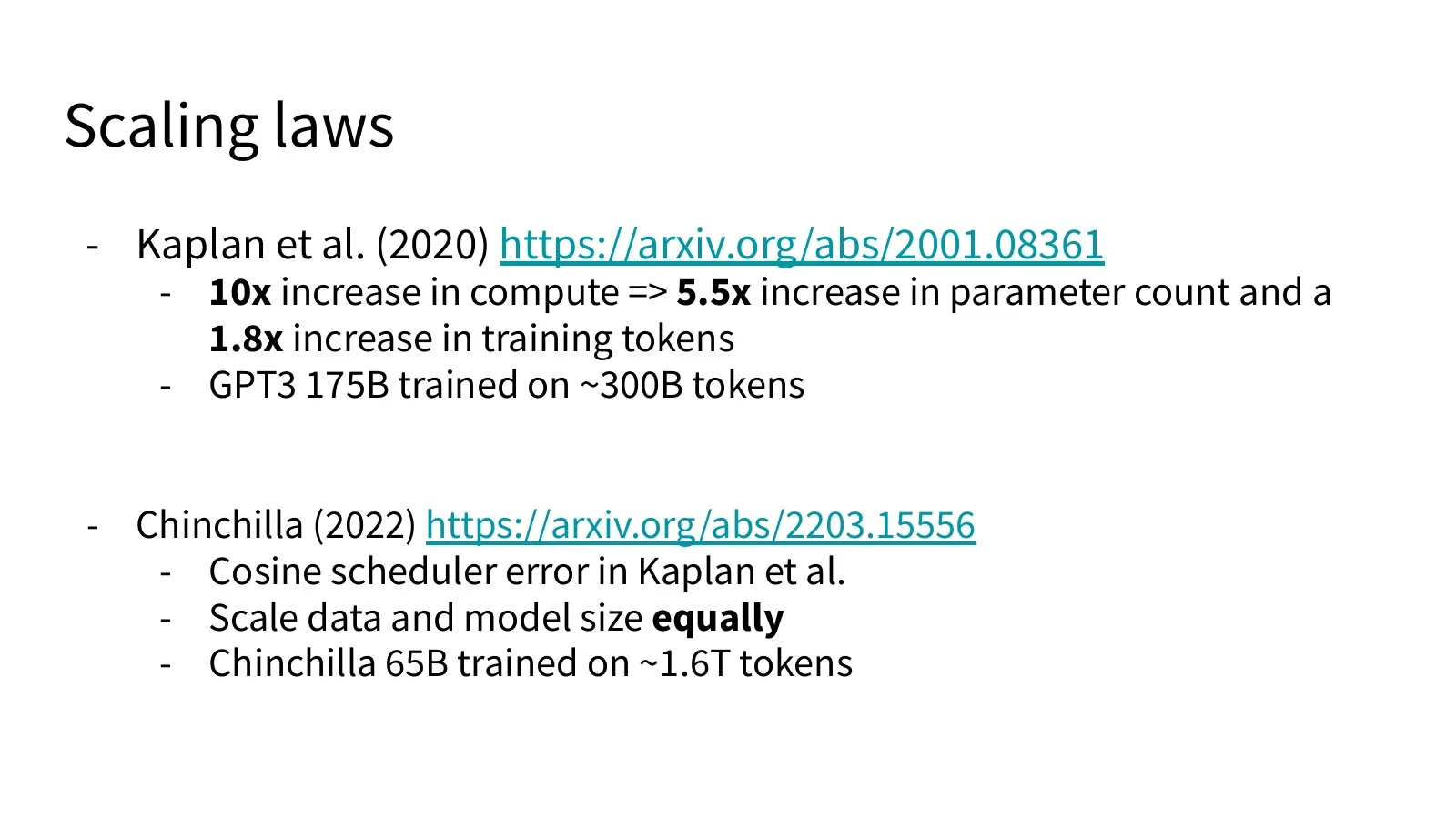
确定“需要多少数据”不能只看已有硬盘容量,而要把模型大小、训练 tokens 和预算同时放进经验曲线。本节先给出 scaling-law 形式,再用 Kaplan 与 Chinchilla 的不同结论说明:所谓 optimum 是在一组假设和 fitted range 下得到的资源配置,而不是脱离数据与硬件的常数。
Kaplan-style empirical law 常写成
其中 \(N\) 为参数量、\(D\) 为训练 token、\(L_\infty\) 为不可约 loss。对 dense Transformer,训练 FLOPs 常近似 \(C\approx 6ND\),固定 \(C\) 时就需要选择模型与数据的组合。
来源:Loubna Ben Allal 官方 deck,第 14 页
来源:Loubna Ben Allal 官方 deck,第 15 页
Kaplan 早期结果给出较大的模型、较少的 token;Chinchilla 通过更广实验修正为参数与 token 更平衡的增长。slide 对比 GPT-3 175B/约 300B tokens 与 Chinchilla 65B/约 1.4–1.6T tokens,教学结论是:同 compute 下,旧模型可能参数过大、训练不足。
常数比率不是永恒法则
“每个参数约 20 tokens”依赖模型族、数据、optimizer、context 和 fitted range。后续模型常 intentionally overtrain,domain 或 data quality 变化也会移动 optimum。
课堂提示
00:06:20–00:09:10,讲者用 Kaplan/Chinchilla 说明 scaling law 是预算分配工具,并提醒这些结论来自特定论文和数据,不应只背一个 token-per-parameter 数字。
读 Chinchilla 曲线:每个 compute budget 都有谷底
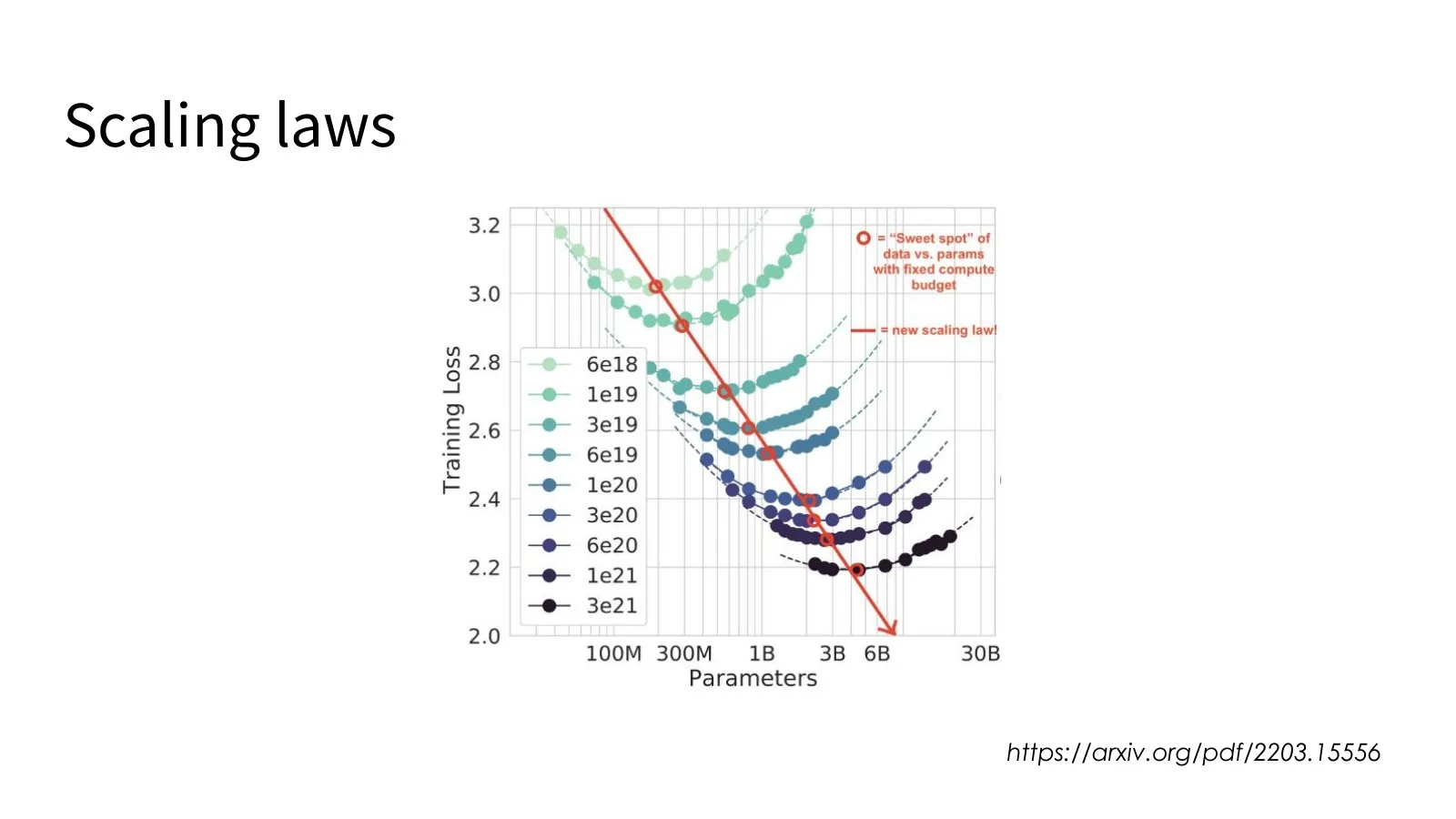
上一节给出了抽象公式,本节转向经验曲线,说明 optimum 在图上怎样出现。读图时先固定一种颜色:横轴是参数量,纵轴是 validation loss;每条曲线先降后升,模型太小欠容量,模型太大则在固定预算下 token 不足,谷底才是该 budget 下的 training-compute optimum。
来源:Loubna Ben Allal 官方 deck,第 16 页
若 \(C=6ND\),将 \(D=C/(6N)\) 代回经验 law,可以求 \(N^*(C)\) 与 \(D^*(C)\) 的幂律。真实训练不会只解公式,还要考虑 discrete hardware shape、parallel efficiency、batch、context 和数据可得性。
曲线不告诉你的四件事
它通常不计 serving cost;不保证 downstream task 同步提升;不描述 license/quality constraints;也不包含训练 failure、checkpoint selection 与 hyperparameter search 成本。
Compute、Data、Model 三条 scaling evidence
Chinchilla 曲线展示固定预算内的谷底,这一页进一步把 loss 分别对 compute、data size 和 model size 作图,展示可拟合直线区间。读图时首先确认其他变量是否接近最优,并检查横轴范围;否则单独增加某一轴可能只是把系统推入 under-training 或 data-limited regime。
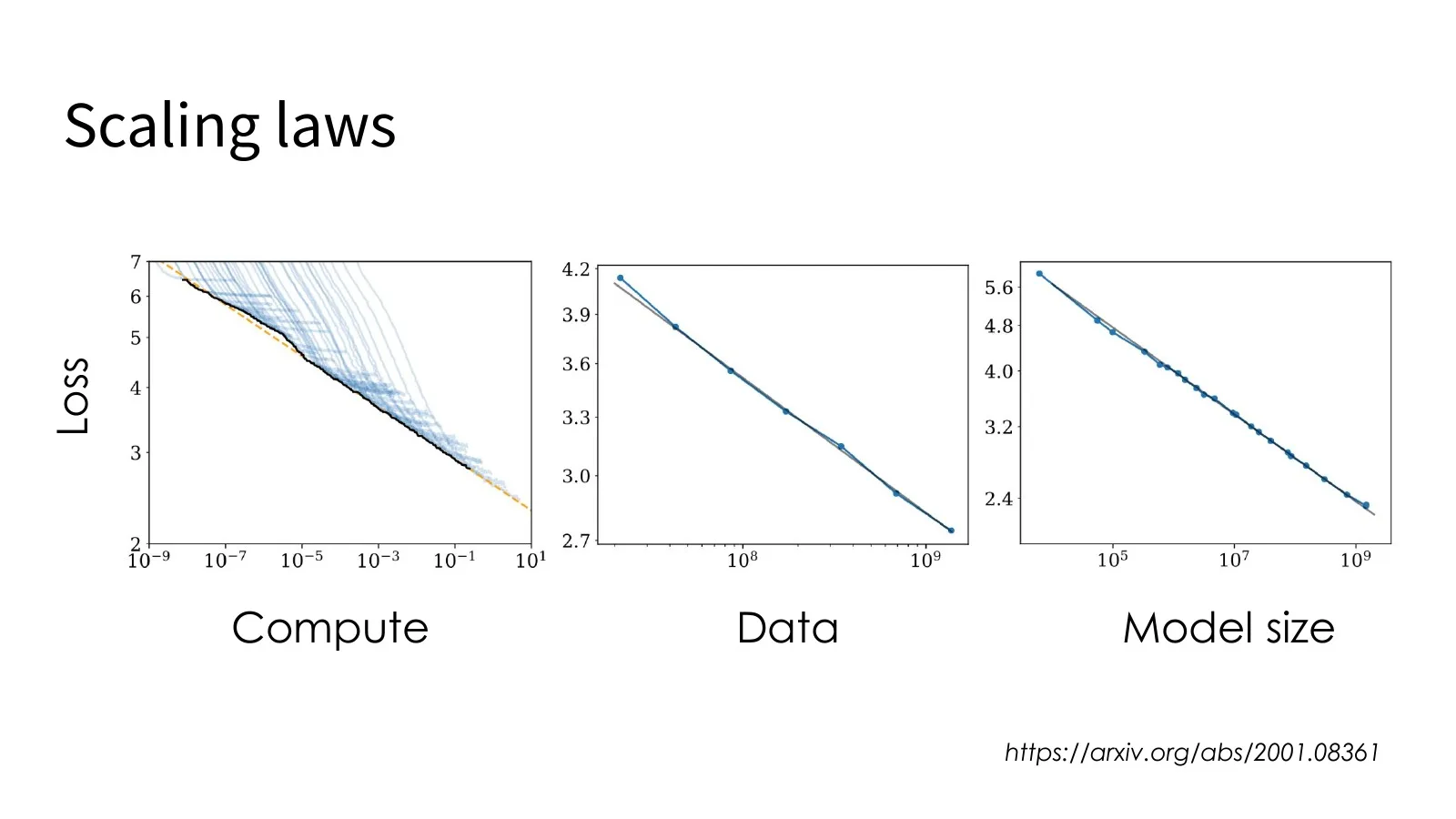
来源:Loubna Ben Allal 官方 deck,第 17 页
三张直线不能拼成无条件因果
这些图是经验边际关系。若 data quality 随规模下降、重复率上升,或模型超出优化稳定区间,同一斜率不会无限延伸。预测必须报告 fitted range 与 confidence。
从 Chinchilla 到 overtraining:optimum 发生了什么变化
时间线展示 Chinchilla 65B/1.4T、LLaMA 7B/1T、LLaMA-3 8B/15T 等趋势。团队主动让较小模型训练更多 tokens,因为一次训练的额外成本,可以换取长期更低的 inference memory、latency 与 deployment complexity。
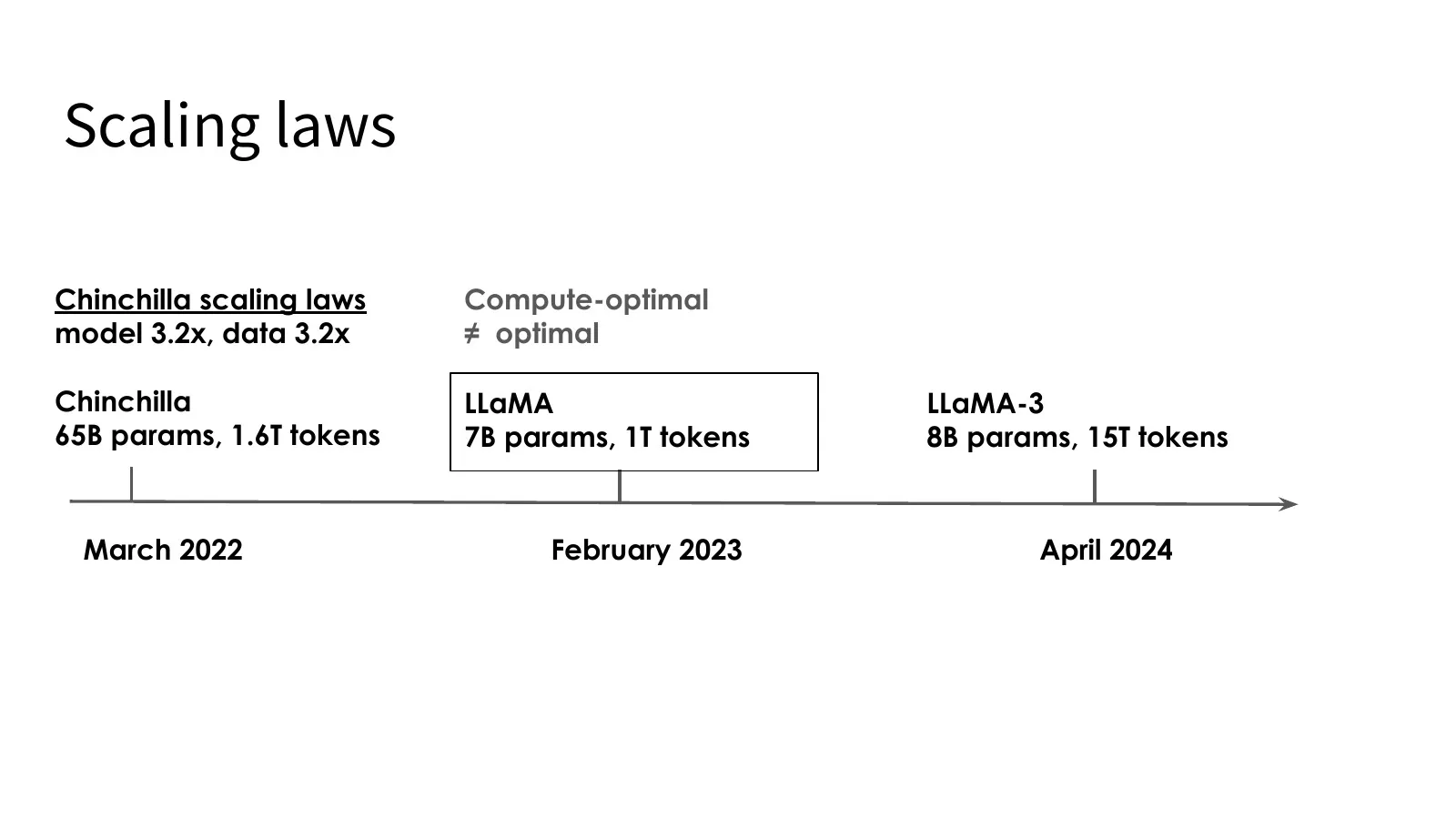
来源:Loubna Ben Allal 官方 deck,第 18 页
定义模型生命周期成本
其中 \(Q\) 是服务期总 token。若 \(Q\) 很大,多训练一个 smaller model 可能降低总成本。
课堂提示
00:09:10–00:11:10,讲者说 Chinchilla scaling law 没把 inference cost 放入目标,所以今天会选择更小、训练更久的模型,并在训练时多付一次成本。
GPT-1 到 GPT-4:scale 同时放大训练与服务账单
前面的 optimum 讨论仍然很抽象;这里用 GPT 系列的数量级变化把训练和服务账单放到同一画面。slides 用 dataset/model size 和粗略训练成本展示规模增长,数字是公开估计而不是审计账本;其教学作用是提醒读者,参数增大不仅影响一次训练,也使每 token latency、GPU memory 和并发服务长期变贵。
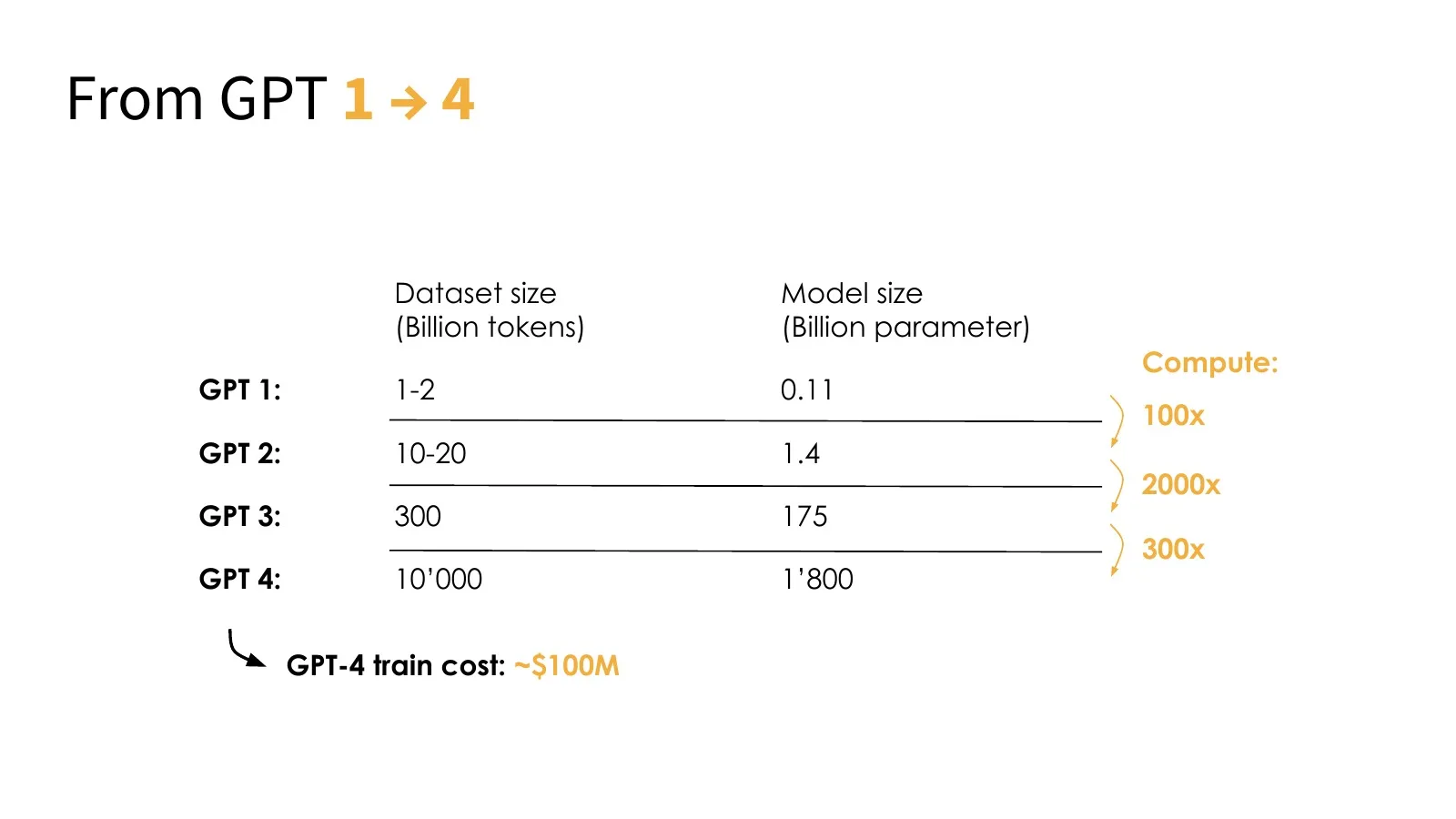
来源:Loubna Ben Allal 官方 deck,第 19 页
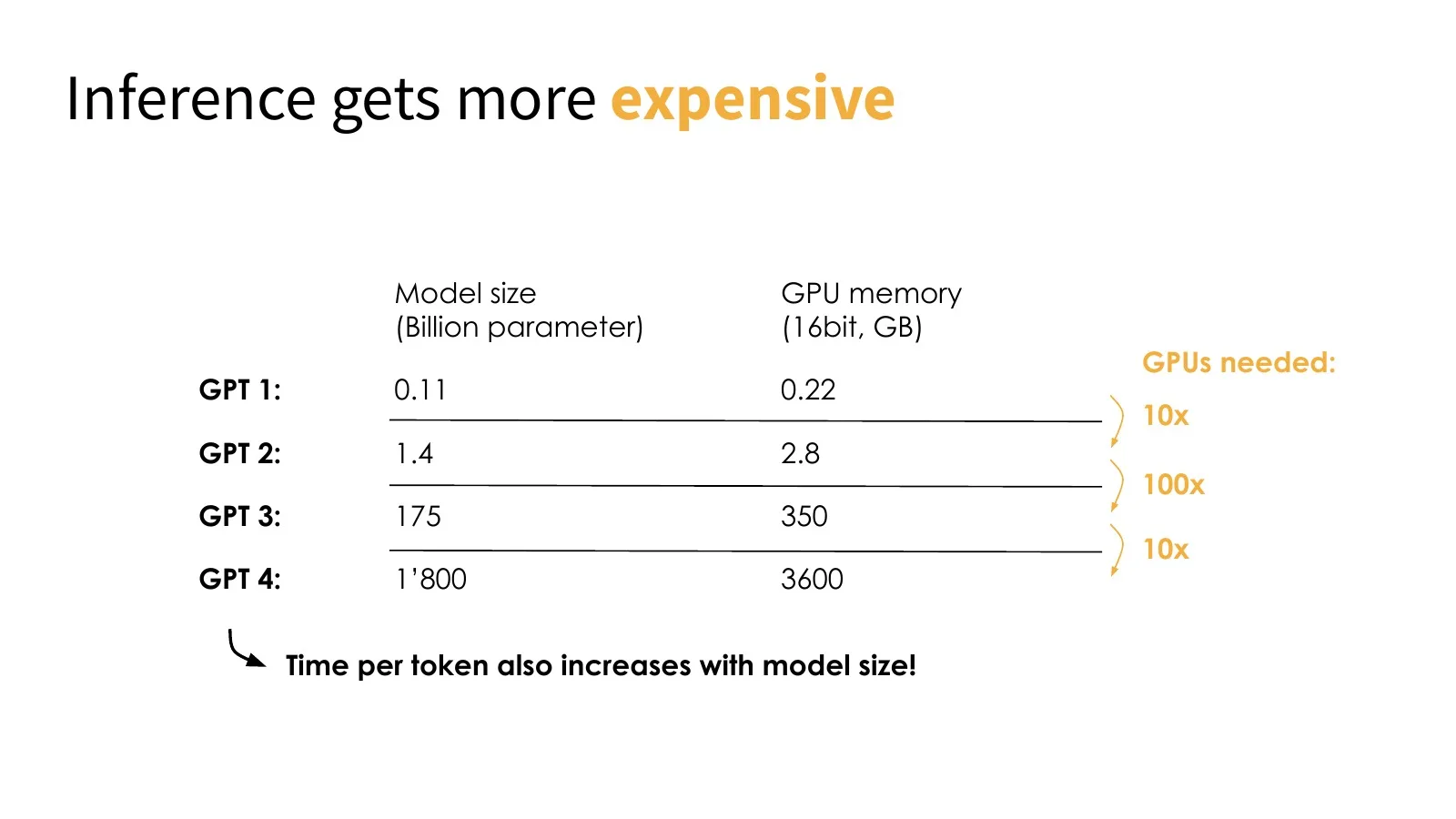
来源:Loubna Ben Allal 官方 deck,第 20 页
若权重精度为 \(b\) bytes,单份权重 memory 至少为
还需 KV cache、activations、workspace 与并行冗余。量化降低 \(b\),但不自动降低所有 compute 和 bandwidth bottleneck。
为什么 IDE code model 偏好更小
代码补全要求低 latency、高并发、较长 repository context,用户每次按键都可能触发请求。一个 benchmark 更强但延迟更高的模型,未必是产品 optimum;这也解释 StarCoder2 提供多种尺寸。
Compute-optimal 不等于 optimal:Harm's law 的警告
上一节说明大模型会反复支付 inference cost;本节因此把目标从单次训练 loss 改成生命周期成本。两页 slide 写明:smaller model 训练更久会提高 upfront compute,却可能降低每次 deployment 成本;所谓 “Harm's law” 只是对越过 Chinchilla 点后额外训练开销的幽默命名,不是新的自然定律。
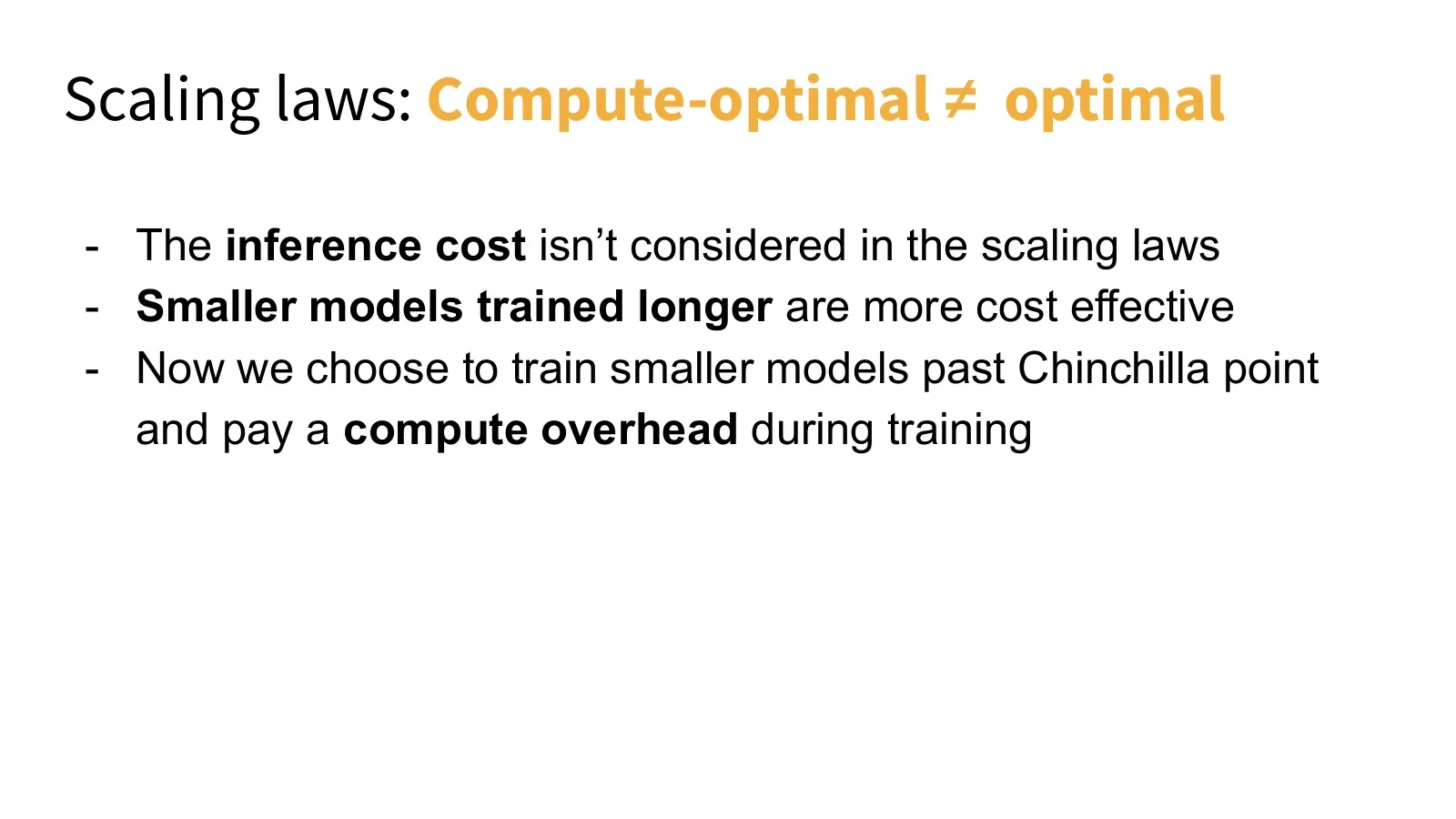
来源:Loubna Ben Allal 官方 deck,第 21 页
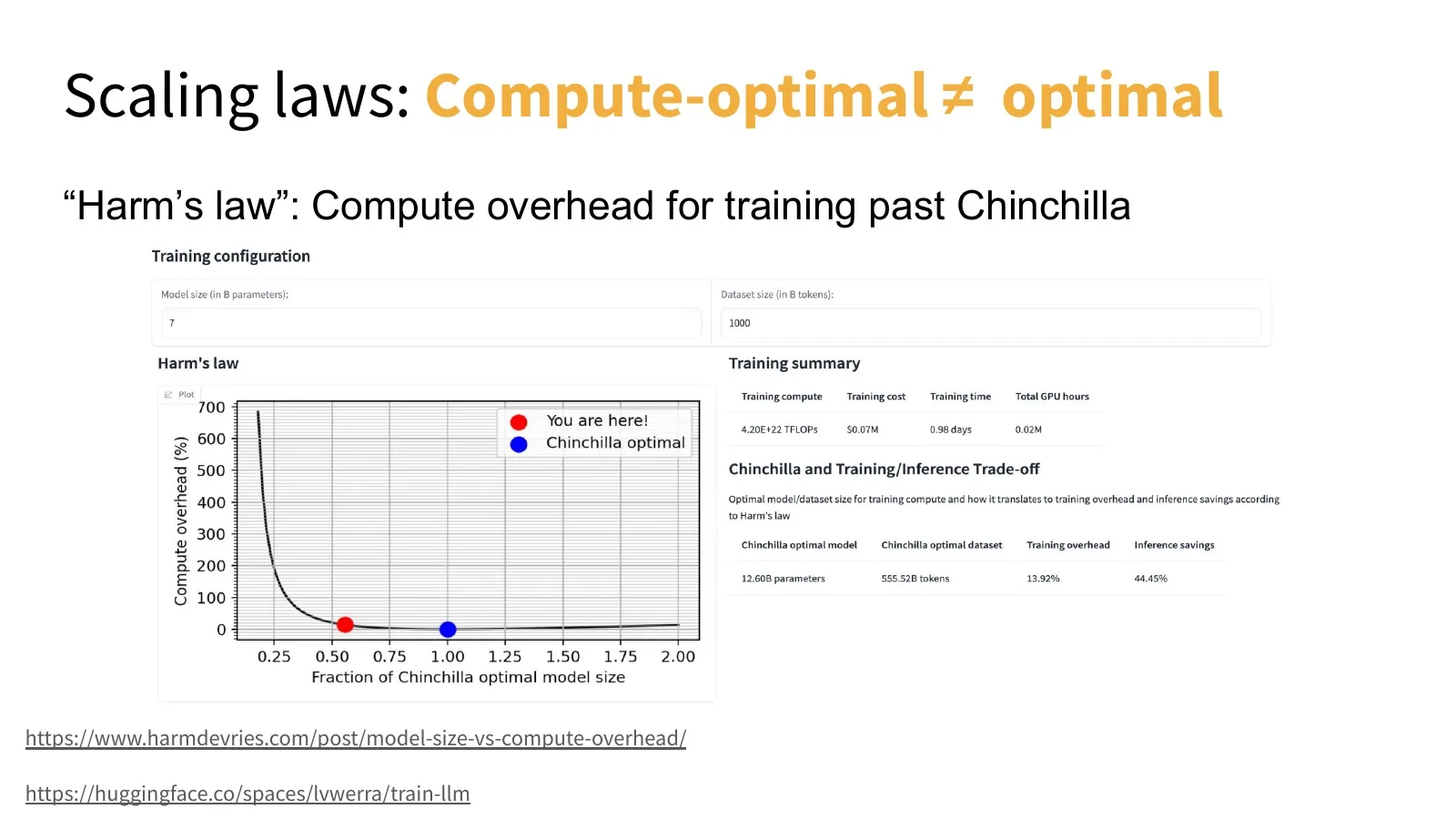
来源:Loubna Ben Allal 官方 deck,第 22 页
做决策时至少画两条曲线
一条是 training loss versus training compute,另一条是 end-to-end product cost/quality versus model size。若只优化第一条,会忽略 repeated inference、memory capacity、energy、edge deployment 与 user latency。
Data constraint 与 quality 会移动 scaling curve
进一步阅读页引入 data-constrained scaling 和 DeepSeek LLM:有限 unique data 时,重复训练会改变收益;更高质量 corpus 也会改变 model/data allocation。换句话说,\(D\) 不只是 token 计数,还带 distribution 和 quality。
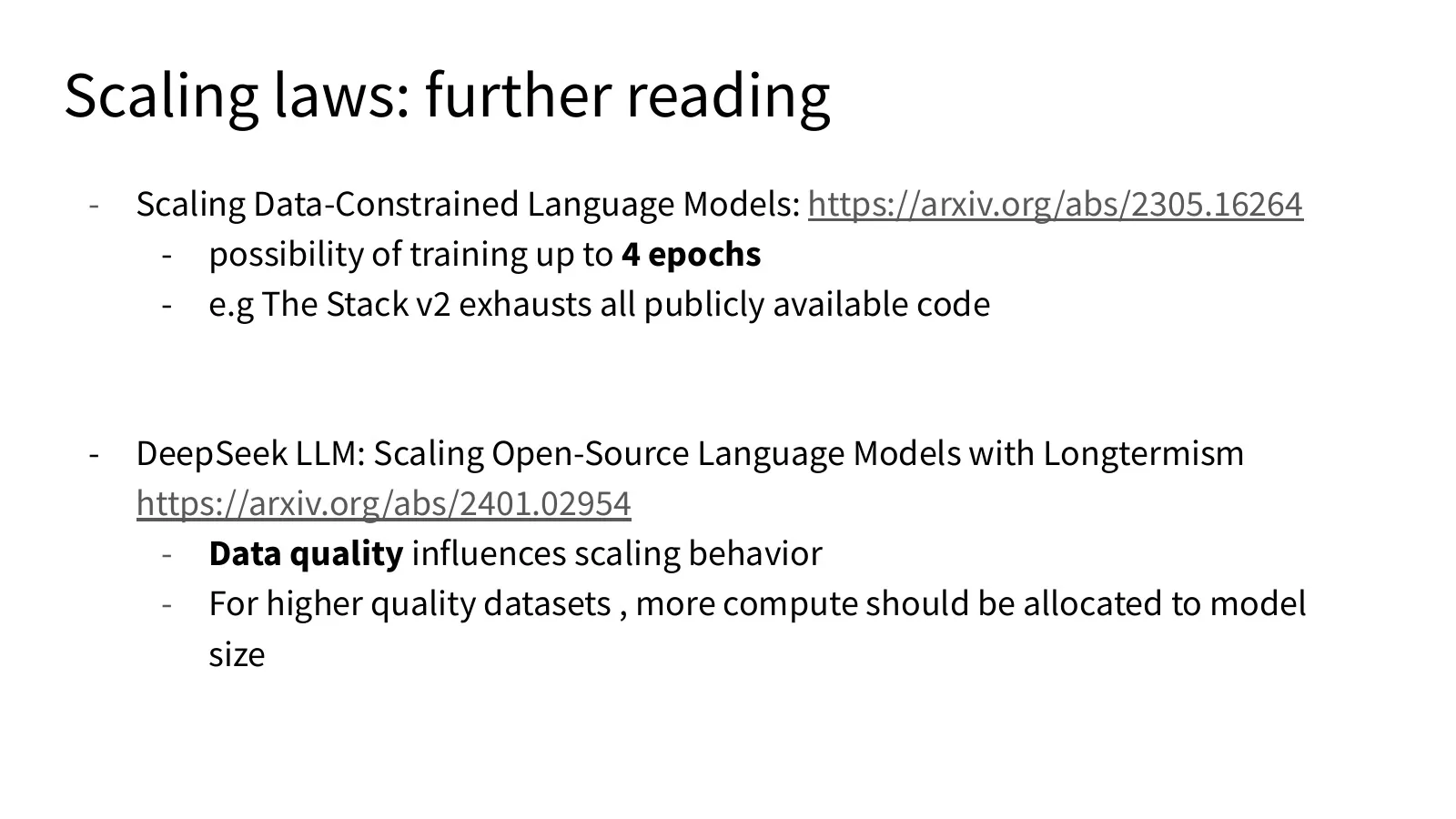
来源:Loubna Ben Allal 官方 deck,第 23 页
Domain scaling 仍是 underexplored 问题
Q&A 中讲者说 Chinchilla 在 English/code 间有一定支持,但 medical 等 domain 可能不同;甚至同 domain 换成更 curated data,optimum 也可能移动。不要把 generic web fit 直接复制到专门领域。
课堂提示
00:11:10–00:13:20,讲者把 data quality 和 domain 作为 scaling-law caveat,并指出 DeepSeek 的结果说明同一领域的数据集变化也会改变分配。
本章小结
Scaling law 回答“固定训练 compute 下怎样分配”,却不回答整个模型生命周期。真正的 optimum 还取决于 serving volume、memory、latency、unique-data constraint、domain 与 quality,因此现代团队常选择更小模型加更多 tokens。
数据从哪里来:Web、Code、Curated 与 Synthetic
有了 token budget 后,第二个问题是 source。不同来源不仅内容不同,还带来不同的抓取、许可、去重、格式和 verification 成本。课程把来源分成 web data、GitHub/code、curated sources 和 synthetic data;StarCoder 则展示 code corpus 怎样做成可检查的数据产品。
Source taxonomy:来源决定后续治理成本
上一章只估算 token budget,本节开始回答这些 tokens 从哪里来,因为 source 会决定后续的 filter、license 和 evaluation 成本。Web 覆盖广但噪声大,GitHub 有结构和许可元数据但含重复与 secrets,curated sources 质量高但规模有限,synthetic data 可定向生成却依赖 teacher、prompt 与 seed diversity。
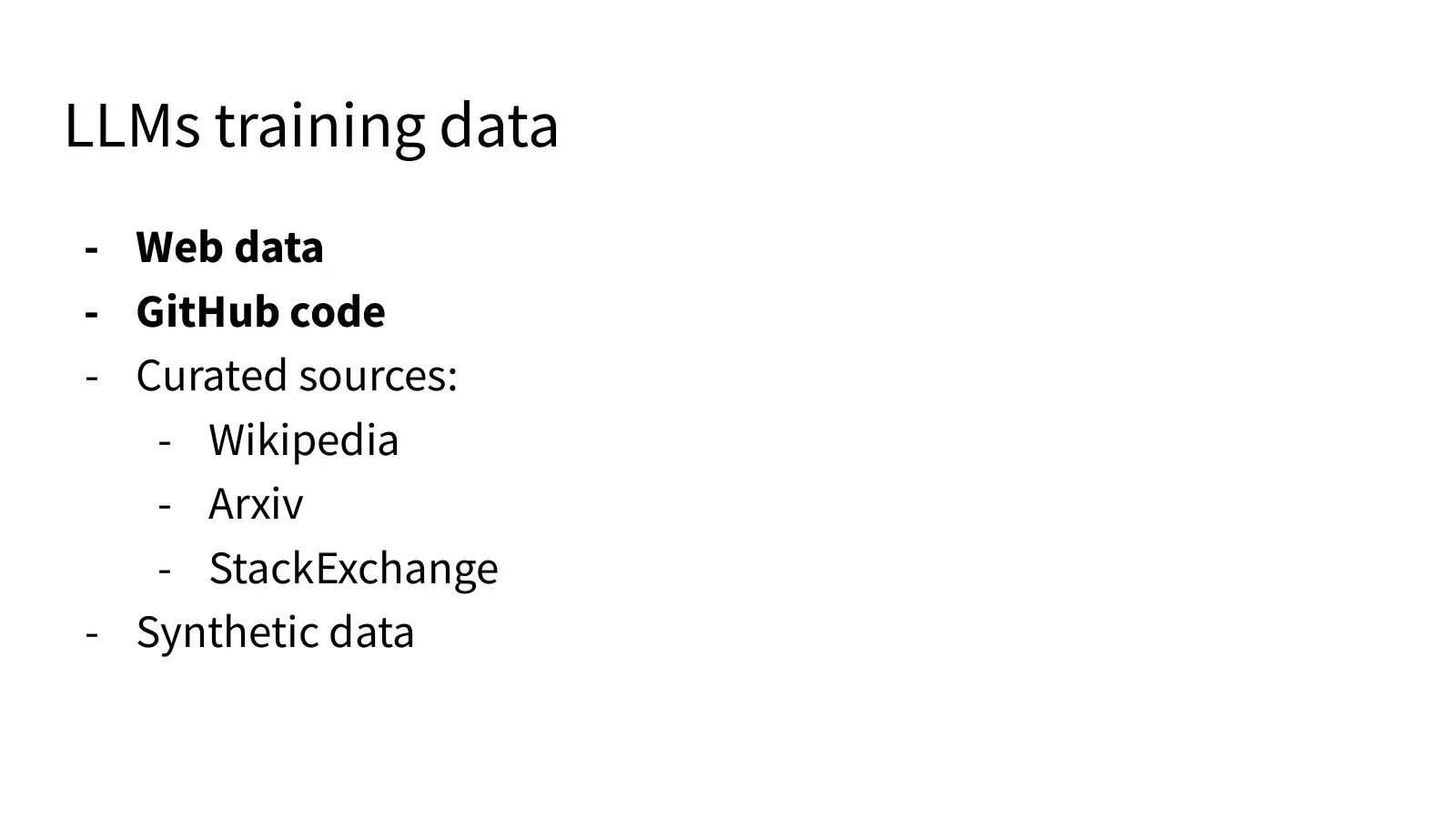
来源:Loubna Ben Allal 官方 deck,第 26 页
来源不是互斥标签
代码仓库包含 README/Markdown,自然语言网页包含代码,synthetic prompts 又常从 web/curated documents 派生。实际 mixture 应按 provenance 和 transformation lineage 记录,而不是只写最终 domain 百分比。
Common Crawl:规模大到必须先过滤再下载/处理
Common Crawl 提供周期性网页快照,raw corpus 可达数百 TB。直接 tokenize 不仅昂贵,还会保留 boilerplate、spam、machine-generated pages、duplicates、PII 与低质量文本,因此通常复用已有 filtered web dataset 或做 distributed filtering。
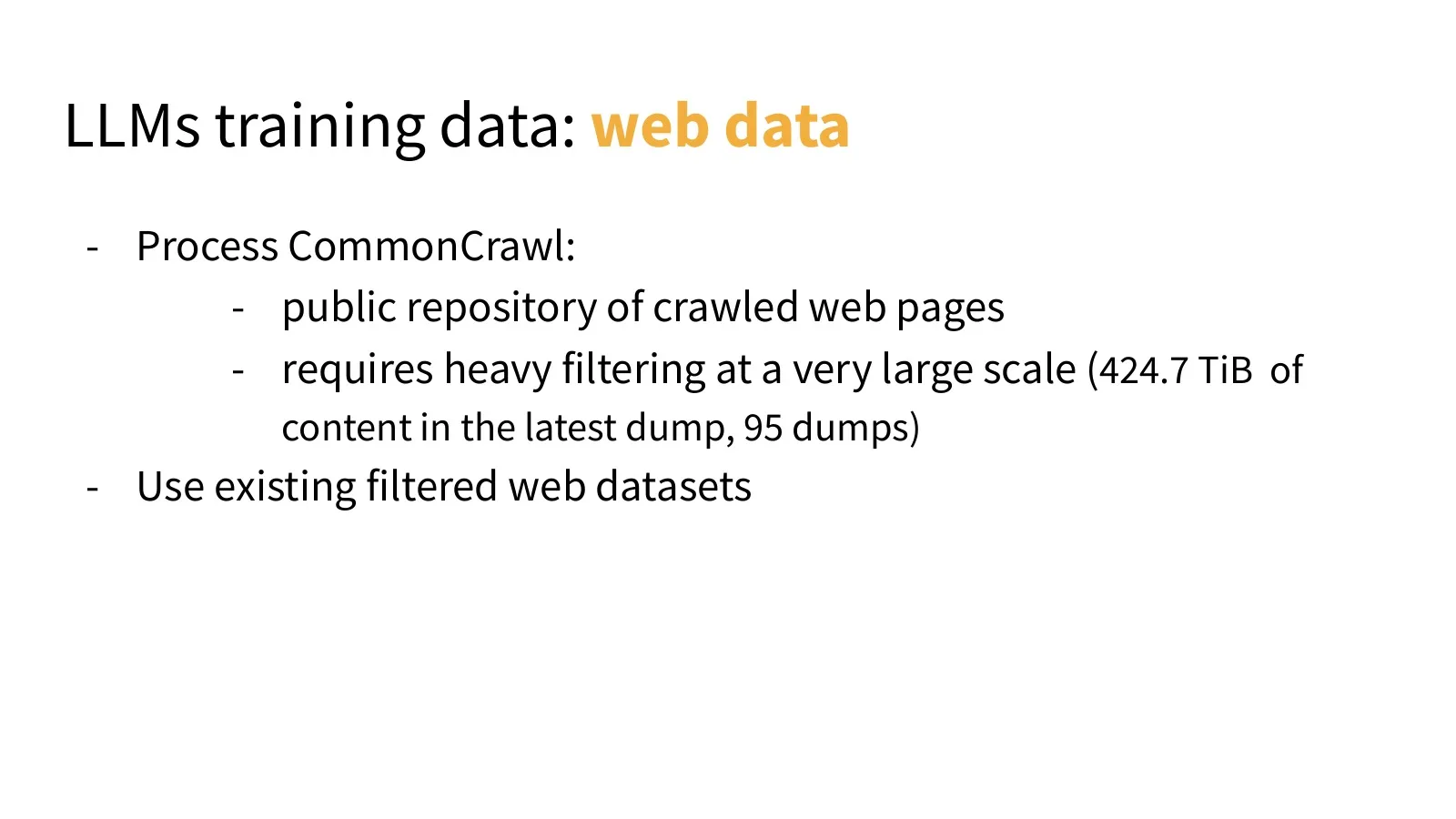
来源:Loubna Ben Allal 官方 deck,第 27 页
抓到网页不等于拥有训练许可
可访问性、robots、copyright、terms、personal data 与 jurisdiction 是不同问题。技术 pipeline 能记录来源和移除样本,却不能自动解决所有法律与伦理判断。
课堂提示
00:13:20–00:16:20,讲者强调 Common Crawl 的原始规模和 filtering cost,建议理解已有 dataset 的处理过程,而不是把 raw crawl 当作即用数据。
FineWeb:更好的 filter 用 early-training curve 证明
FineWeb slide 比较多个 web corpora 上的小模型训练曲线。读图时应先确认相同 architecture、token budget、evaluation 和 seed,再看哪个 corpus 更快达到较高 score。曲线支持的是 filter pipeline 在该设置下优于对照,不是任何模型/任务都最优。
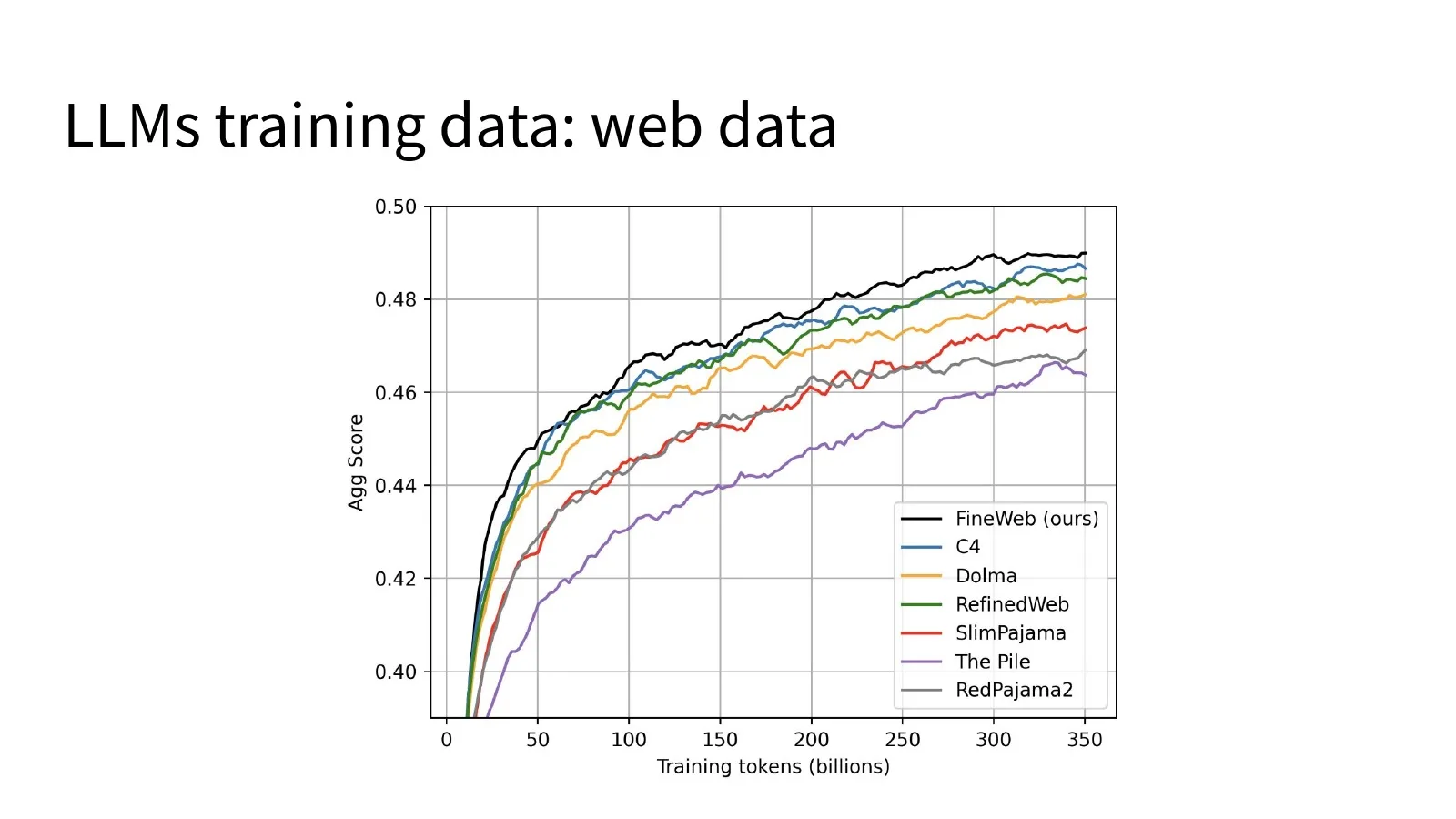
来源:Loubna Ben Allal 官方 deck,第 29 页
Data quality 的 operational definition
高质量不是“看起来像好文章”。在预训练里,它应表现为更低 validation loss、更快 downstream learning、更少 memorization/toxicity/PII、更好 domain coverage,且在 matched compute 和多 seeds 下成立。
The Stack:代码数据需要 raw collection、inspection 与 opt-out
代码不像纯文本网页:文件有 repository、path、license、language、stars、commit history 等结构,也可能包含 generated files、vendor copies、secrets 与 benchmark solutions。The Stack pipeline 因此不仅抓取,还要语言检测、license/metadata 管理、dedup 和社区 inspection。
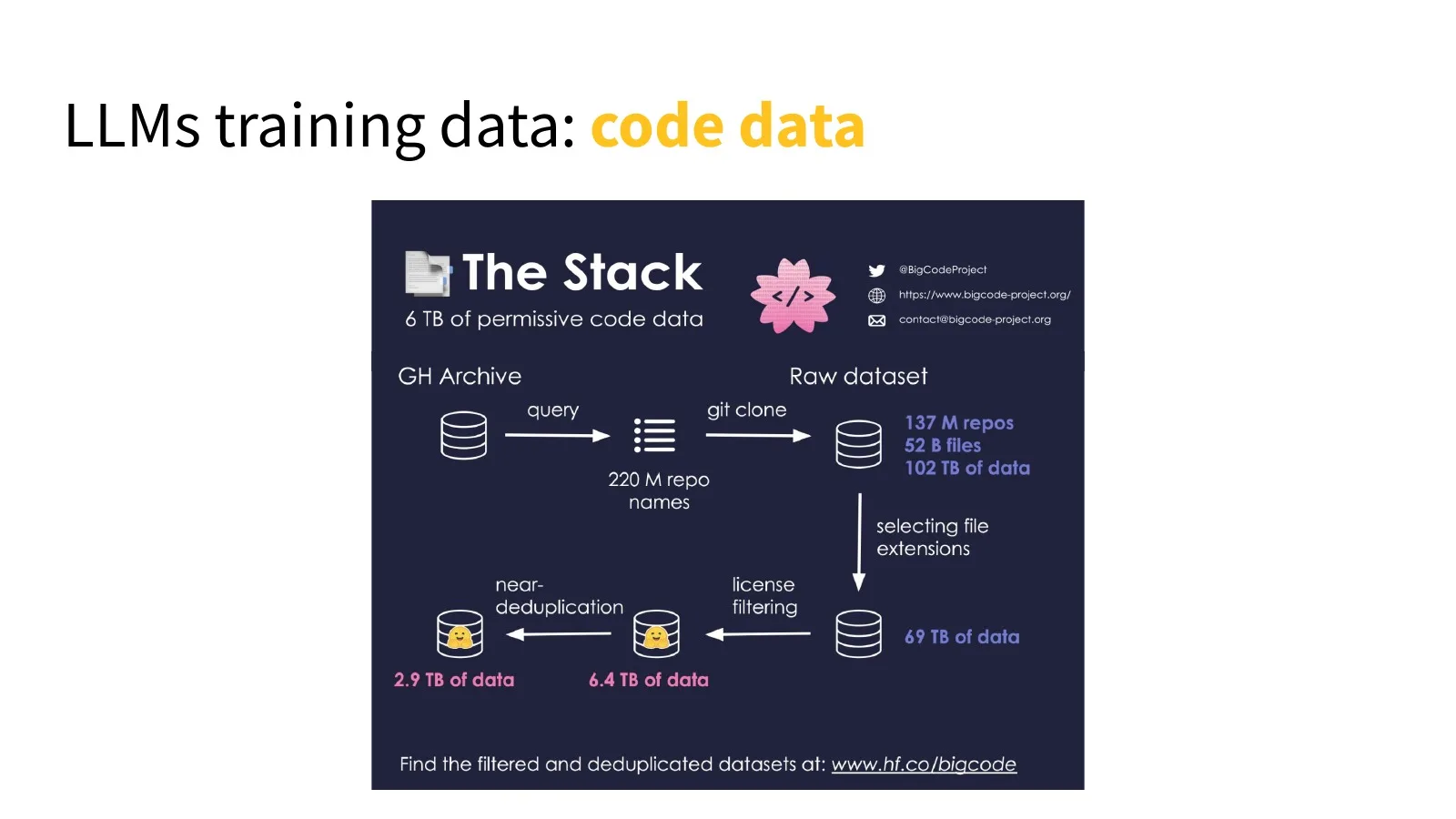
来源:Loubna Ben Allal 官方 deck,第 30 页
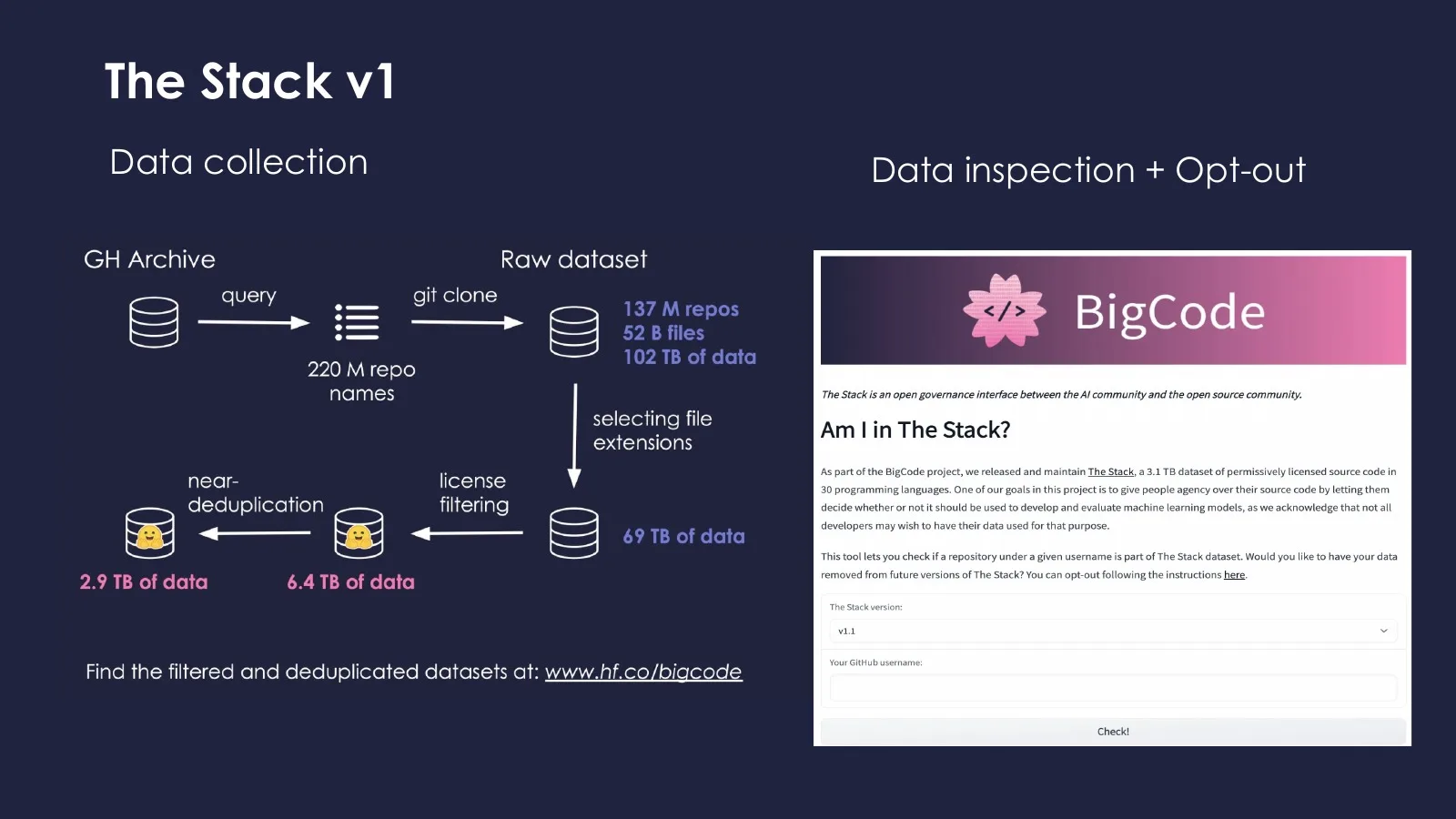
来源:Loubna Ben Allal 官方 deck,第 31 页
Opt-out 在 pipeline 中的位置
Opt-out 需要 stable repository/file identifiers、公开查询工具、处理请求的版本化列表,以及 future retraining 时的排除机制。它不是训练完成后删一个网页链接,而是 data lineage 的一部分。
课堂提示
00:17:10–00:19:10,讲者说明 BigCode 在 v1 发布 inspection tool 和 opt-out form,让开发者能检查代码并请求未来训练排除;这是开放数据项目的核心设计。
The Stack v2:Software Heritage 与更多开发过程数据
v2 不再主要依赖直接 clone GitHub,而从 Software Heritage archive 提取,并加入 issues、pull requests、commits、Jupyter/Kaggle notebooks、math/coding datasets。这样 corpus 不只教最终代码,还包含问题、修改、讨论和执行环境。
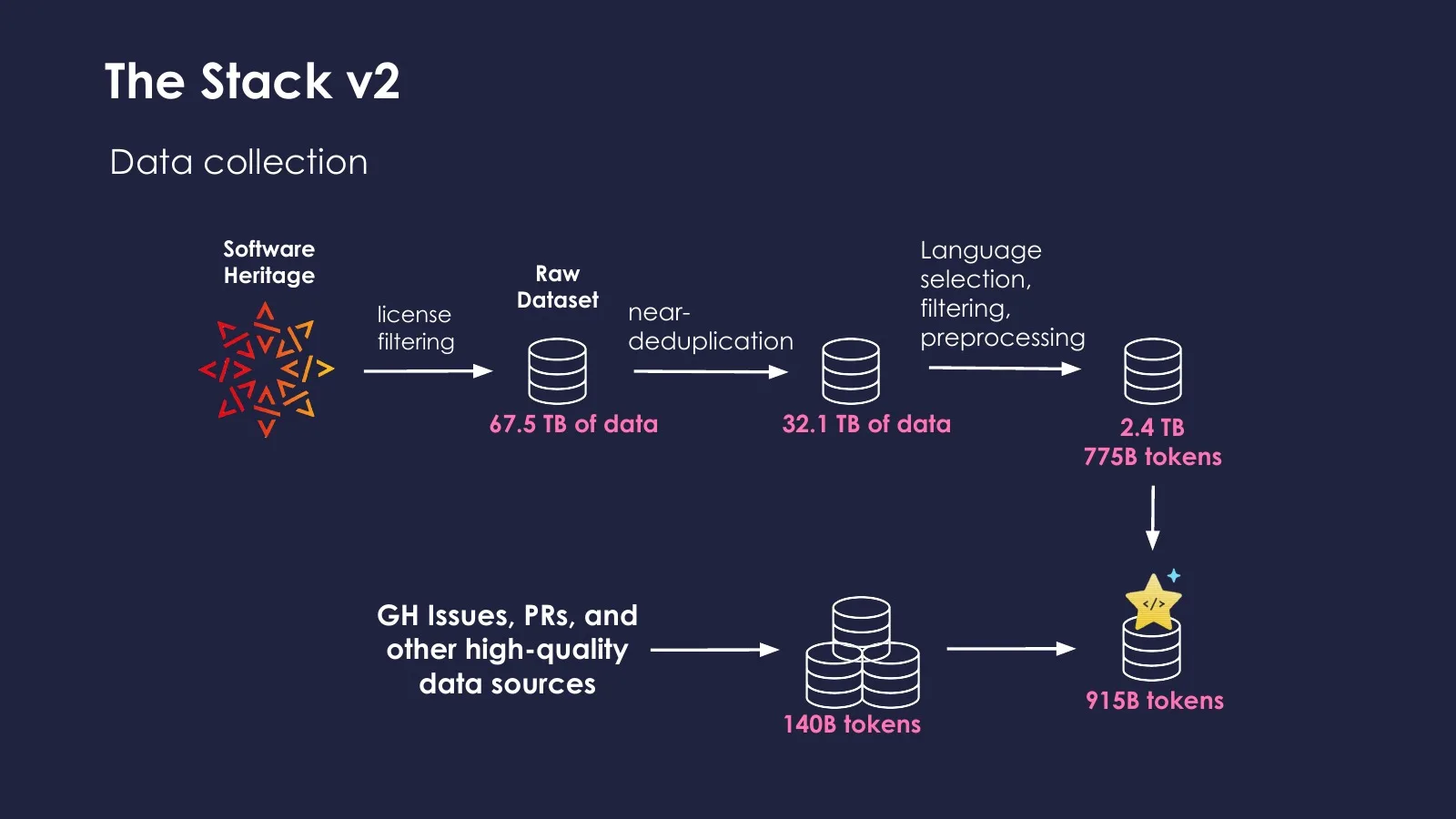
来源:Loubna Ben Allal 官方 deck,第 32 页
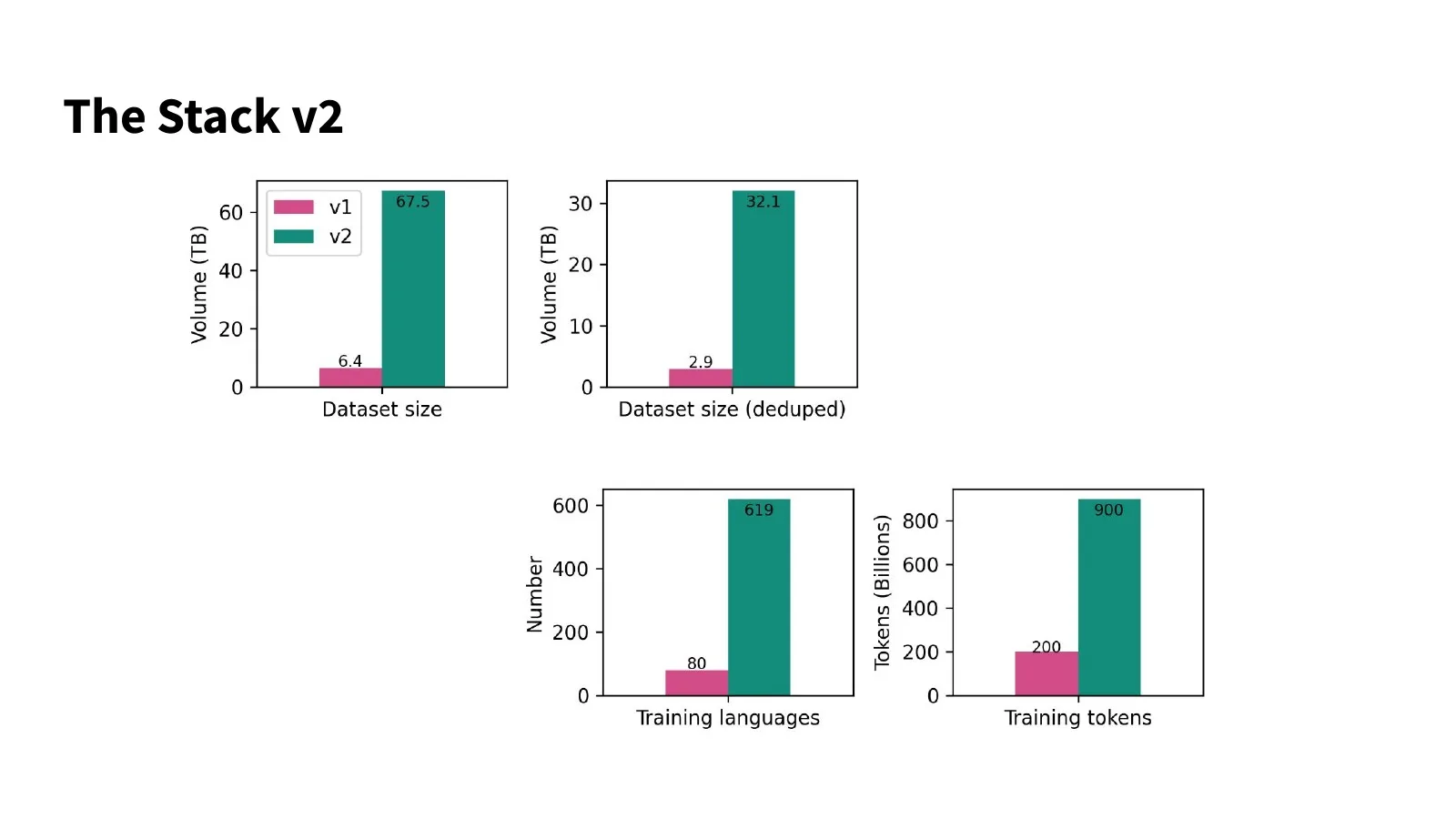
来源:Loubna Ben Allal 官方 deck,第 33 页
Raw scale 与 usable scale 的差距就是工程量
v2 raw size 约为 v1 的十倍,而过滤后仍约为 v1 的四到五倍。被删除的绝大部分不是“浪费”,而是 duplicates、低质量、unsupported formats、PII 或不合适语言;过滤率本身不代表好坏,需看保留 diversity 与模型结果。
课堂提示
00:19:10–00:20:20,讲者把 v2 的关键改进放在 archive source、更多语言和辅助开发数据,而不仅是“token 更多”。
Synthetic data:从 Phi 到可控生成 corpus
Textbooks Are All You Need/Phi 系列展示用 GPT-3.5/4 生成高质量教材式数据,可以用远少于 web-scale 的 corpus 训练强小模型。它引发的不是“synthetic 取代真实数据”定论,而是把 generator、prompt、seed、verification 变成新数据工程变量。
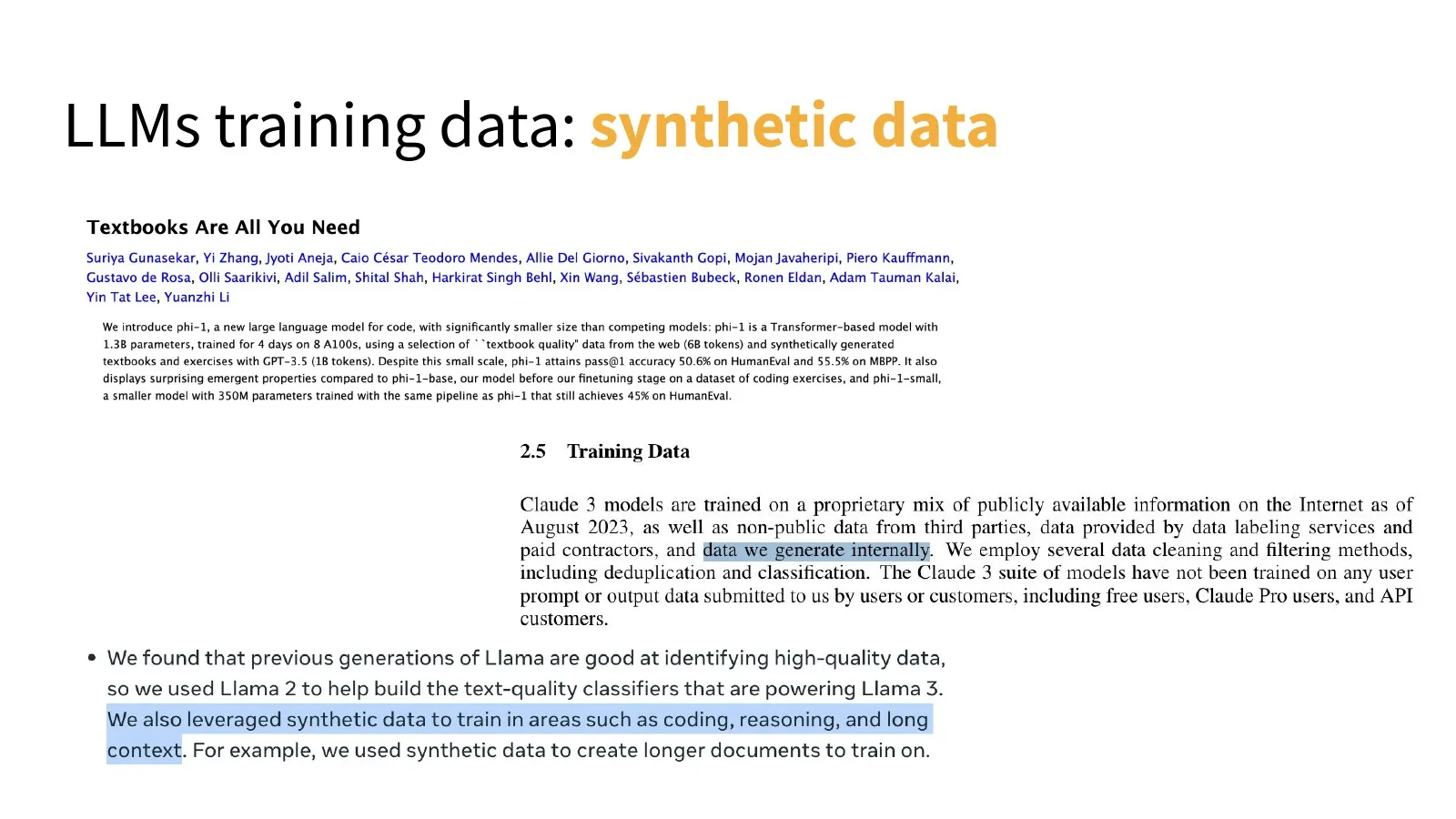
来源:Loubna Ben Allal 官方 deck,第 34 页
设 seed/context 为 \(s\)、prompt template 为 \(p\)、generator 为 \(G\),synthetic sample 为
数据质量取决于 \(s\) 的覆盖、\(p\) 的约束、\(G\) 的能力与后验 verifier \(v(y)\),不能只靠采样数量。
Synthetic feedback loop
若 generator 和 verifier 共享盲区,重复生成会放大风格同质化、事实错误与 representation collapse。应记录 teacher/version、seed provenance、rejection reasons、novelty 与 human spot checks。
Cosmopedia:用 web/curated seeds 扩大多样性
Cosmopedia 使用 Mixtral-8x7B 生成约 25B tokens 的教材、博客、故事等。核心技巧不是一句“让模型写课本”,而是从 web samples、Stanford courses、WikiHow 等抽取 context,把 topic 与具体 seed 一起放入 prompt,限制 hallucination 并增加主题分散度。
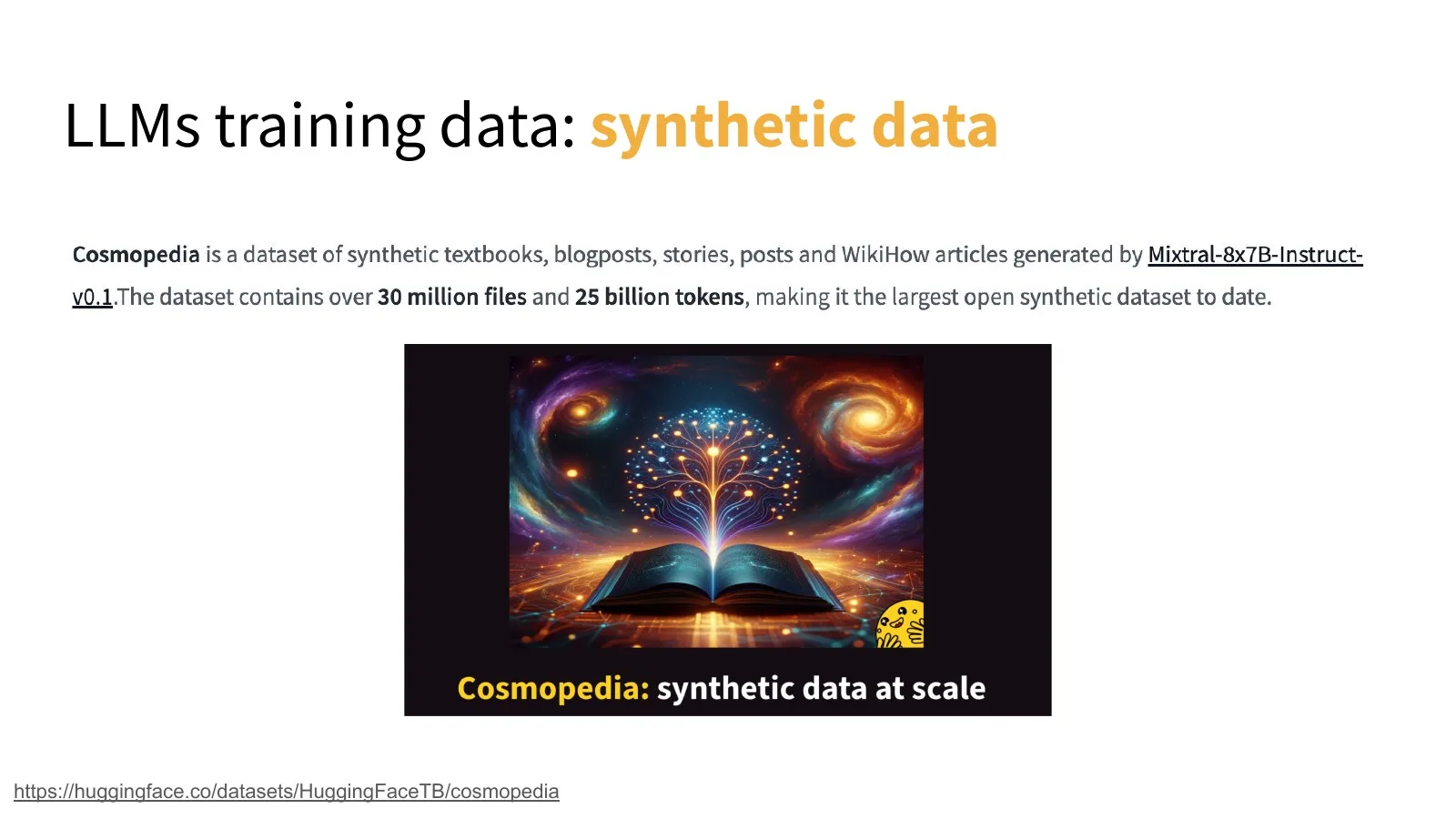
来源:Loubna Ben Allal 官方 deck,第 35 页
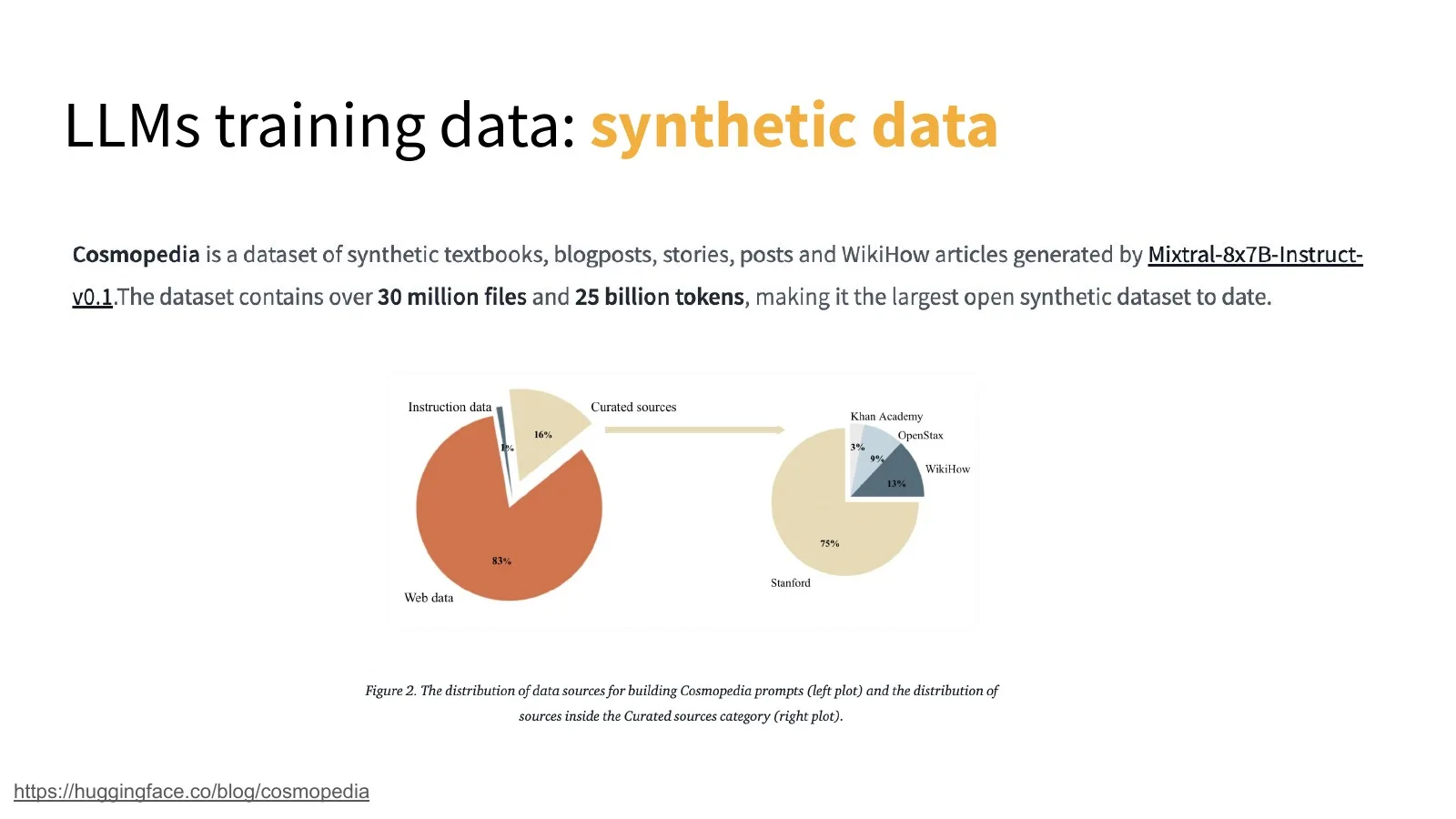
来源:Loubna Ben Allal 官方 deck,第 36 页
Synthetic corpus 的四项审计
- Coverage:topic、language、difficulty、style 是否分散?
- Grounding:生成是否受 seed/context 约束?
- Verification:事实、代码、数学是否有自动/人工检查?
- Lineage:teacher、prompt、seed、filter 与 license 是否可追踪?
课堂提示
00:20:20–00:24:20,讲者说 synthetic data 很新、很有前景,也“very tricky”获得 diversity。Cosmopedia 用大量 web/curated seeds,而不是从少数空泛 prompts 无限扩写。
本章小结
数据 source 决定后续处理成本。Web 提供覆盖,code 提供结构,curated sources 提供高 signal,synthetic data 提供定向扩展;任何来源都必须附带 provenance、filter、license/opt-out 与 evaluation 设计。
怎样发现好 Filter:不要相信直觉,先跑 Ablation
“清洗数据”最容易被写成规则清单,但真正困难的是判断规则是否提升模型。课程把 filter discovery 变成实验科学:manual inspection 提出候选,small-model ablation 估计因果效果,多个 seeds 和 high-signal benchmarks 降低噪声。
从质量主张到可执行 pipeline
第一张 evidence slide 引用 Yi/Open Foundation Models 的观点:standard architecture 加高质量数据也能表现很强。它只提供动机;下一页才展示 language filtering、quality rules、dedup、semantic/topic 等可执行 stages。
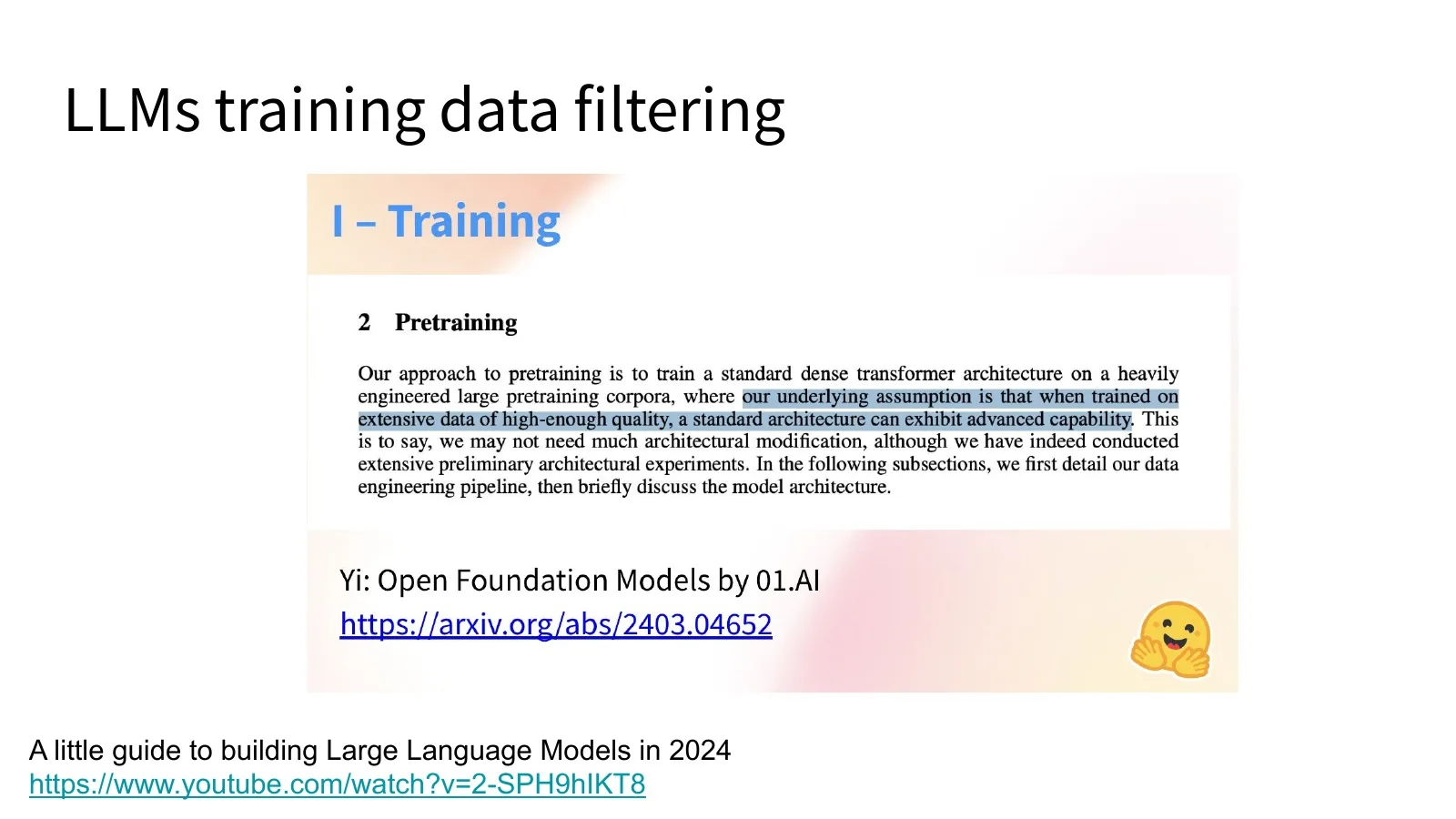
来源:Loubna Ben Allal 官方 deck,第 39 页
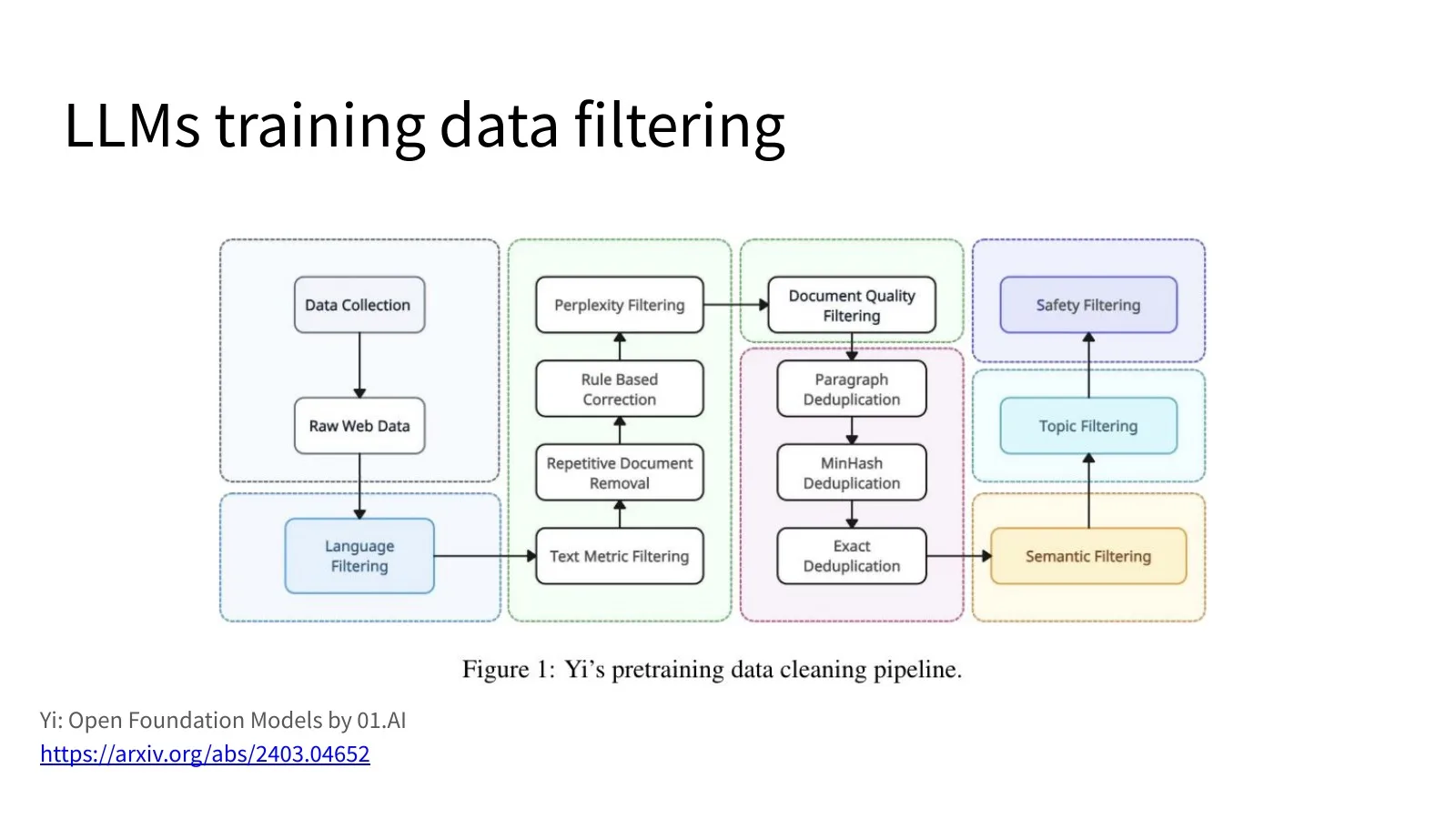
来源:Loubna Ben Allal 官方 deck,第 40 页
常见 rule/perplexity filter 可写成保留条件
其中 \(q(x)\) 是长度、重复行、符号比例等 heuristic,\(r\) 是 reference model。阈值 \(a,b,\tau\) 必须用样本和 ablation 校准。
Perplexity filter 的双刃剑
高 PPL 可能是垃圾,也可能是稀有语言、代码、公式或新知识;低 PPL 可能是模板与重复。使用 reference-model PPL 会把其 bias 带入 dataset,应与 diversity/coverage 指标联合。
寻找最佳过滤技术:manual inspection 只是起点
前一节列出 language、rule、perplexity 与 dedup stages,但还没有回答阈值怎样选。本节把 filter 设计变成可证伪实验:先看数据并解释异常,再训练 matched-compute 小模型验证;评测选择 early-training 就有 signal 的 benchmark,并用不同 seeds 避免把 optimizer noise 当成 filter gain。
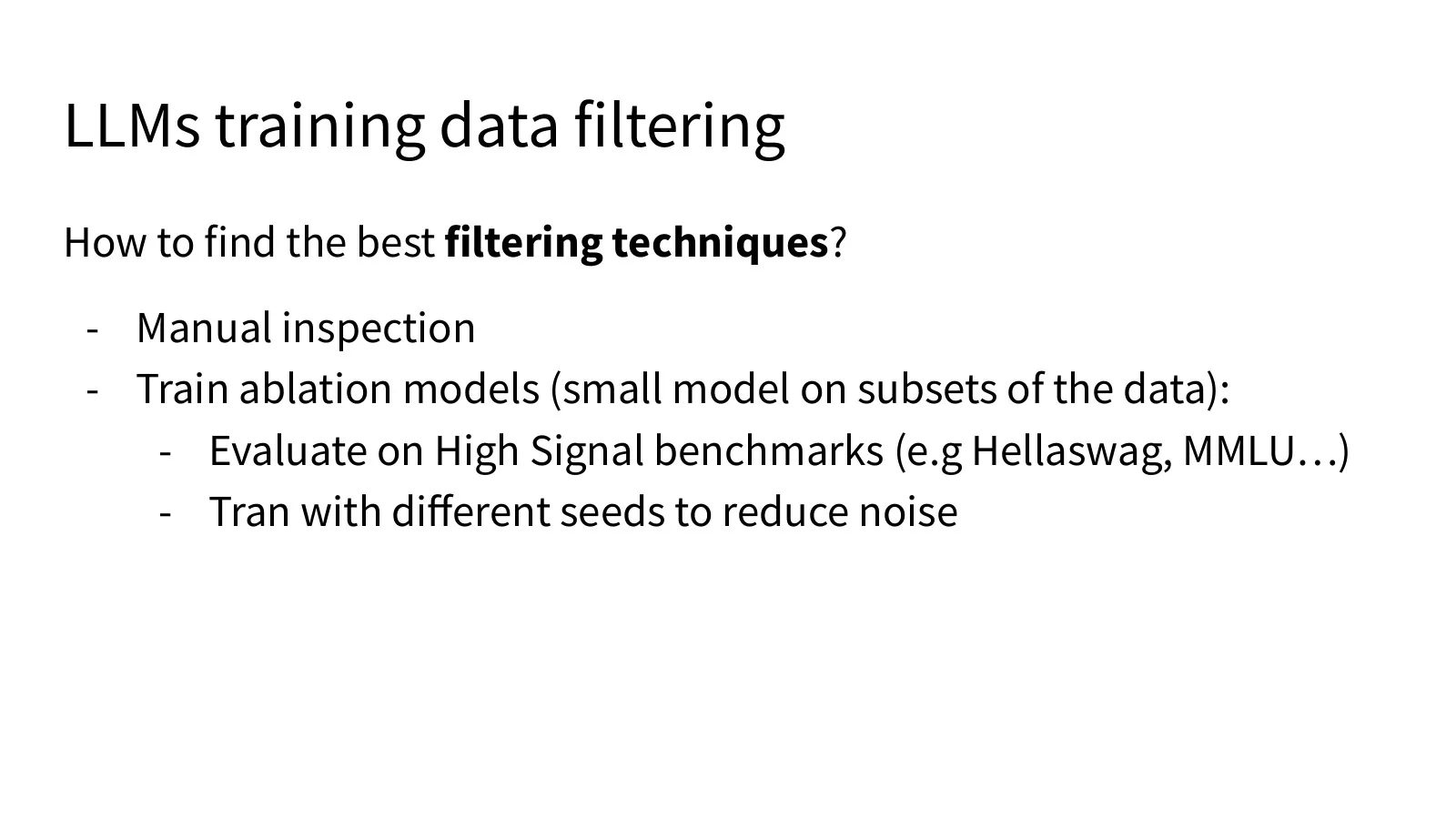
来源:Loubna Ben Allal 官方 deck,第 42 页
若 filter \(f\) 与 baseline 的分数差为 \(\Delta_s\),跨 \(k\) 个 seeds 的均值和标准误可写为
只有 effect 超过 noise,才值得把规则应用到 TB-scale corpus。
for filter_candidate in candidates:
    subset = apply_filter(raw_subset, filter_candidate)
    for seed in seeds:
        model = train_small_model(subset, matched_tokens, seed)
        scores[filter_candidate, seed] = evaluate(high_signal_suite)
compare_mean_variance_cost_and_retained_diversity(scores)
课堂提示
00:27:10–00:30:00,讲者给出两个负结果:按 comment density 过滤几乎没提升;删除少于 5 stars 的仓库移除 70% 以上数据,并训练出最差 ablation。直觉必须让位于实验。
FineWeb 的 200+ ablations:数据 recipe 也需要 search budget
FineWeb 团队训练 200 多个约 1B 参数、约 30B tokens 的 ablation models 来选择 filters。这个规模说明 data research 不是廉价预处理;它需要 model-training budget、benchmark harness 和统计纪律。
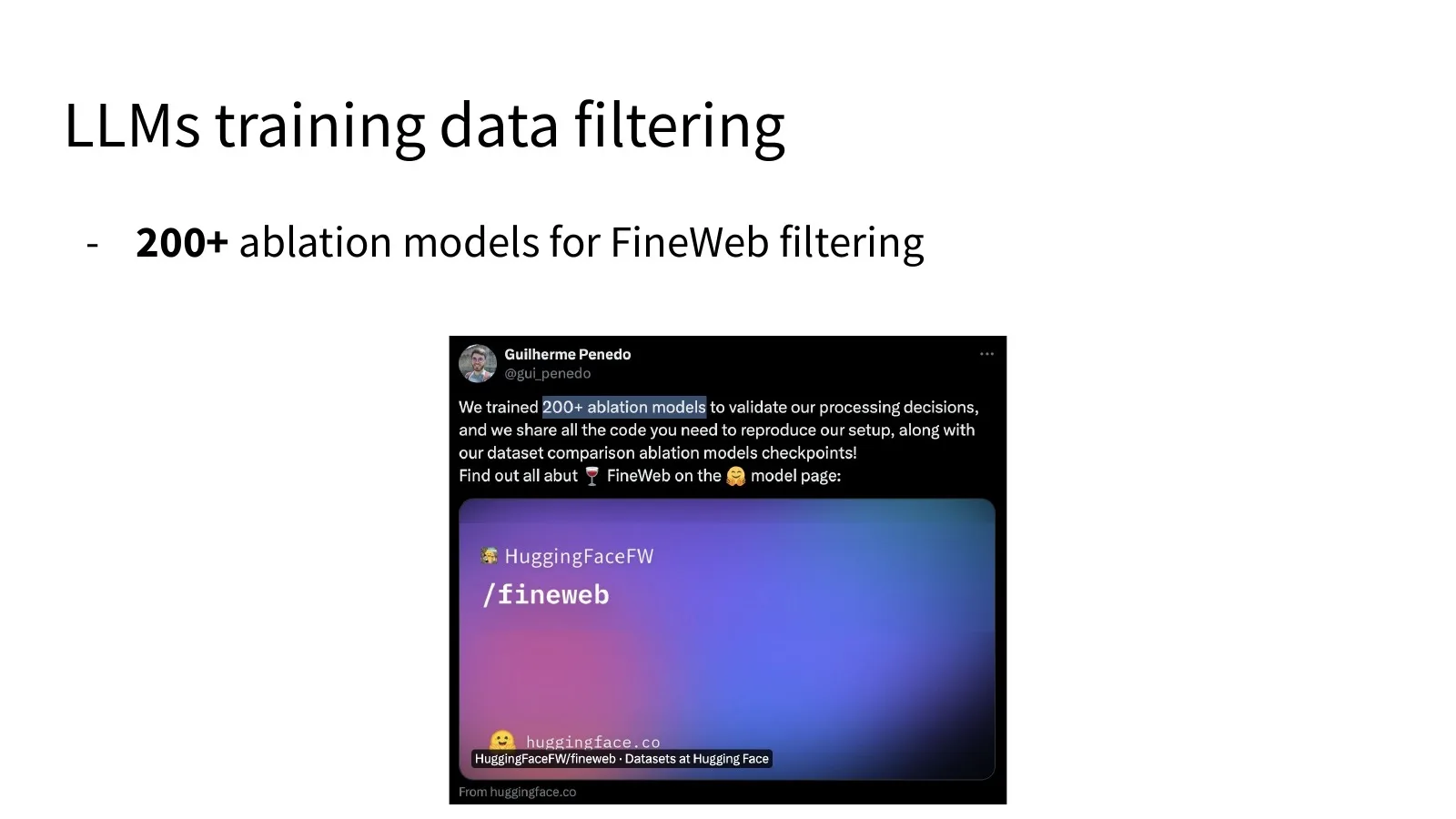
来源:Loubna Ben Allal 官方 deck,第 43 页
把 data recipe 当作 hyperparameter search
Filter type、threshold、dedup radius、language mixture、source weights 与 sampling temperature 都是超参数。与 architecture search 一样,应避免 test-set tuning,保留 held-out evaluation,并记录失败实验。
本章小结
好 filter 不是规则看起来合理,而是在 matched compute、多 seeds、多个 early-signal benchmarks 下提高模型,同时保留 diversity 与 governance 目标。Star filtering 的失败是本讲最重要的实践经验之一。
The Stack 到 StarCoder:代码数据的端到端管线
这一章把一般 filtering protocol 落到真实 code corpus。代码数据的特殊性来自语言差异、仓库复制、generated files、secrets、benchmark solutions、metadata 与结构化开发事件。每一步都会改变模型能学到的任务。
Raw 到 training data:大幅缩小不等于浪费
The Stack v1 从约 6.4TB source code 缩到 StarCoder 使用的约 800GB;v2 从约 32.1TB 缩到约 3.6TB。这个 reduction 汇总语言选择、quality rules、dedup、PII 与格式约束。
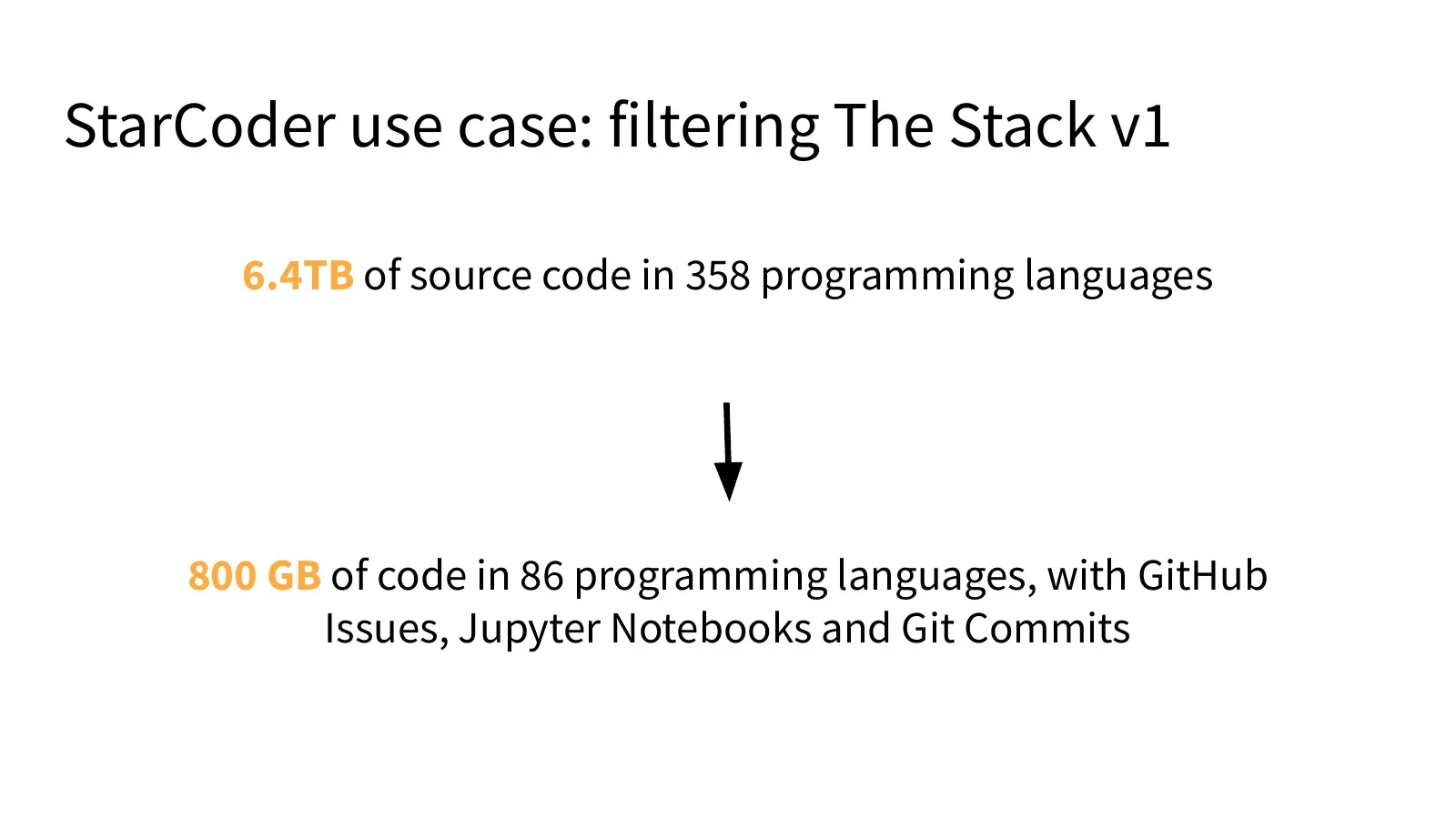
来源:Loubna Ben Allal 官方 deck,第 44 页
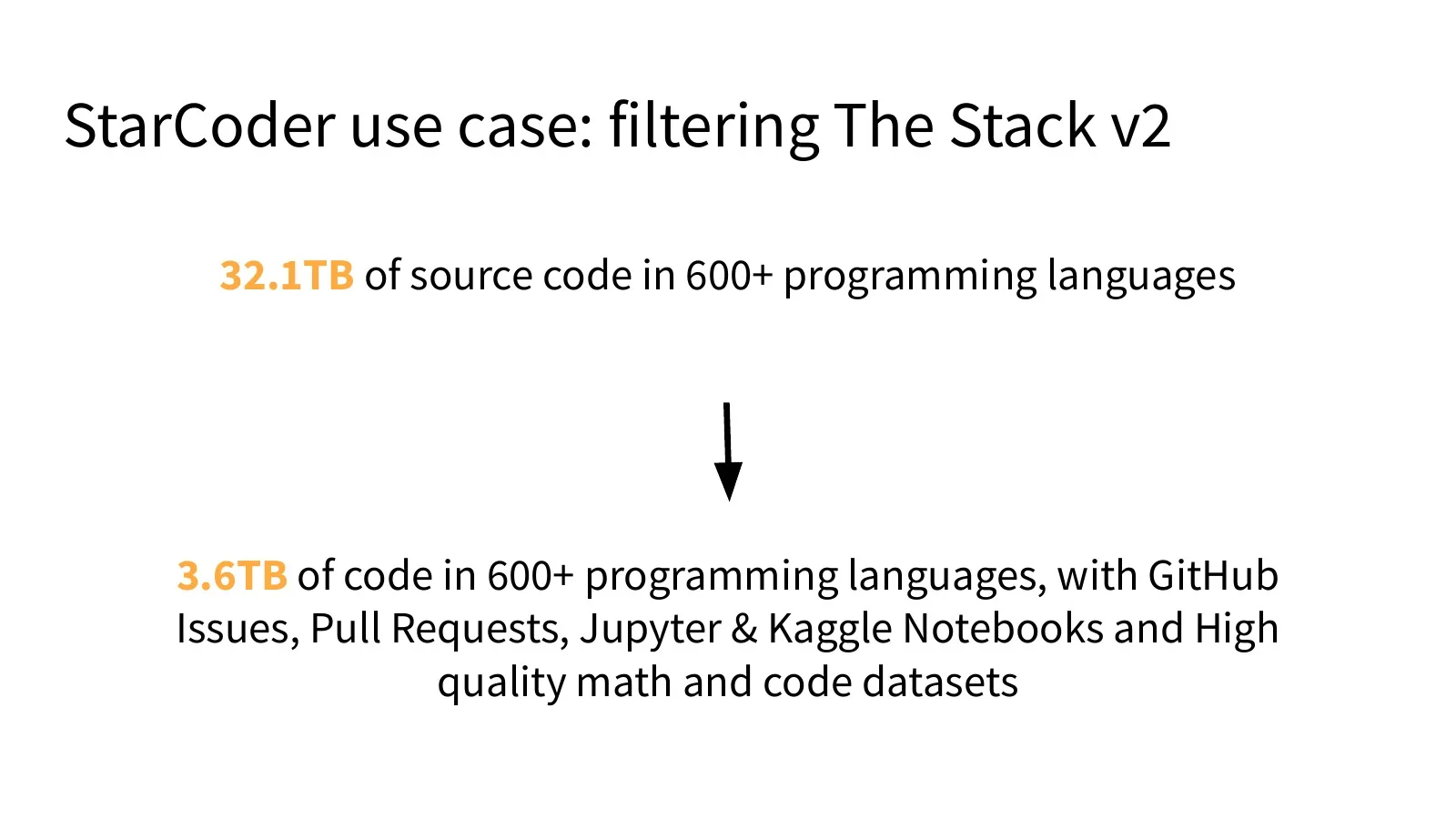
来源:Loubna Ben Allal 官方 deck,第 45 页
过滤率不是 quality metric
删除 90% 可能清掉 duplicates,也可能抹掉 rare languages;保留 90% 可能保持 diversity,也可能保留 spam。必须报告被删类型、source/language retention、token distribution 与 downstream effect。
Language selection 与 per-language thresholds
v1 从 358 languages 中选择约 86 个,排除 configs 和不维护语言;v2 扩展到 600+。平均行长、文件大小、comment ratio 等统计不能共用一个阈值,因为不同语言 idiom 和 generated-code patterns 不同。
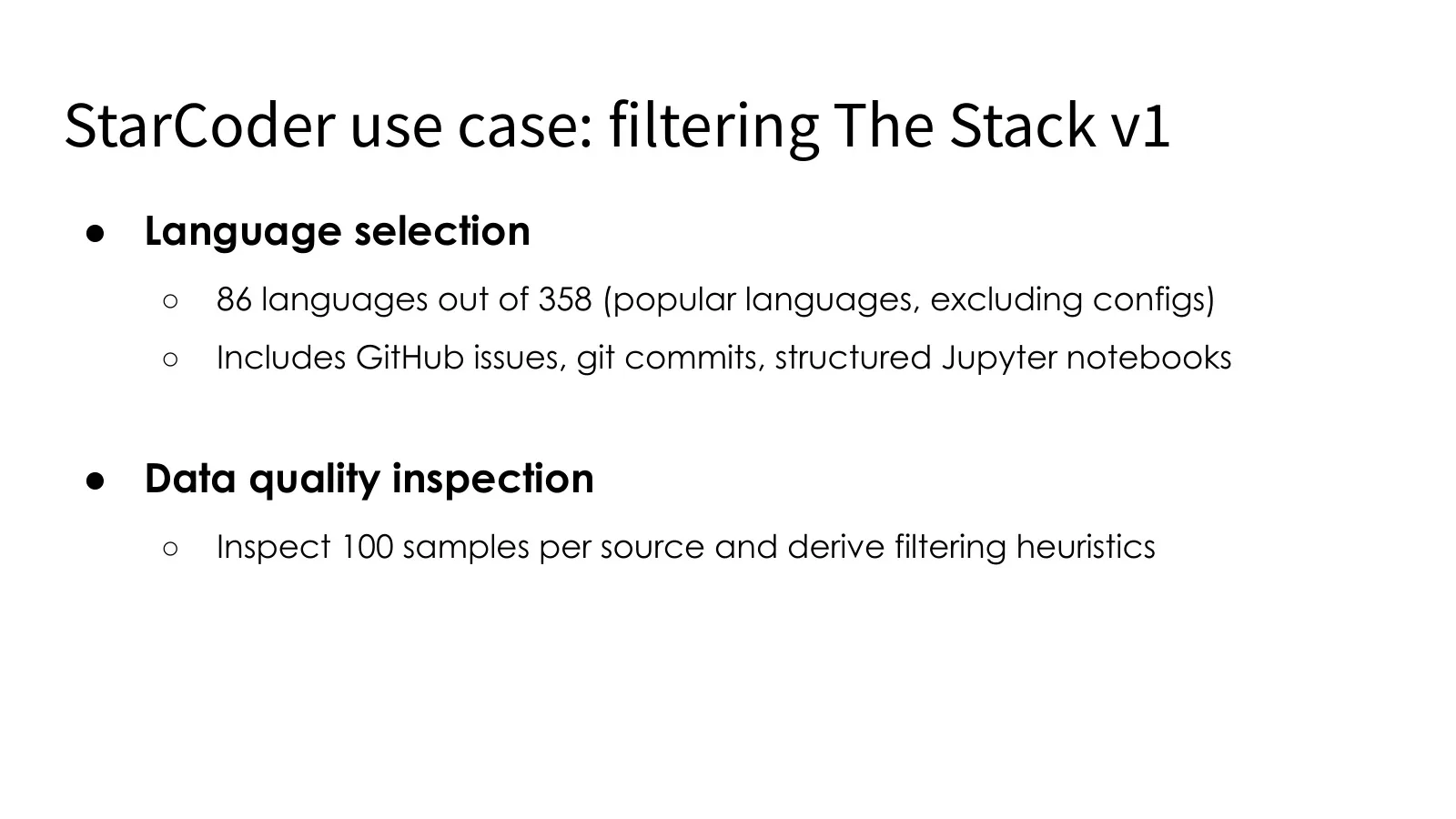
来源:Loubna Ben Allal 官方 deck,第 46 页
人在环路的具体形式
BigCode 社区按 extension 检查约 100 个样本,记录真实 code、generated/vendor data、异常长度和格式,再推导 heuristics。它不是让志愿者逐文件审批,而是用 domain knowledge 校准 scalable rules。
课堂提示
00:30:00–00:33:20,讲者强调同一 average-line-length threshold 不能用于所有语言;社区 inspection 提供了按语言设计阈值的依据。
Near-dedup:MinHash 与 LSH 为什么适合 TB-scale code
Exact dedup 只删完全相同文件;near-dedup 要识别改名、格式变化或局部修改。将文件表示为 shingles 集合 \(A,B\),Jaccard similarity 为
MinHash 满足哈希碰撞概率近似 \(\Pr[h(A)=h(B)]=J(A,B)\),再用 LSH(Locality-Sensitive Hashing)把相似 signatures 放进候选桶,避免全对全比较。
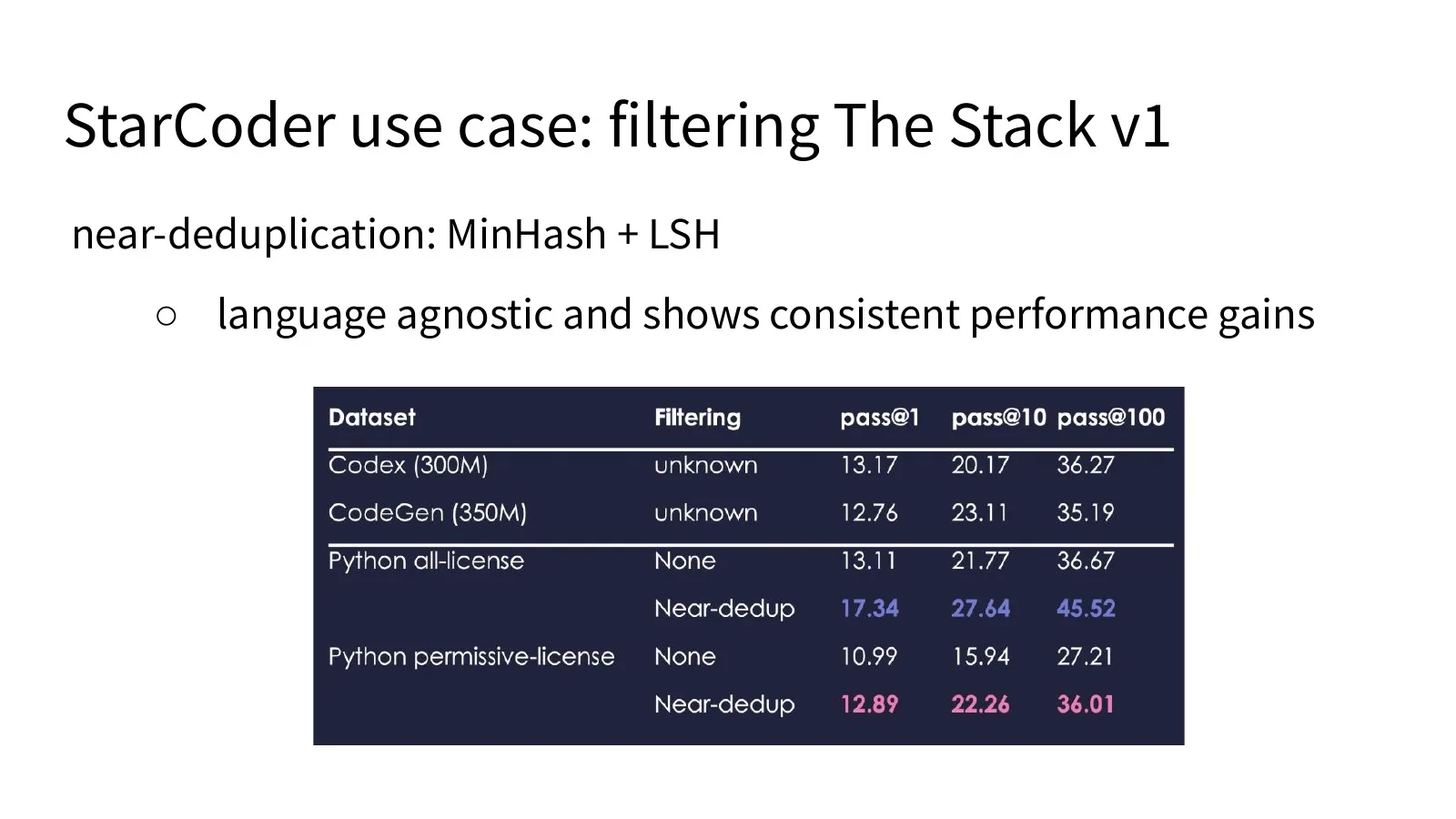
来源:Loubna Ben Allal 官方 deck,第 47 页
为什么 near-dedup 是高价值 filter
它语言无关、容易并行,并直接减少重复训练与 memorization。slide 的 ablation 显示多种 code subsets 上 pass@1 明显提高,因此团队采用 strong dedup;这比未经验证的 stars/comments heuristic 更可靠。
课堂提示
00:33:20–00:35:20,讲者说 near-dedup 是效果最大的 filter,而且无需为 86 种语言分别修改;这同时满足收益与可扩展性。
PII、secrets 与 benchmark decontamination
GitHub 自带 secret scanning 仍不能保证 corpus 无 emails、names、passwords 和 keys。BigCode 先人工标注 PII spans,再训练 StarPII NER model 扫描全量数据;课堂报告这一步约消耗 800 GPU hours。随后还要移除 evaluation benchmarks,避免 inflated score。
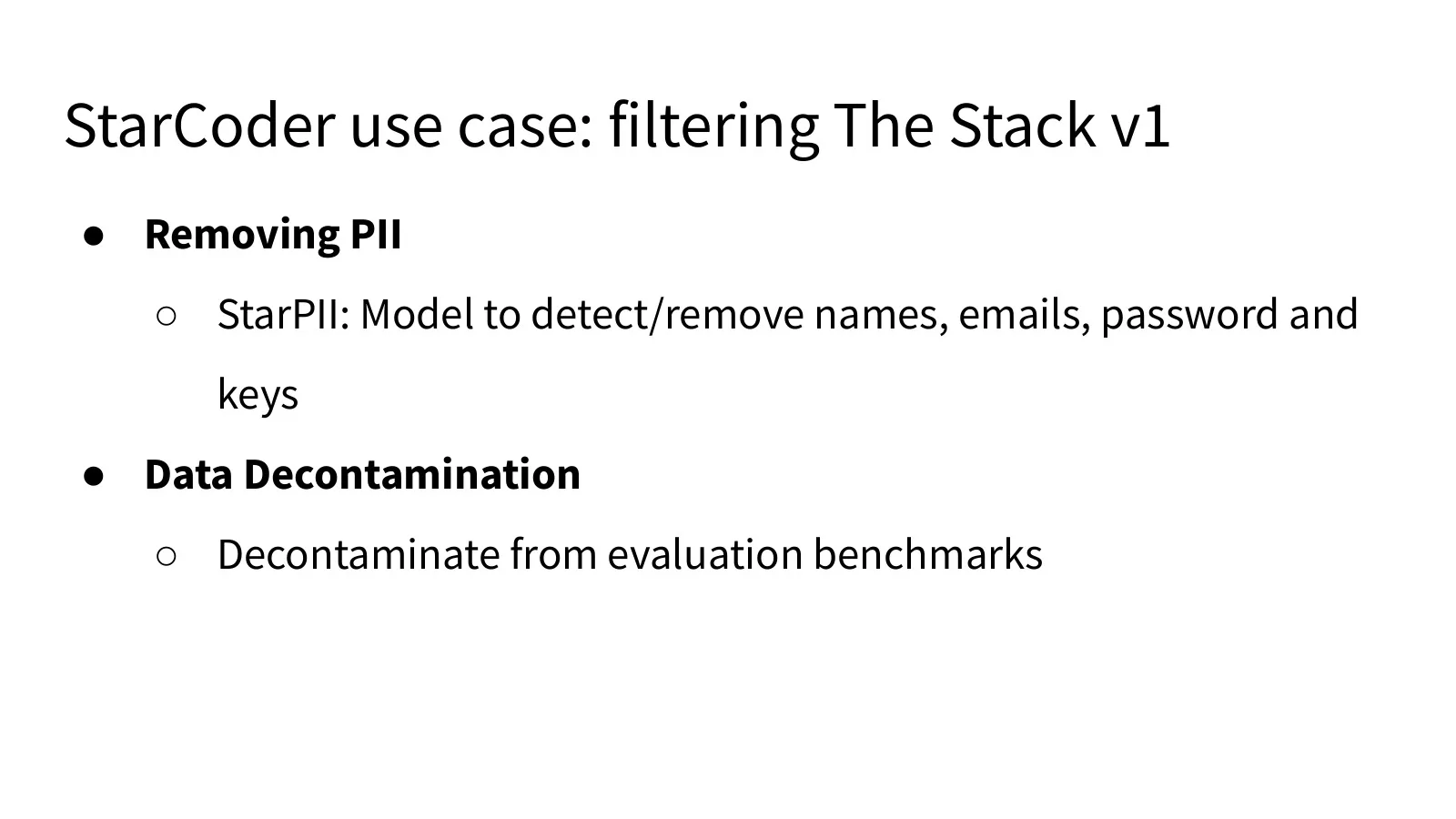
来源:Loubna Ben Allal 官方 deck,第 48 页
首次定义:PII 与 decontamination
PII(Personally Identifiable Information)包括能识别个人的 names、emails、phones 等;secrets 还包括 tokens/passwords/keys。Decontamination 是从训练数据中移除 benchmark items 及其近似/派生版本,保护 evaluation independence。
Detector 只能降低风险,不能出具“零 PII”证明
NER 有 false negatives,代码字符串可能被混淆,历史 commit 可能泄漏删除内容。发布时还需 sample audits、reporting channel、gating 与 incident response。
课堂提示
00:34:00–00:36:20,讲者把 PII 处理的 annotation、NER 和 800 GPU-hour 成本说得很具体,也提醒 evaluation set 必须从 training corpus 移除。
Formatting:把 repository context 变成训练信号
过滤后仍需决定 sequence format。StarCoder 在 code 前加入 repository/name/file metadata tokens;issues 包含 title、comment、user roles。格式让模型学到上下文边界,也会定义推理时可控制的接口。
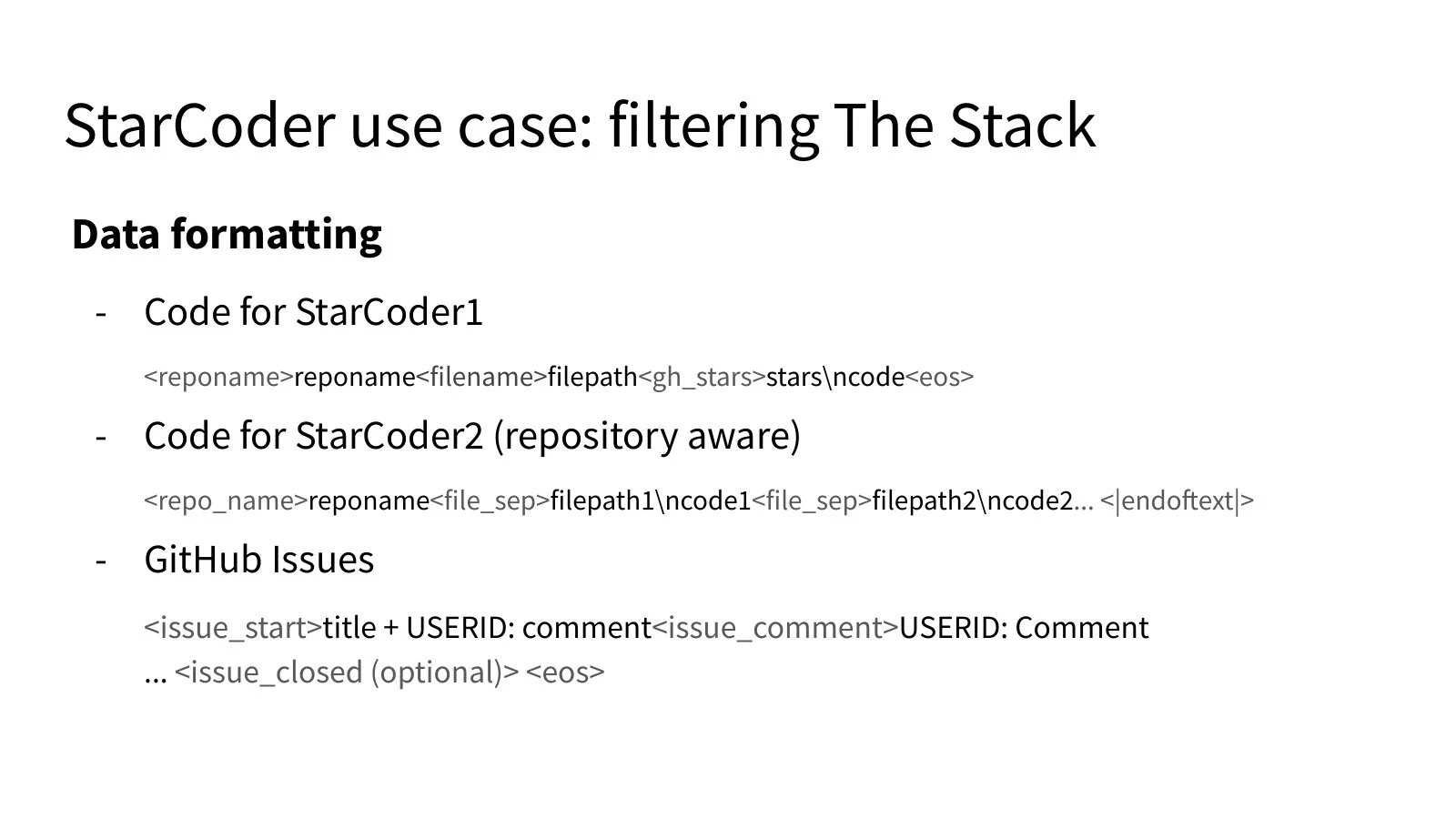
来源:Loubna Ben Allal 官方 deck,第 49 页
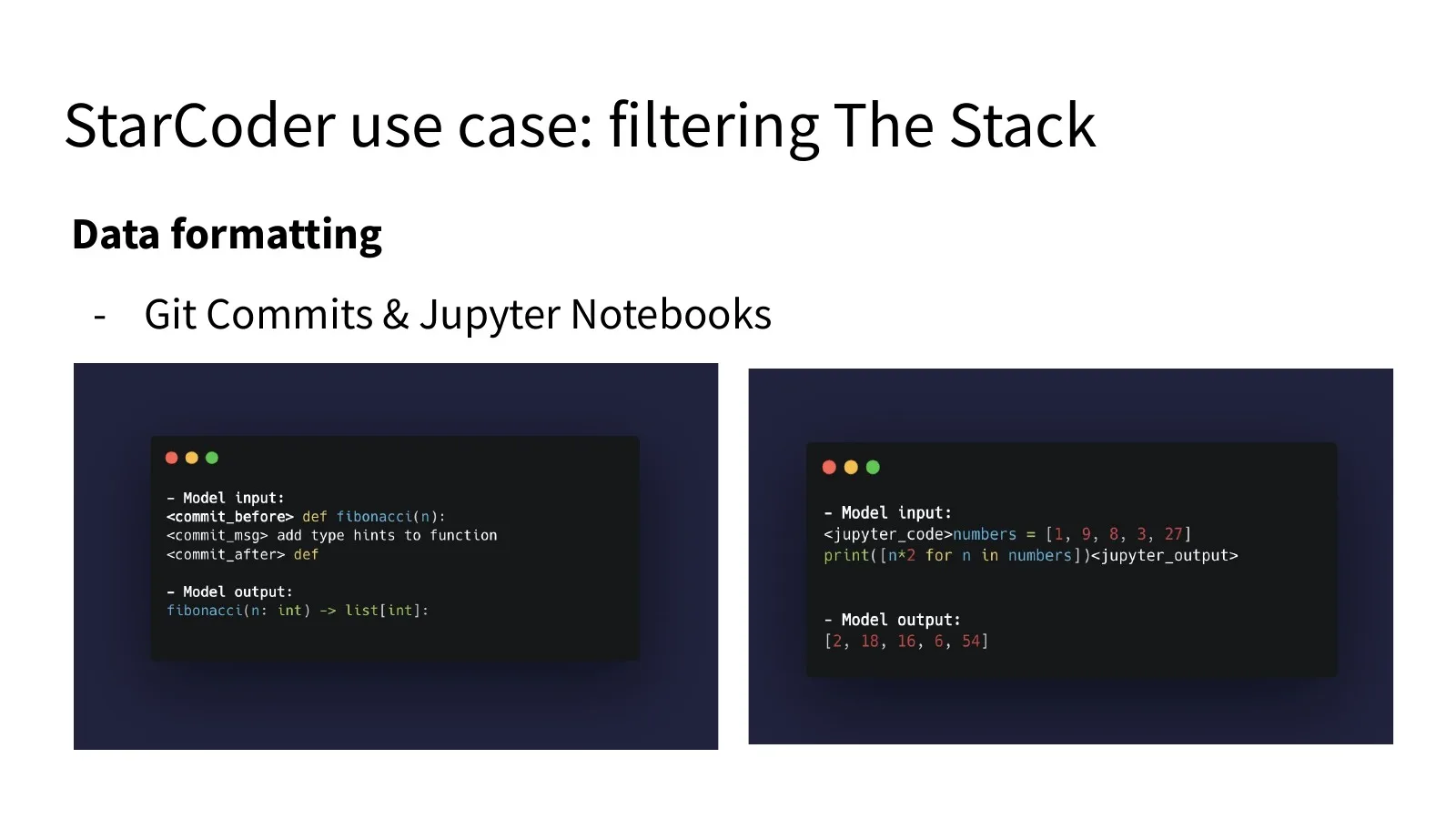
来源:Loubna Ben Allal 官方 deck,第 50 页
对于 fill-in-the-middle(FIM),将文档切成 prefix \(P\)、middle \(M\)、suffix \(S\),训练序列可重排为
仍用 next-token loss,却让模型学习在已知前后文时生成中间 code。
Metadata tokens 也可能成为 shortcut
若 stars、repository name 或 user identity 与质量标签高度相关,模型可能记忆 source bias。应评估移除 metadata 后的能力、privacy risk 和跨仓库 generalization。
StarCoder2 mixture:不同 source 贡献不同任务
训练数据表列出 The Stack、GitHub issues、pull requests、notebooks、documentation、math/code datasets 等,并区分是否做 FIM、epochs 和 sample weight。读表时不要只看 token 百分比,要问每类 source 教什么 behavior。
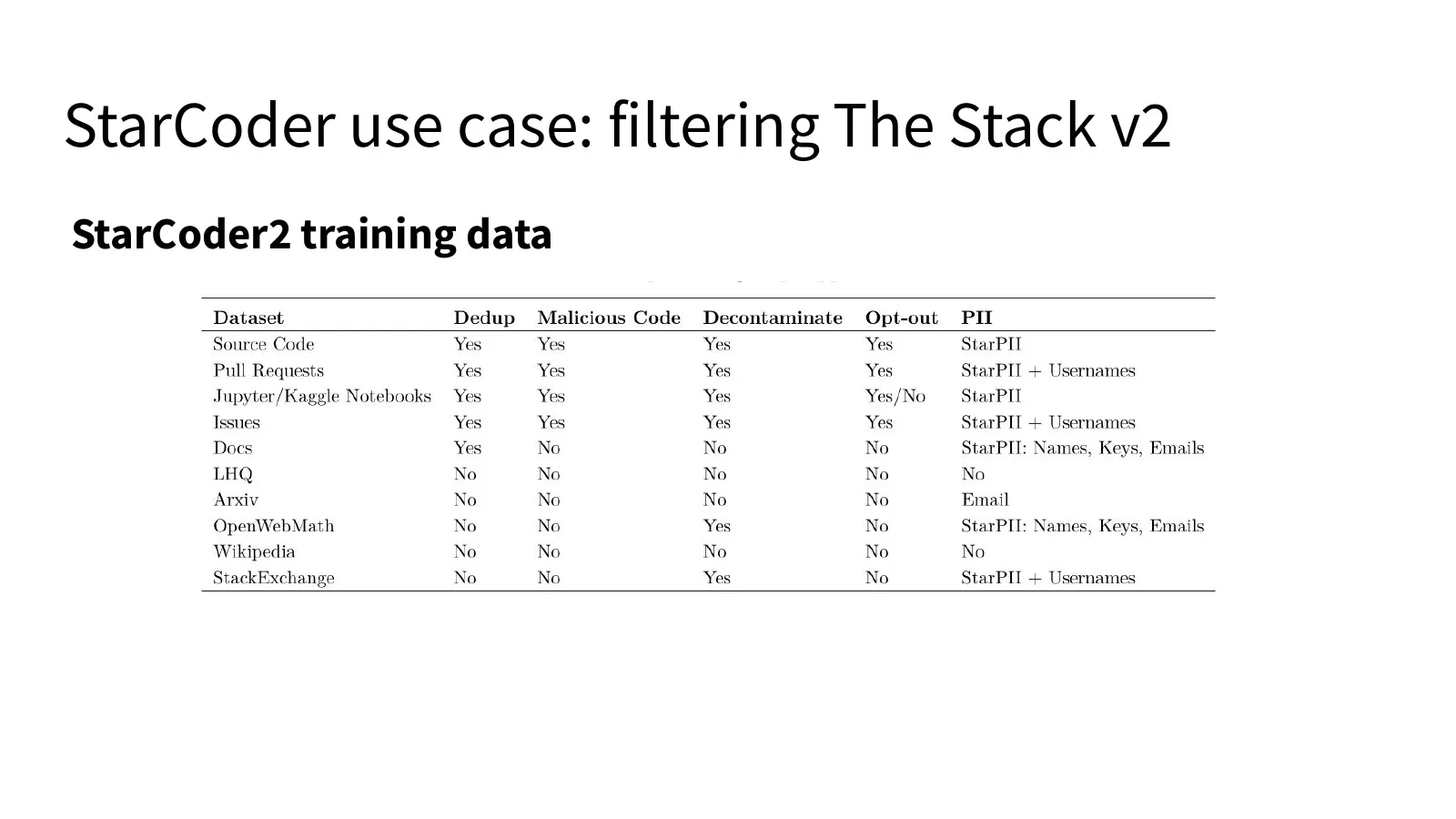
来源:Loubna Ben Allal 官方 deck,第 51 页
若 source \(i\) 有 \(T_i\) tokens、sampling weight \(w_i\),实际抽样概率为
小 source 可通过 \(w_i>1\) 被 oversample,但重复 exposure 也增加 memorization,必须用 validation/evaluation 校准。
Source-to-behavior mapping
Code files 教 syntax/algorithms;issues 教 problem description 与 discussion;commits/PRs 教 edit rationale;notebooks 教 code–output–markdown 交织;documentation 教 API usage;math datasets 教 symbolic/reasoning。Mixture 是能力设计,不只是拼接。
Tooling:可复现数据管线不能藏在一次性 notebook
最后一页列出 datasets、datatrove、datatrove-like distributed pipelines、tokenizers/training code 与 BigCode processing repo。TB-scale filtering 需要 streaming、sharding(把文件或样本切成可由不同 workers 独立处理的分片)、checkpointing、deterministic transforms 和 dataset versioning。
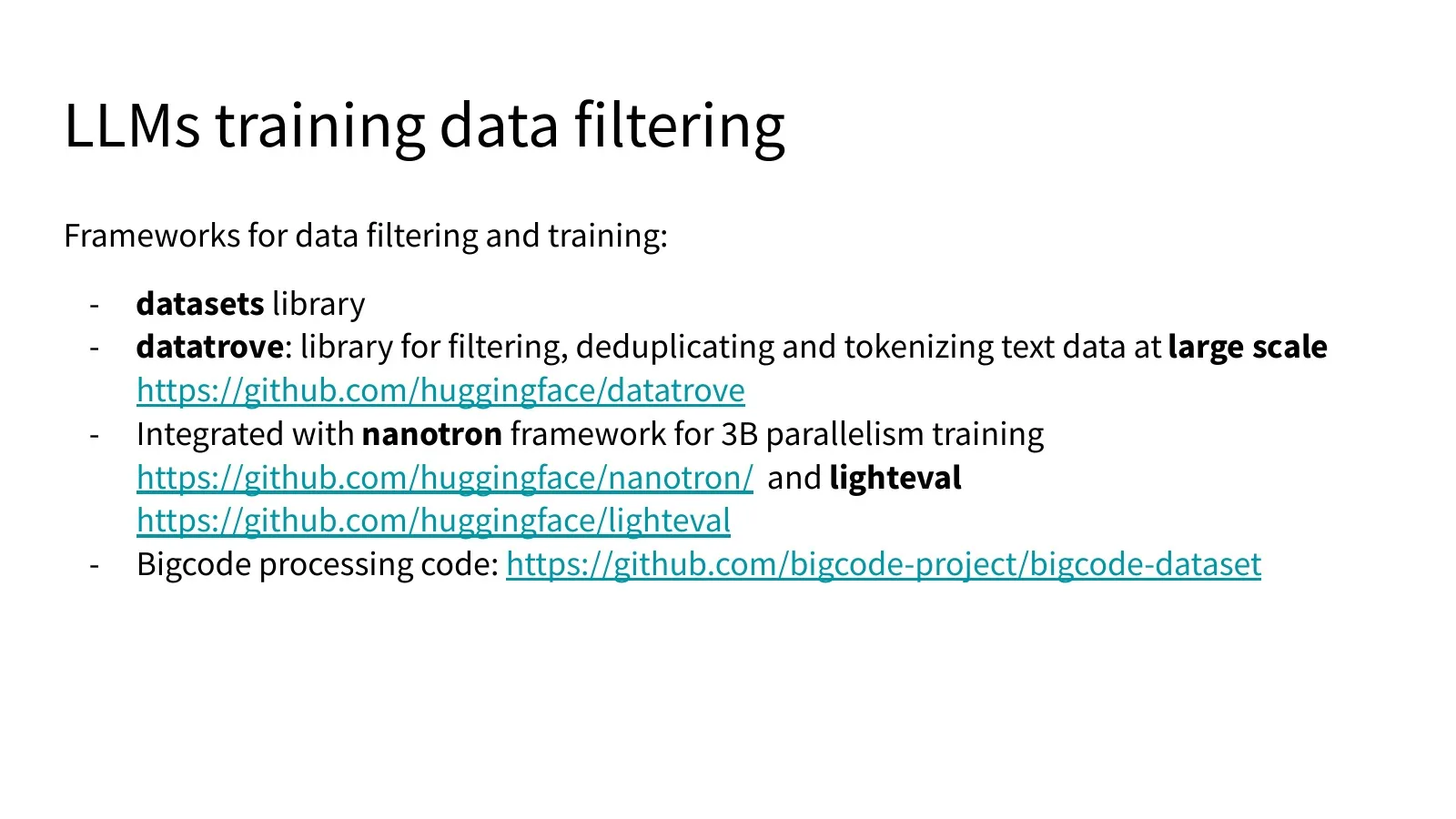
来源:Loubna Ben Allal 官方 deck,第 52 页
discover_sources_and_record_provenance()
normalize_and_language_classify()
apply_quality_filters_with_versioned_thresholds()
exact_and_near_deduplicate()
detect_pii_secrets_and_benchmark_overlap()
format_sequences_and_sample_mixture()
publish_manifest_hashes_stats_and_opt_out_state()
本章小结
StarCoder 的 data advantage 不是某个神奇 filter,而是 source selection、per-language inspection、near-dedup、PII/decontamination、structured formatting、mixture 和 reproducible tooling 的组合。每一步都有成本、失误方式和 evidence。
代码模型生态:从 Copilot 到 BigCode 协作
数据管线完成后,课程回到 code LLM 的历史和生态。核心变化是 Codex/Copilot 证明 next-token prediction 足以成为强 baseline,社区随后把公开数据、模型和 fine-tuning 组合成大量 code assistants。
2021:代码可以像文本一样做 next-token prediction
早期 code modeling 常显式使用 AST、program analysis 或 feature engineering;Codex 展示把大 Transformer 喂入大量 code,也能学会 completion。结构化方法仍有价值,但不再是进入强 code generation 的必要前置。
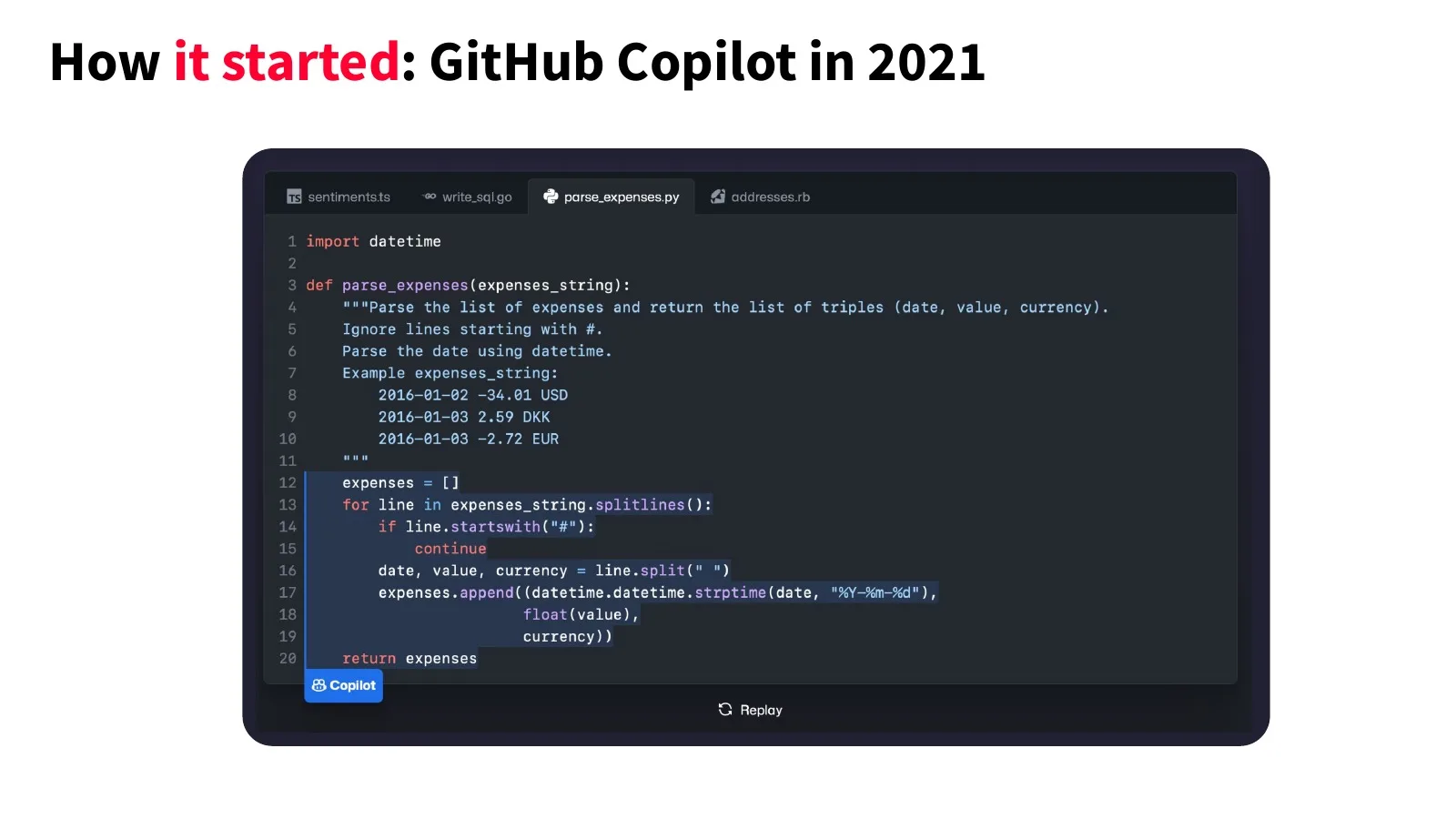
来源:Loubna Ben Allal 官方 deck,第 55 页
课堂提示
00:38:30–00:40:00,讲者把 Codex 的历史意义总结为“code can be treated like text”:不是代码没有结构,而是强 sequence baseline 把手工特征的门槛大幅降低。
2024:1.7K+ open code models 与 leaderboard landscape
Hub 上出现大量 code-pretrained 或含 code mixture 的模型;同时 base 与 instruction-tuned models 在 HumanEval 类榜单上快速提升。数量说明 ecosystem 活跃,不等于 1,700 个独立高质量 pretraining runs,许多是 fine-tunes、quantizations 或 derivatives。
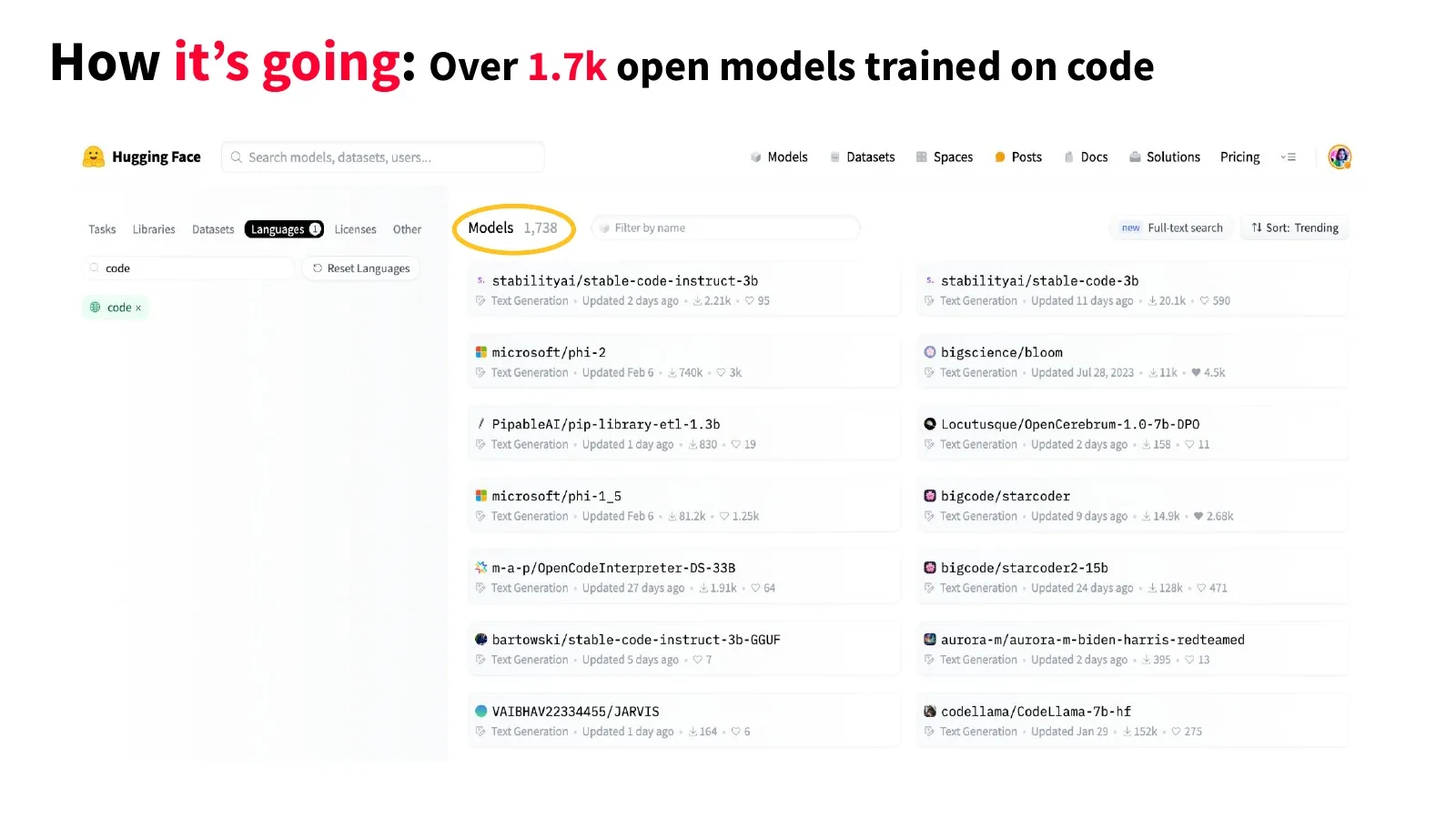
来源:Loubna Ben Allal 官方 deck,第 56 页
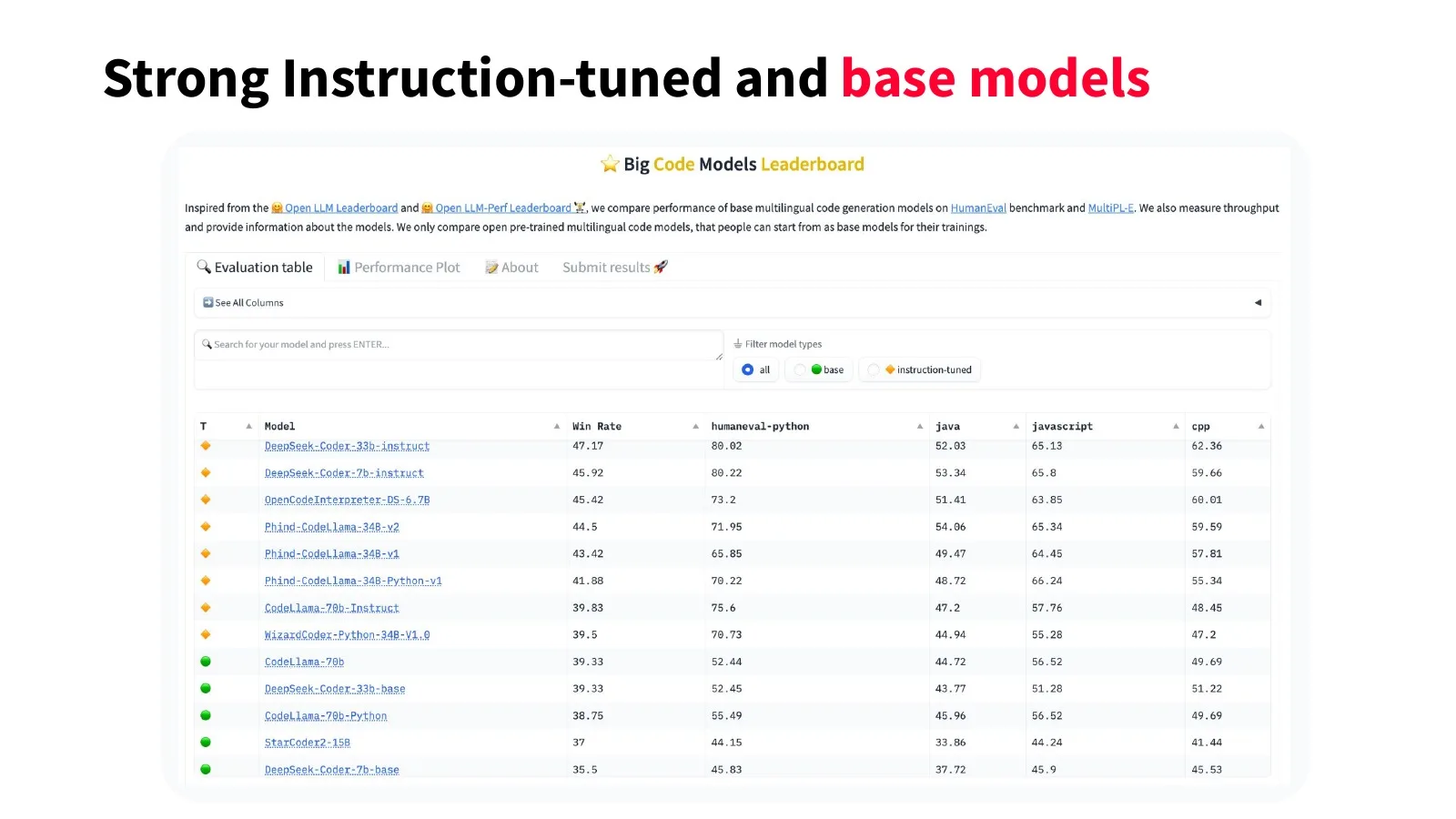
来源:Loubna Ben Allal 官方 deck,第 57 页
HumanEval 80% 不是“80% 编程能力”
HumanEval 是约 164 个 Python function-completion tasks,以 unit tests 判断。分数受 prompt、sampling、pass@k、contamination 和 instruction tuning 影响,不能外推到 repository editing、debugging、安全或多文件软件工程。
Open code LLM landscape:provider、size 与 objective
Meta Code Llama、BigCode StarCoder、DeepSeek Coder 等构成不同 family,另有 CodeGen、StableCode、CodeQwen、Granite。比较时应区分 base/instruct、context、FIM、license、languages、training date 与 benchmark protocol。
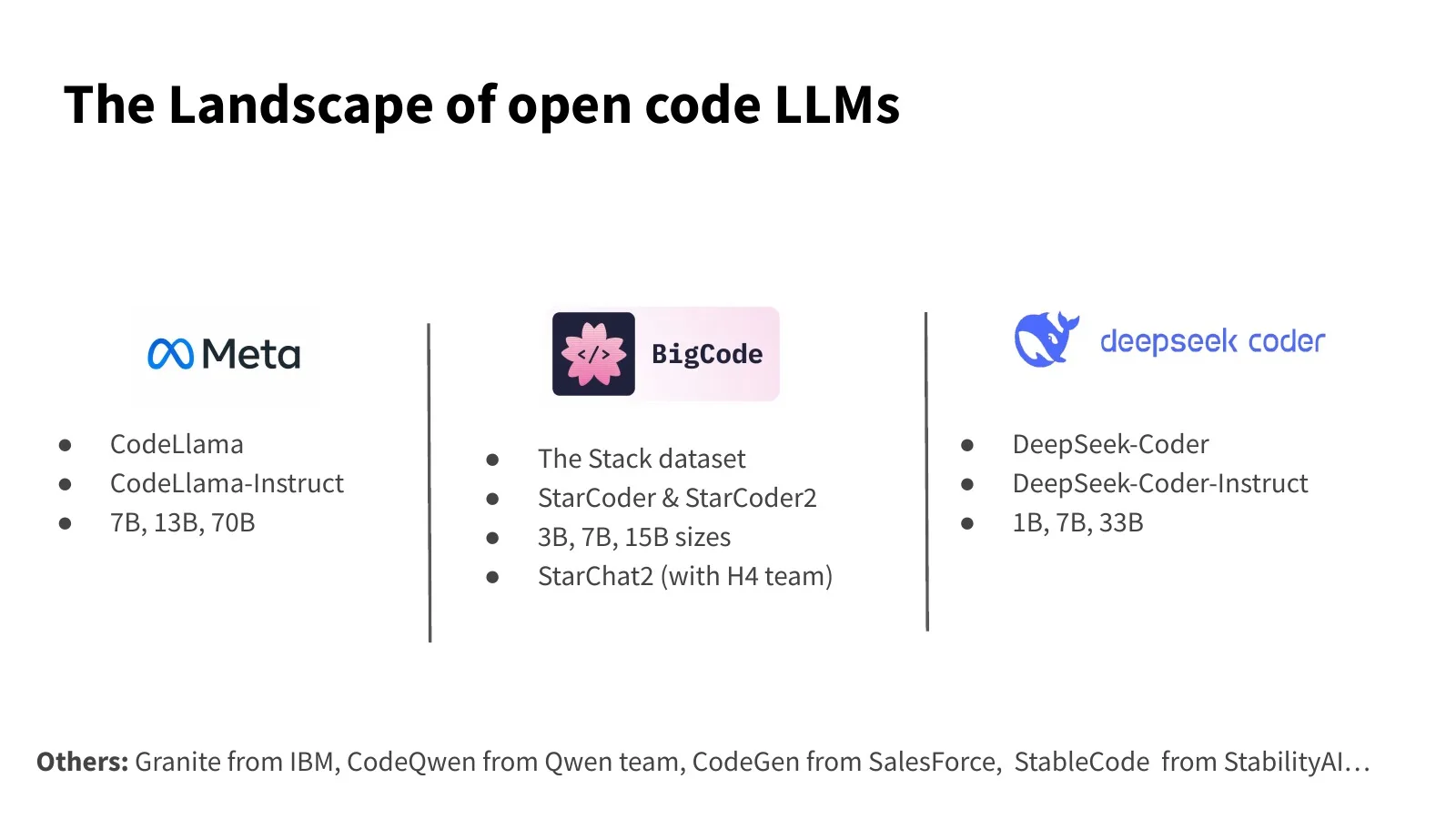
来源:Loubna Ben Allal 官方 deck,第 58 页
Code model 的首次术语消化
Base model 主要学 next-token/FIM;instruction-tuned model 学指令回答;MQA 让所有 query heads 共享一组 KV;GQA 让若干 query heads 共享一组 KV,通常在质量与 KV-cache 之间折中。
课堂提示
00:55:00–00:57:20,Q&A 中讲者说 code/text 训练总体相似,但 code assistant 更看重 long context、MQA/GQA inference efficiency 和 IDE-friendly smaller models。
BigCode:开放科学协作的目标
BigCode 不只发布 weights,而是让 1,000+ 研究者/工程师参与 Slack,公开 data processing、training code、models 和 friendly license。这里的价值是能检查 decision trail,而不是把 collaboration size 当成 quality guarantee。
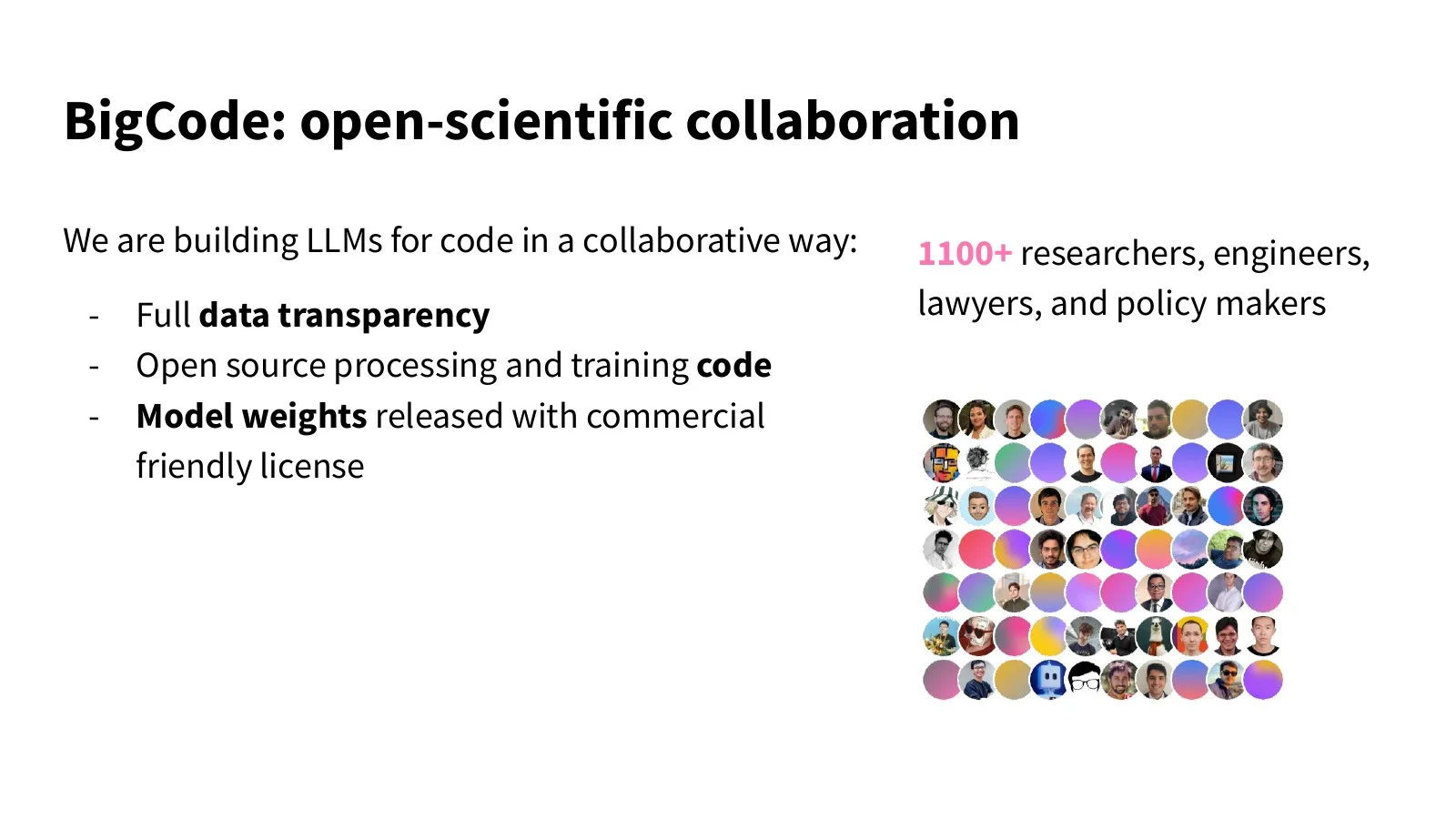
来源:Loubna Ben Allal 官方 deck,第 59 页
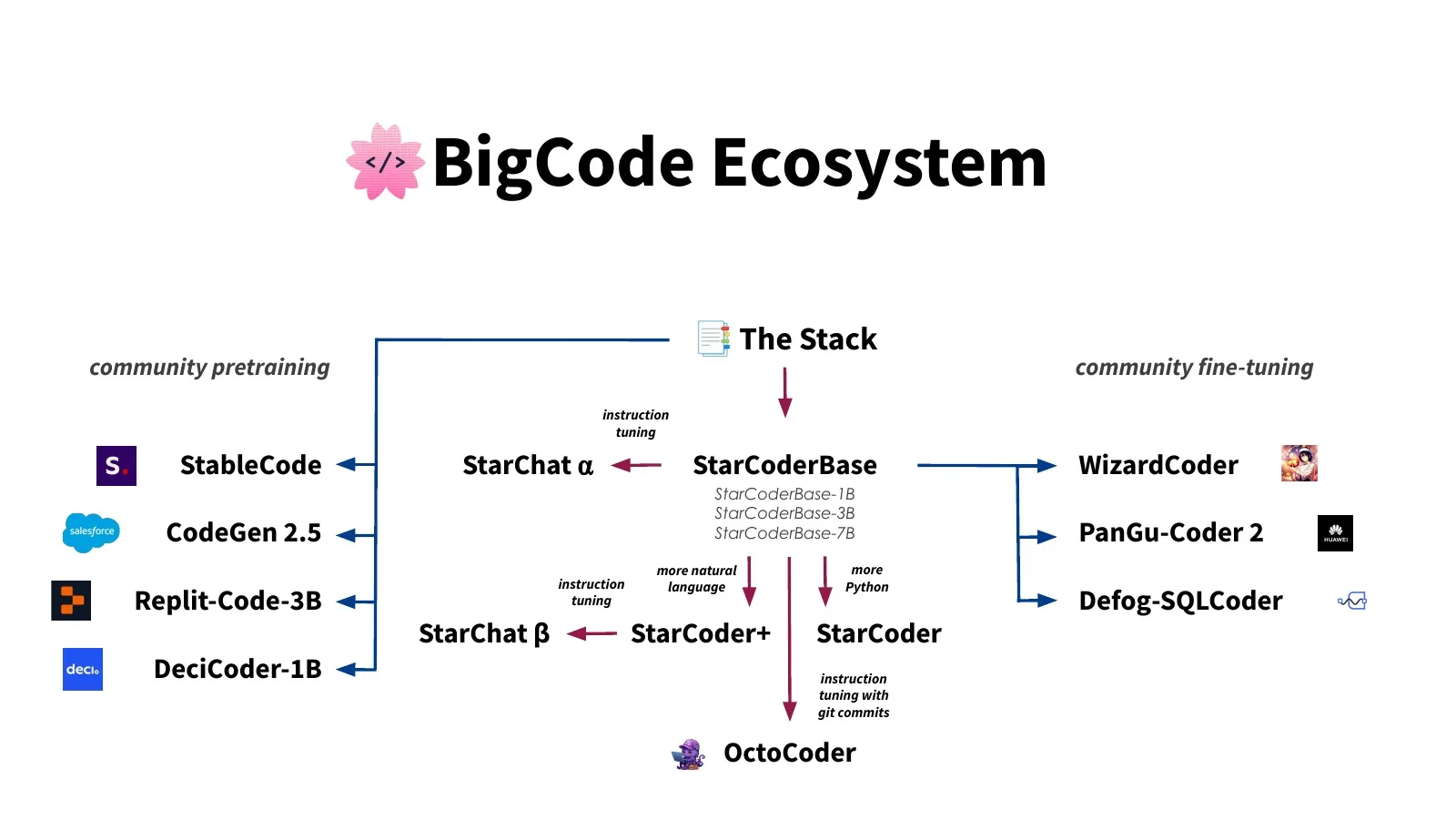
来源:Loubna Ben Allal 官方 deck,第 60 页
Ecosystem 的复用链
The Stack 被多种 code models 使用;StarCoder checkpoints 又成为 StarChat、WizardCoder 等 fine-tunes 的 base。复用扩大影响,也意味着 upstream data quality、license 与 contamination decisions 会向下游传播。
课堂提示
00:40:00–00:43:10,讲者说 BigCode 发起的直接原因是 full data transparency:社区可以 inspect data、复用 processing code、检查模型,而不是只下载 weights。
本章小结
Code LLM 生态从闭源 Copilot 快速扩展到公开 datasets、base models 和 fine-tunes。下一步问题不再是“有没有模型”,而是 release 是否真正开放、透明、可复现和负责。
Open and Responsible:权重开放只是四分之一
这一章把 data governance 放在模型 release 的核心。开放性至少包含可访问数据、可访问模型、可复现研究和完整文档;responsibility 还要求 opt-out、PII、license、evaluation 与 limitation reporting。
四层开放:Data、Models、Research、Documentation
slide 将开放拆成四列。数据需要 inspection/opt-out/PII;模型需要 weights、training code、evaluation interface;研究需要 processing/training/evaluation reproducibility;文档需要 dataset/model cards、governance、architecture、cost 与 limitations。
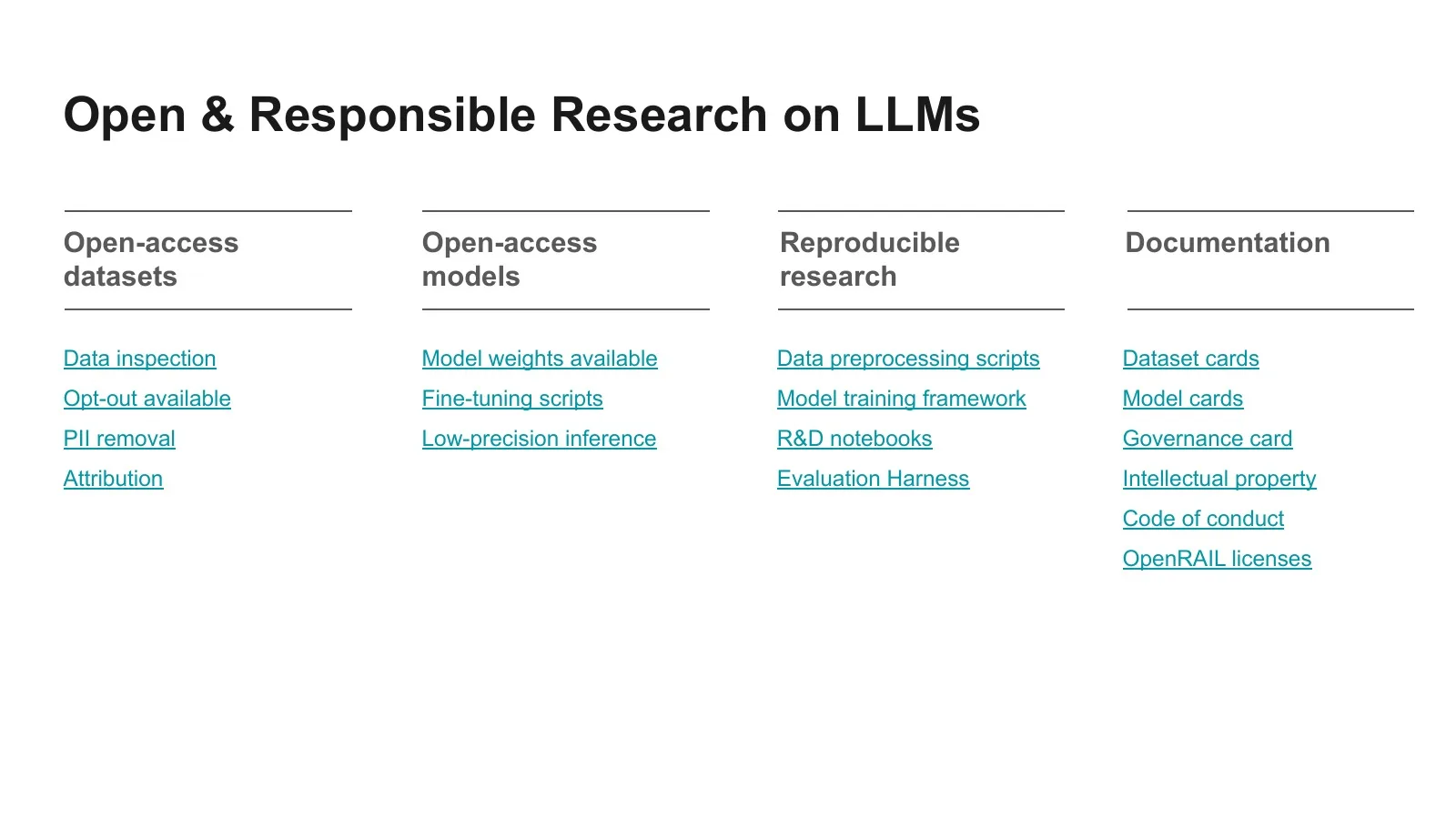
来源:Loubna Ben Allal 官方 deck,第 61 页
开放 release 的最小定义
- 能知道模型用了什么 data 和 transformation;
- 能获得或至少审计 weights/code/config;
- 能复现主要 training/evaluation path;
- 能看到 license、limitations、PII/opt-out 与 cost。
仅有 downloadable weights,不足以回答这些问题。
课堂提示
00:43:10–00:45:10,讲者明确说 open release 不是“release model weights and stop there”,而是 data tools、opt-out、PII、reproducibility、evaluation tools 与 technical reports 的组合。
SantaCoder、StarCoder、StarCoder2:项目怎样迭代
SantaCoder 作为约 1.1B ablation platform,StarCoder 扩到 15B/约 1T tokens,StarCoder2 提供 3B/7B/15B 并使用更大更多语言 corpus。slide 同时列出 Python source 比例下降,以及透明度与开放访问的延续。
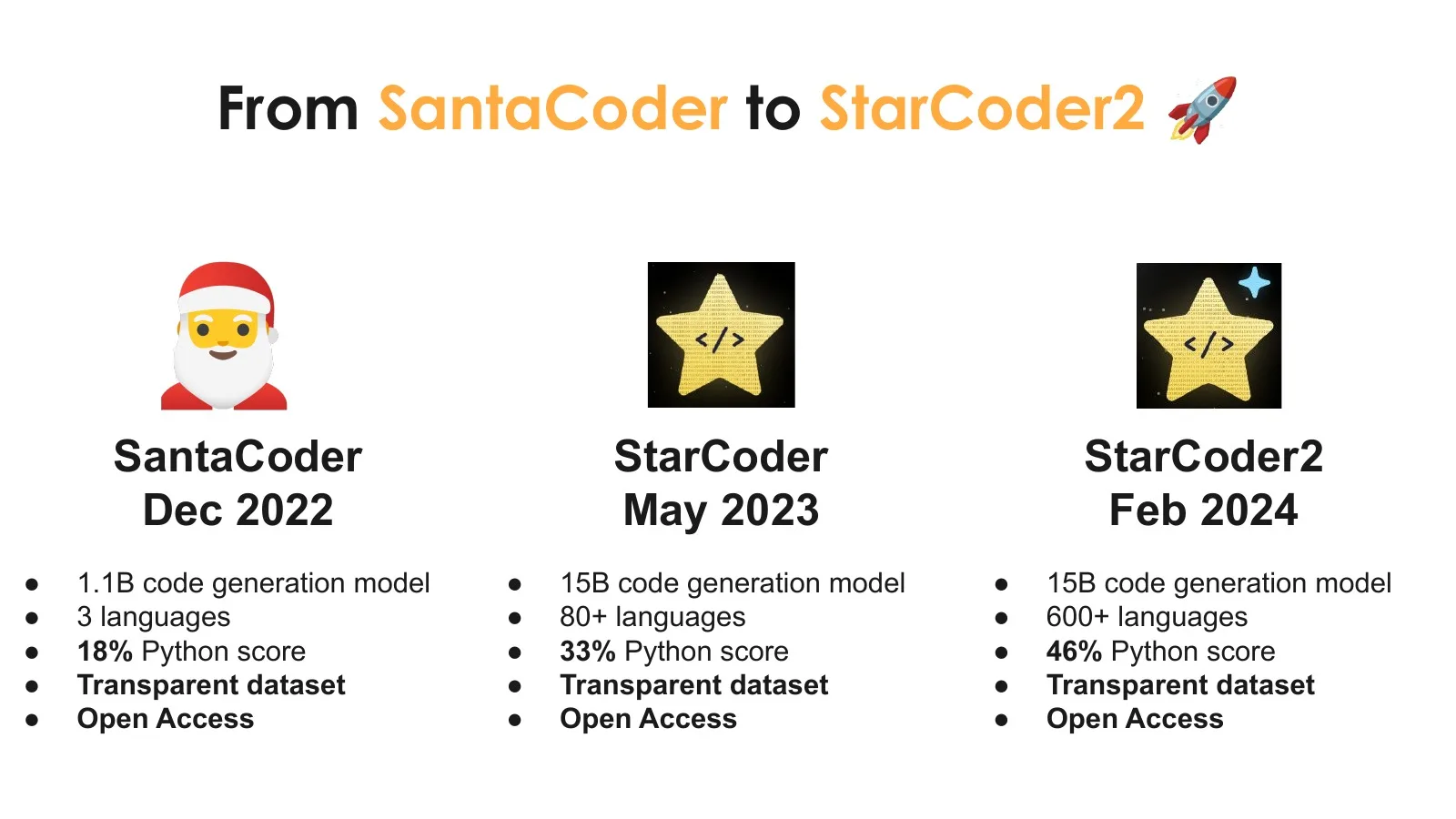
来源:Loubna Ben Allal 官方 deck,第 62 页
为什么先做 SantaCoder
TB-scale data rule 无法直接在 15B full run 上反复试。小模型提供 filter/format/objective ablation platform;但 extrapolation 仍需在更大模型验证,不能假设所有 data effect 完全 scale-invariant。
Transparency Index:外部指标衡量披露,不衡量全部能力
Stanford Foundation Model Transparency Index 按 data、labor、compute、risks、downstream 等披露维度评分。StarCoder 在课堂快照中排名靠前,说明文档/透明努力被外部框架捕捉;它不证明模型最准确、最安全或法律争议已解决。
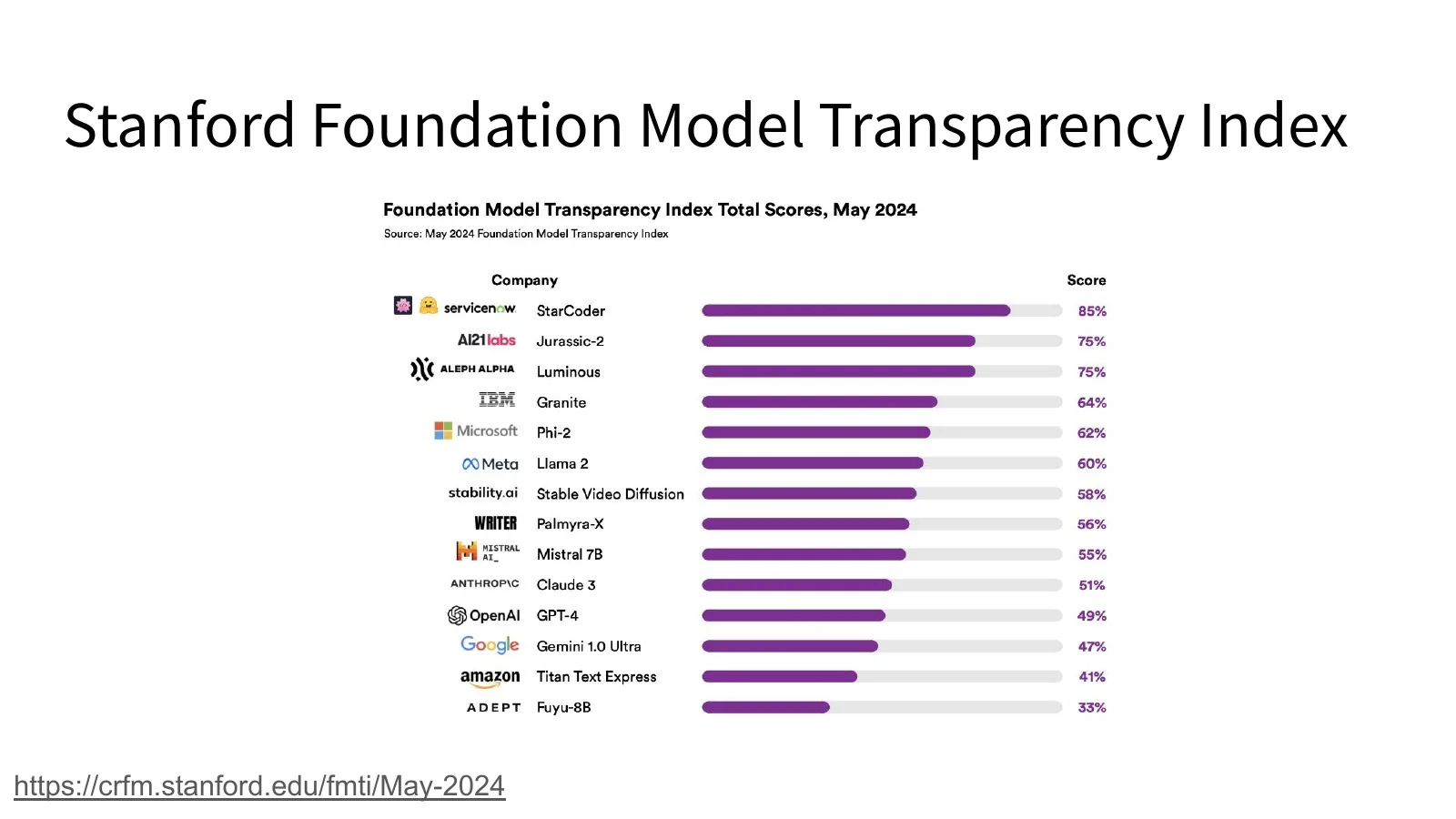
来源:Loubna Ben Allal 官方 deck,第 63 页
Transparency 与 responsibility 相关但不等价
披露坏结果比隐藏更透明,却仍可能不负责任;没有完整披露也可能有内部控制,但无法被公众验证。Index 衡量可见信息,不能替代 independent audit 或 legal judgment。
本章小结
Responsible open model 需要 data、weights、code、evaluation、documentation 与 governance 一起发布。BigCode 的价值在于把这些层变成项目目标;透明度指标则提供外部检查,但不能替代能力与风险评估。
Evaluation 与 Tooling:先防 Contamination,再谈 Leaderboard
预训练结束并不意味着结果可信。代码 benchmark 尤其容易出现在 GitHub、教程和 instruction data 中;公开 leaderboard 还会诱导反复优化。课程因此主张多 benchmark、decontamination、membership test 与 time-split evaluation。
多 benchmark:一个分数无法描述 code model
第一张表同时比较 code completion、code reasoning、data science、math 与 repository tasks。模型 size 更大通常更强,但不同 tasks 的排序可能不同。评估必须绑定 model version、prompt、sampling、tests 与 execution environment。
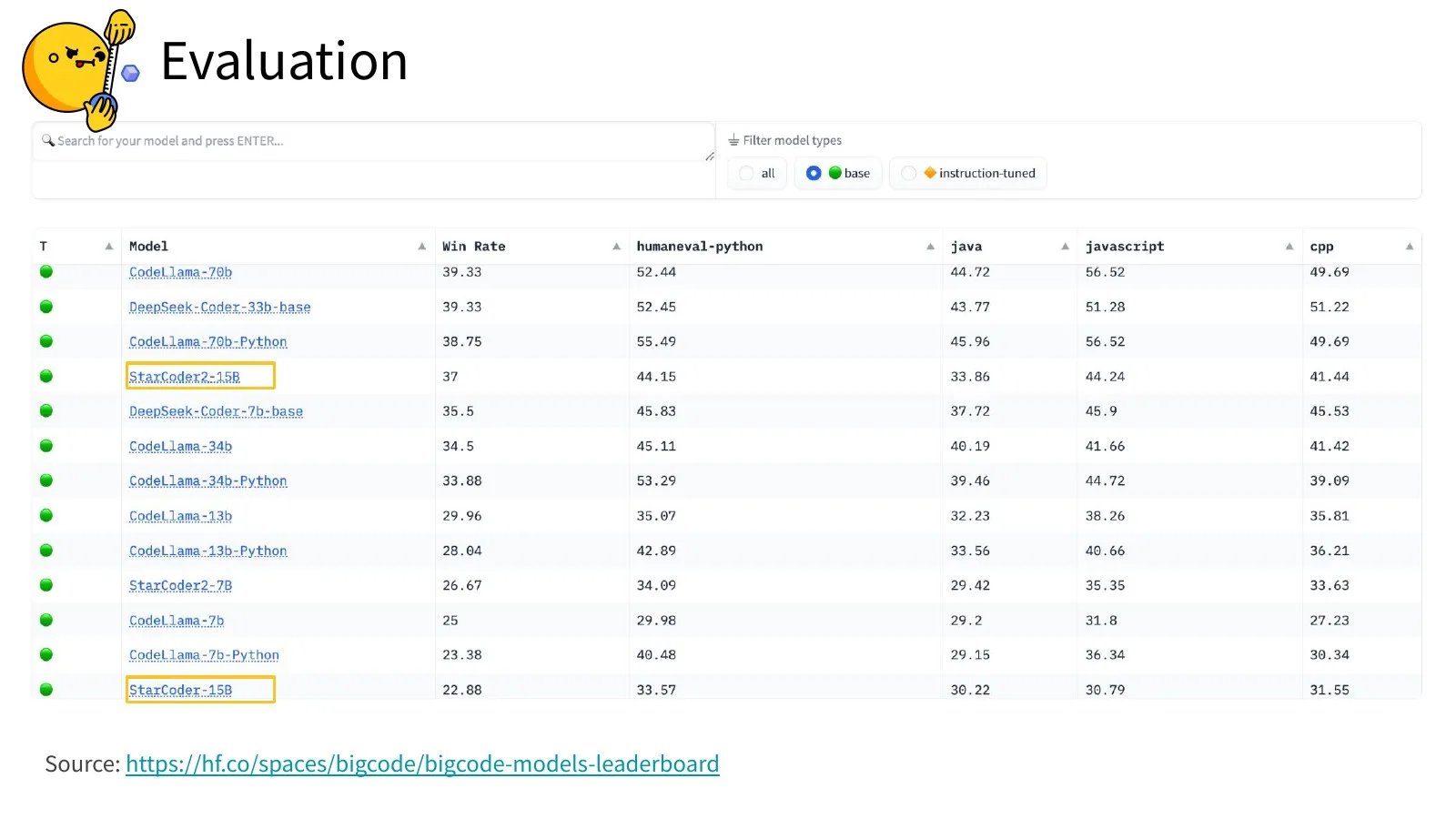
来源:Loubna Ben Allal 官方 deck,第 64 页
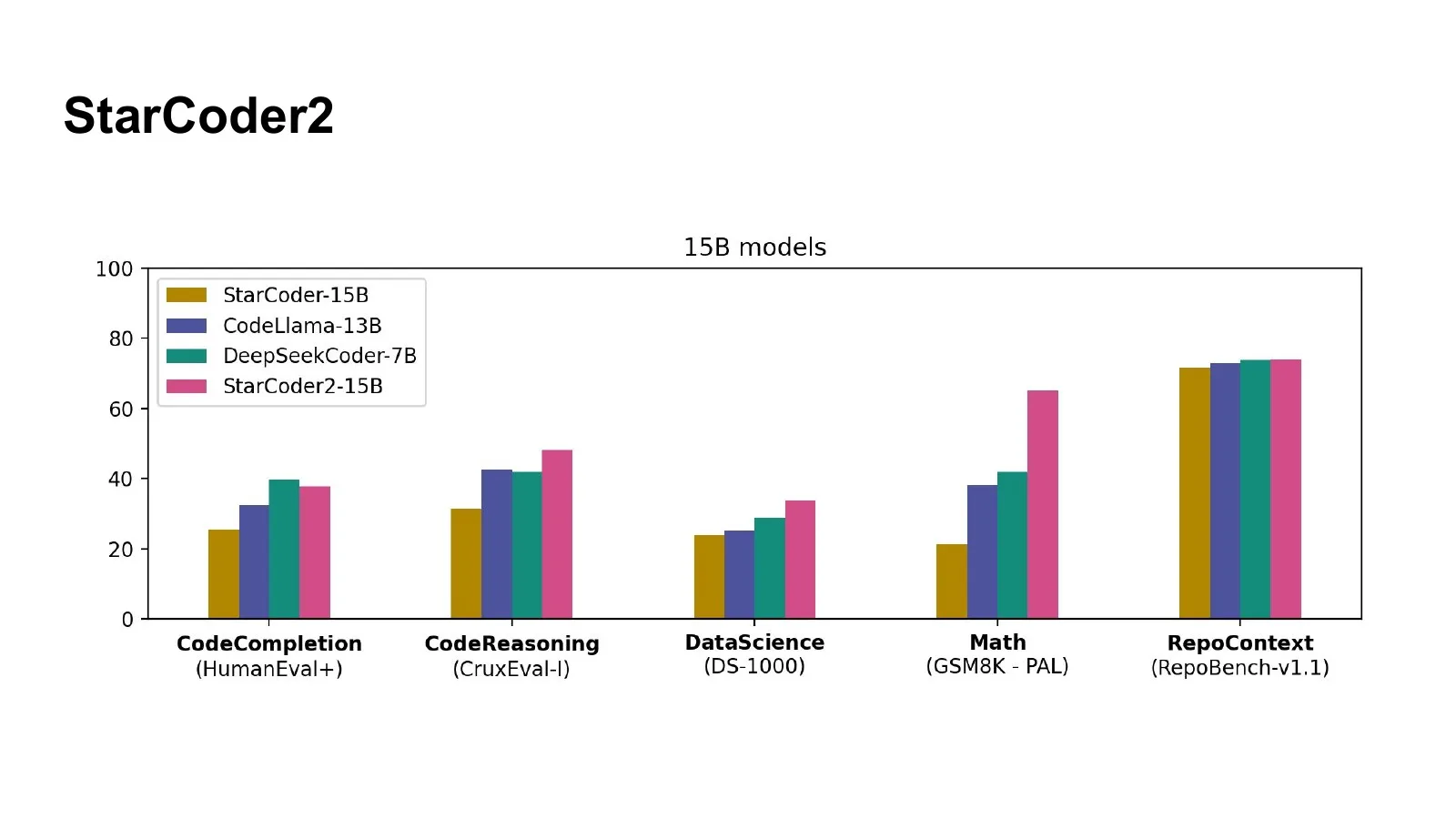
来源:Loubna Ben Allal 官方 deck,第 65 页
对于每个问题采样 \(n\) 个 solutions,其中 \(c\) 个通过 tests,pass@\(k\) 的常用无偏估计为
pass@1 更接近一次 completion;较大 \(k\) 衡量多次尝试中至少一次成功,不能直接横比。
Unit tests 只覆盖写出的行为
通过 tests 不保证 efficiency、security、style、undefined behavior、dependency correctness 或 hidden edge cases。若 tests 太弱,模型可生成看似正确却不可靠的代码。
课堂提示
00:44:20–00:46:20,讲者建议 release 时用尽可能多的 benchmarks:某一个可能有 contamination,多任务也能揭示模型行为分布,而不是只追单项 headline。
Autocomplete 与 membership test:部署侧也要做 attribution
BigCode 还发布 VS Code extension 和 membership test。后者尝试判断 generated snippet 是否与 training data 相似,并向用户提示潜在来源。它是 provenance aid,而不是确定的 memorization proof。
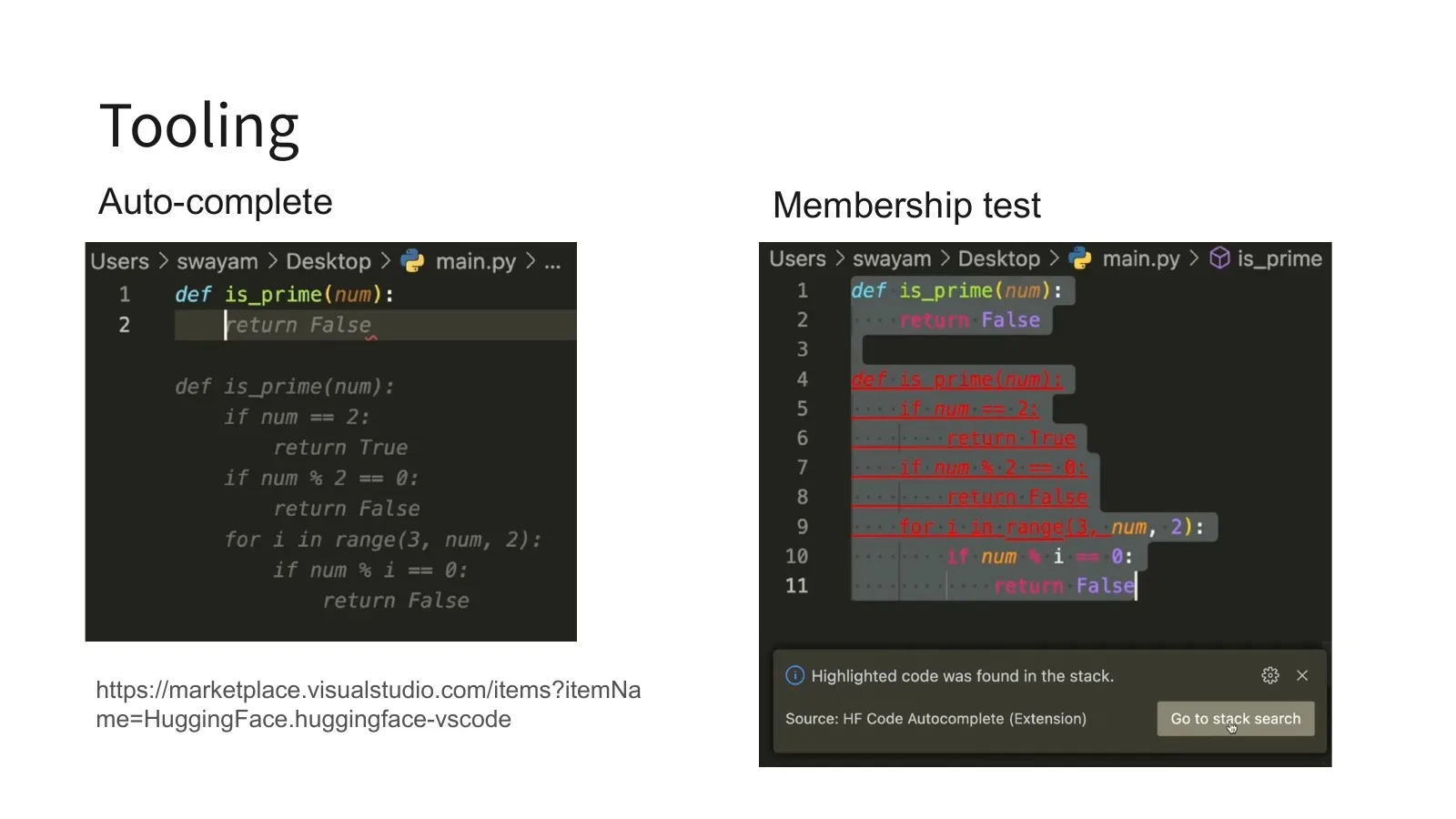
来源:Loubna Ben Allal 官方 deck,第 66 页
Membership test 的边界
Exact match 高精度但漏掉改写;fuzzy match 会把 common idioms 误报;training corpus 不完整或版本不同又会产生 false negative。输出应是相似度与候选来源,不应写成法律结论。
课堂提示
00:45:00–00:47:00,讲者把 membership test 放在 code attribution 努力里:生成代码可能来自训练样本时,应给作者/用户一个可检查提示。
Customize code model:预训练原则怎样缩小到单 GPU
Personal Copilot workflow 仍是 collect–filter–dedup–format–train–evaluate,只是从 full pretraining 变成 repository-specific continued pretraining 或 fine-tuning。LoRA 将权重更新写成低秩矩阵
只训练 \(A,B\),显著减少 optimizer states 和梯度 memory。
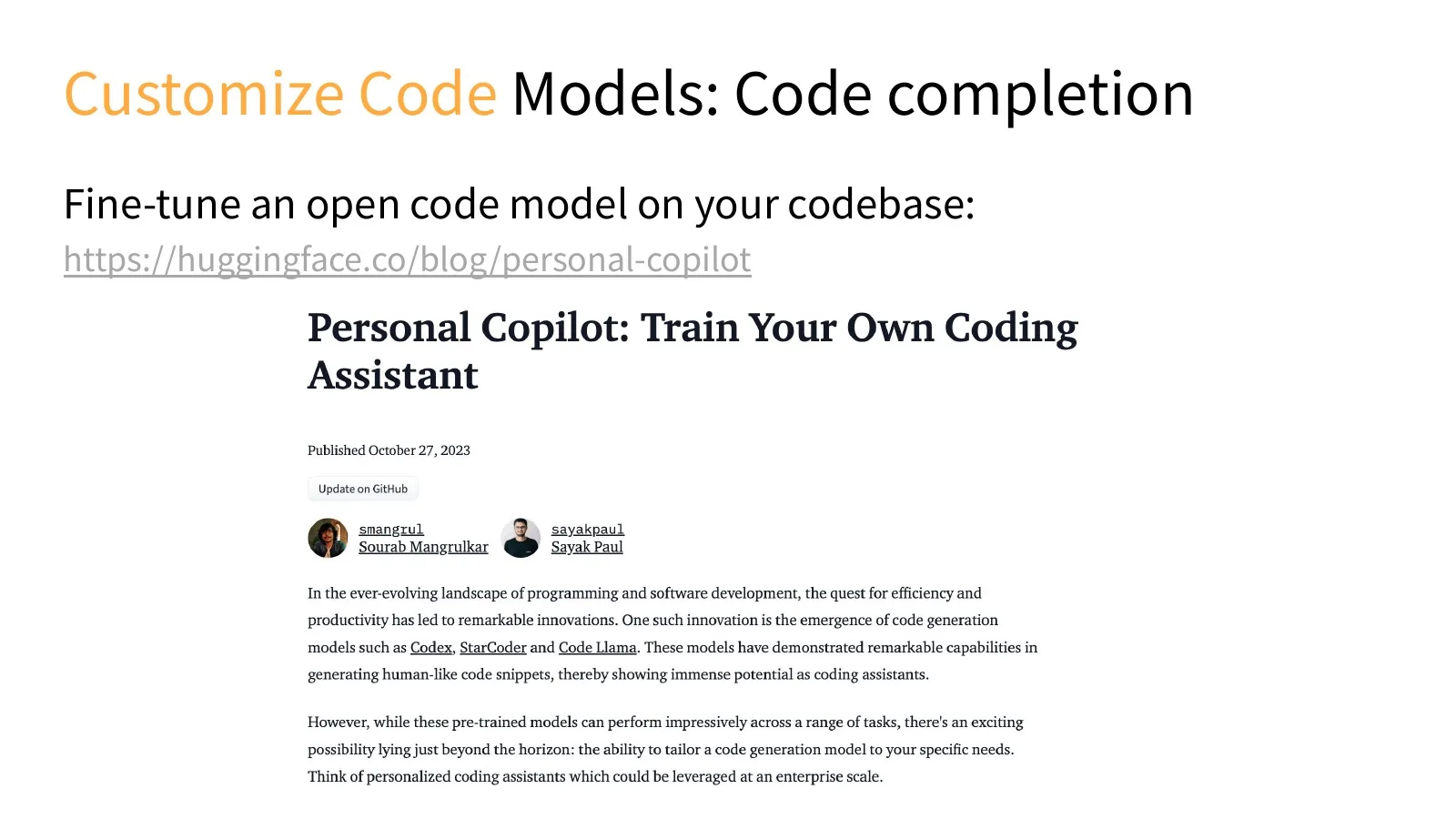
来源:Loubna Ben Allal 官方 deck,第 67 页
select_small_strong_base_with_code_and_long_context()
collect_only_authorized_repository_data()
deduplicate_and_split_by_repository_or_time()
format_fim_and_repository_context_examples()
fine_tune_with_peft_or_lora_on_one_gpu()
evaluate_execution_latency_leakage_and_regressions()
课堂提示
00:57:20–00:59:10,Q&A 中讲者给单 GPU 建议:选强 base、curated data、quantized/on-device runtime 与 PEFT,而不是试图从头预训练。
Leaderboards:界面很方便,protocol 更重要
公开 leaderboard 聚合 model scores,帮助发现候选;但每个 row 背后包含 model date、prompt、temperature、test harness、contamination policy 和 submission rules。截图是入口,不是可复现实验记录。
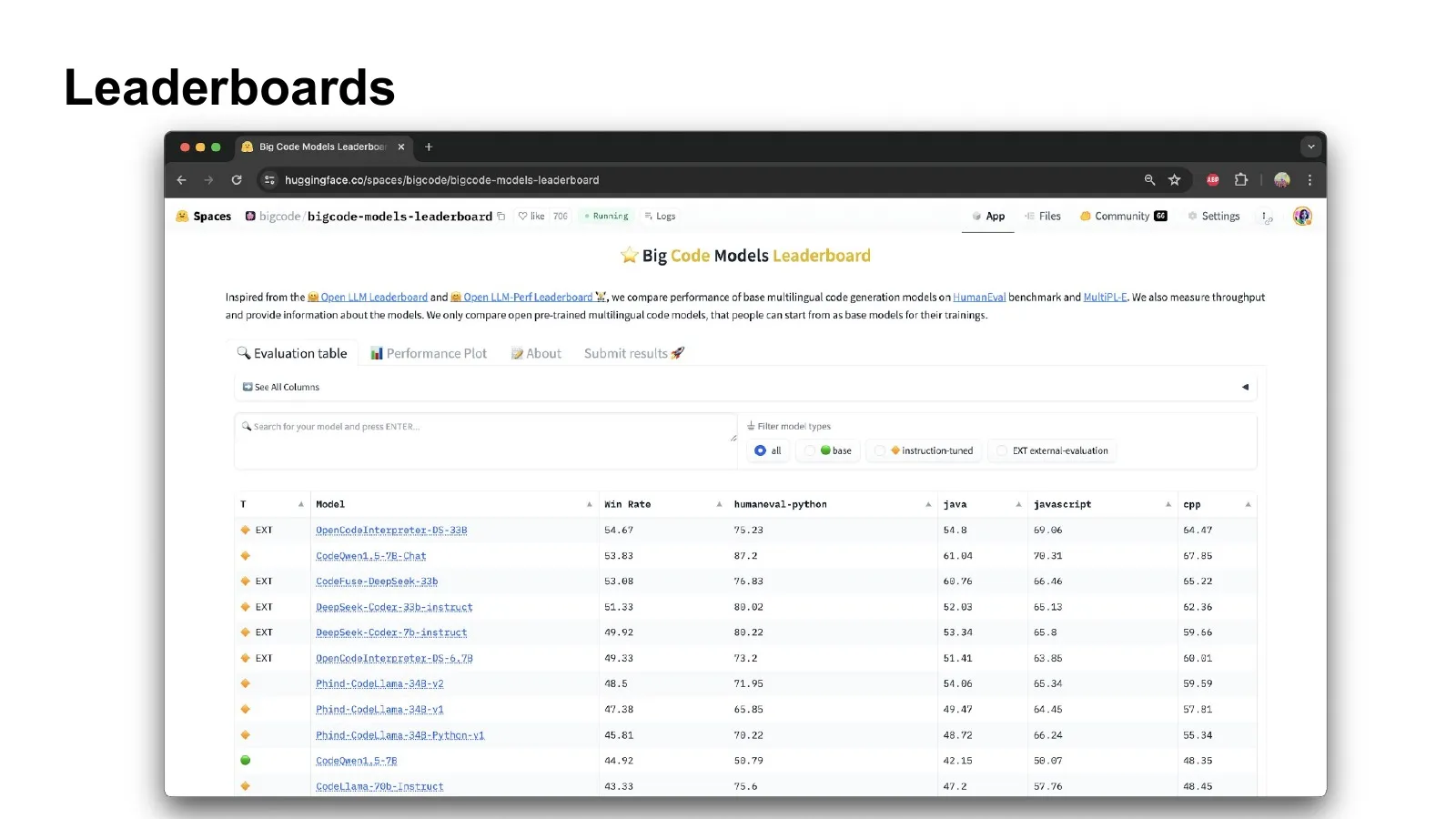
来源:Loubna Ben Allal 官方 deck,第 68 页
Leaderboard 使用顺序
先看 benchmark version 和 cutoff,再看 model release/training date;确认 base/instruct、pass@1/pass@k、execution sandbox、prompt;最后才比较分数。若 protocol 不同,排名没有可解释性。
HumanEval overfitting:instruction tuning 也会污染
即使 pretraining 删除 HumanEval,instruction data 仍可能包含“实现一个函数并通过 tests”的近似题。模型可能学习 benchmark style 或见过语义等价问题,导致 public score 相对真实新题过高。
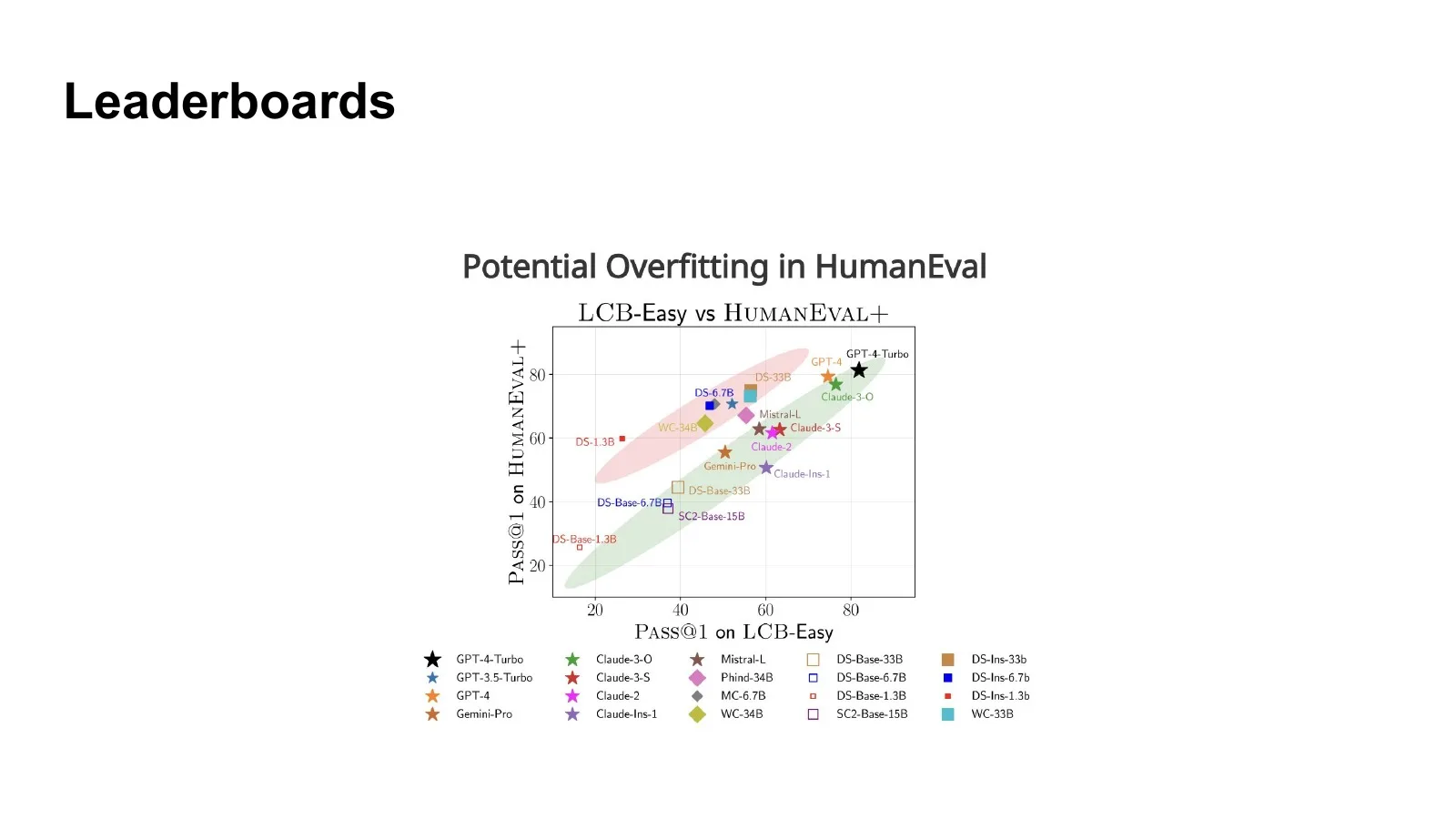
来源:Loubna Ben Allal 官方 deck,第 69 页
若训练样本 \(x\) 与 benchmark \(b\) 的 similarity \(s(x,b)>\tau\),可标记潜在 overlap;但 semantic equivalence 不一定被 lexical detector 捕捉。decontamination 应结合 exact/fuzzy/code-structure/time metadata,并报告阈值。
Instruction data 是 contamination 的第二入口
只清 pretraining corpus 不够。SFT、RLHF prompts、synthetic exercises、benchmark explanations 和 GitHub solutions 都可能泄漏 test pattern;每个 stage 都需要 provenance scan。
LiveCodeBench:用 release date 建立时间隔离
LiveCodeBench 定期抓取新 contest problems,并只用模型 release 之后的问题评估,降低训练中见过题目的概率。它还比较 full-history 与 post-cutoff score,若差异大,可能提示旧 benchmark overfit。
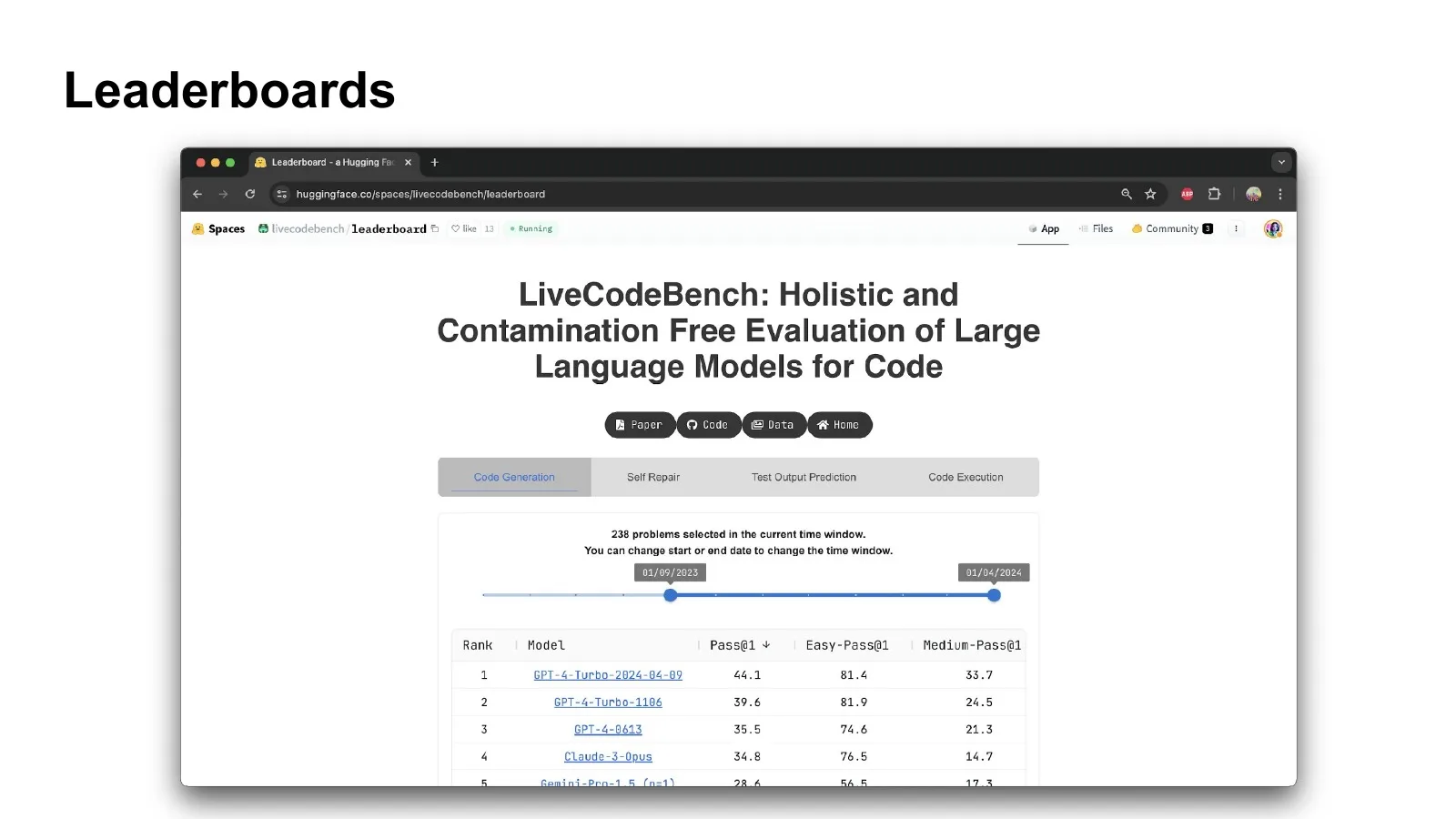
来源:Loubna Ben Allal 官方 deck,第 70 页
可将 time-split 定义为
它减少直接时间泄漏,但模型可能基于未公开 checkpoint、网页提前出现题目或相似 templates,仍需谨慎。
课堂提示
00:49:00–00:52:40,讲者把 LiveCodeBench 作为重要解决方案:使用模型发布后出现的问题,观察一些模型在 uncontaminated slice 上是否仍保持表现。
本章小结
可信 code evaluation 需要多任务、可执行 tests、明确 pass@k、数据/时间 decontamination、membership/attribution tools 和 repeated protocol。Leaderboard 是导航,time-split 与 source audit 才是对 contamination 的实质防线。
Q&A:Domain、Tokenizer、Fine-tuning 与 Dataset Release
Q&A 把 lecture recipe 放到边界场景:multimodal data 能否替代 text、code 是否需要特殊 architecture、一个 GPU 怎样做、scaling 是否跨 domain、tokenizer 有何差异、fine-tuning 是否用同样 filter,以及大数据集发布还需哪些治理。
Code 与 text:相似 training,优先级不同
讲者认为 architecture/training 总体相似,code model 仍可用 decoder Transformer;差别更多在 long repository context、FIM、fast IDE inference、MQA/GQA 和 data formatting。code tokenizer 仍用 BPE,但会保留 number splitting,并在 code mixture 上检查 under/overrepresented tokens。
Tokenizer 首次定义与 sanity checks
BPE(Byte Pair Encoding)反复合并高频 token pairs。代码 tokenizer 应检查 whitespace/indentation、operators、numbers、Unicode、paths 和 language coverage;平均 token-per-character 过高会增加 context cost,过大的 whole-identifier tokens 又会损害组合泛化。
课堂提示
00:58:20–01:00:00,讲者说 code tokenizer 与 text tokenizer 很接近,重点是 number splitting、在真实 mixture 上训练并检查 outlier tokens;代码中也有大量 Markdown/English。
Pretraining 与 fine-tuning 的 filter 强度不同
预训练需要 breadth,过强 star filter 会删掉太多数据;fine-tuning 面向特定 repository/language,可以更严格地筛高质量样本。LIMA 的 1,000 instructions 结果说明 alignment 阶段 quality 可能比 quantity 更重要,但不代表 1,000 样本适合所有任务。
不要把 LIMA 外推成“少数据总是够”
LIMA 使用强 pretrained base 和特定 alignment setting。domain knowledge 若不在 base 中,fine-tuning 仍需要足够覆盖;小数据也更容易过拟合风格、泄漏评测或缺少 rare cases。
课堂提示
00:59:20–01:00:20,讲者对比:pretraining 不能轻易删到没有 breadth;fine-tuning 数据需求更小,可以投入更多精力做严格过滤。
Multimodal、Domain scaling 与不确定答案
被问到 image/video 是否减少 text-only data 时,讲者明确说没有做过,不能给比例;她只观察到当时 VLM 仍有大量 text。被问到 medical 等 domain 时,她认为 scaling optimum 可能变化,现有 evidence 不足。
保留“不知道”也是 teacher voice
高质量讲义不应替讲者补出确定答案。这里的可执行结论是:对新 modality/domain 重新做 scaling/data-mixture ablation,而不是引用 generic Chinchilla ratio。
课堂提示
00:52:40–00:55:00,讲者对 multimodal data substitution 直接回答“没有试过,不能真正回答”,只给出观察性判断。
发布大型数据集:技术、治理和访问控制一起设计
发布前需要 license/copyright review、opt-out、PII/secrets detection、dataset card、processing code、statistics、gating sensitive subsets 和 versioned removal list。Hub/gated access 能改善可达性与风险控制,但不是法律豁免。
record_source_license_timestamp_and_transform_lineage()
publish_filter_dedup_pii_and_decontamination_versions()
provide_inspection_opt_out_and_removal_workflows()
gate_sensitive_annotations_or_high_risk_subsets()
release_statistics_cards_tools_and_known_limitations()
version_updates_and_propagate_removals_to_future_models()
课堂提示
01:00:00–01:01:30,讲者建议同时考虑 license、copyright、opt-out、工具和文档;对 PII annotation data 这类敏感 subset,可以使用 gated access。
本章小结
Code LLM 并非完全不同的物种;它复用语言模型 recipe,却在 context、inference、format 和 evaluation 上有不同优先级。有限预算应做 curated fine-tuning;新 domain/modalities 则需要重新测 scaling;数据发布必须把治理工作流当成产品功能。
总结与延伸
这节课真正展示的是一个 data-to-model control loop:先用 scaling 和 lifecycle cost 决定目标规模,再选择来源与 provenance,接着用 ablation 找 filter,用 governance 处理 opt-out/PII/license,用 formatting/mixture 定义任务,最后用 contamination-aware evaluation 检查模型。StarCoder 的价值不只是 code score,而是这条链可以被审计。
端到端因果链
从 data decision 到 model behavior
- Source 决定知识、许可和长尾覆盖;
- Filter/dedup 决定质量、diversity 与 memorization;
- Formatting/mixture 决定模型看到的任务和上下文;
- Training scale 决定容量与 exposure;
- Evaluation 决定我们能否区分泛化与 contamination。
任何一层不可见,最终 benchmark 都难以解释。
最容易犯的五个错误
从 headline 滑向伪结论
不要把 Chinchilla ratio 写成跨 domain 常数;不要把 stars/comments 当 quality label;不要把 PII detector 写成零风险证明;不要把 HumanEval 分数写成软件工程能力;不要把 open weights 写成完整 openness。课程中的负结果和治理限制与正结果同等重要。
复现实验清单
pin_model_tokenizer_optimizer_and_code_commit()
hash_raw_filtered_and_formatted_dataset_versions()
report_source_mixture_repeats_and_effective_tokens()
publish_filter_ablations_seeds_and_negative_results()
document_opt_out_pii_license_and_decontamination()
freeze_evaluation_prompts_harnesses_cutoffs_and_dates()
report_train_and_inference_compute_memory_latency_cost()
自测问题
- 为什么 open weights 不等于完整 transparent release?
- Kaplan 与 Chinchilla 对 model/data allocation 的差别是什么?
- 为什么 compute-optimal 不一定是 lifecycle-optimal?
- raw bytes、unique tokens 与 training tokens 有何区别?
- Common Crawl 为什么不能直接 tokenize 后训练?
- The Stack v1 的 opt-out 需要什么 data lineage?
- v2 使用 Software Heritage 带来什么变化?
- synthetic data 的 seed、generator、verifier 分别控制什么?
- Cosmopedia 怎样增加生成多样性?
- 为什么 repository stars filter 训练出最差 ablation?
- 多 seeds 对 filter experiment 有什么作用?
- MinHash/LSH 为什么适合 near-dedup?
- strong dedup 为什么可能提升 code benchmark?
- PII detection 与 secret scanning 有何区别?
- decontamination 为什么要覆盖 SFT data?
- repository/file metadata 怎样改变训练任务?
- FIM 如何用 next-token objective 实现?
- source sampling weight 怎样改变 effective mixture?
- MQA 与 GQA 主要优化什么?
- BigCode 的 openness 为什么超过权重发布?
- pass@1 与 pass@k 能否直接比较?
- membership test 为什么不能证明 memorization?
- LiveCodeBench 的 time split 减少哪类泄漏?
- 单 GPU 做 code assistant 应优先投资什么?
拓展阅读
- Hoffmann et al., Training Compute-Optimal Large Language Models:Chinchilla scaling。
- Muennighoff et al., Scaling Data-Constrained Language Models:unique data 受限时的重复训练。
- Kocetkov et al., The Stack;Lozhkov et al., StarCoder 2 and The Stack v2。
- Penedo et al., RefinedWeb 与 FineWeb:web filtering 与 ablations。
- Lee et al., Deduplicating Training Data Makes Language Models Better。
- Li et al., StarCoder: may the source be with you!:模型、FIM、治理与评测。
- Brown et al., HumanEval;Jain et al., LiveCodeBench:execution 与时间隔离评测。
- Zhou et al., LIMA;Hu et al., LoRA:少量高质量 alignment 与 parameter-efficient fine-tuning。